\n
## Text-Based Table: Commonsense Misunderstanding Analysis
### Overview
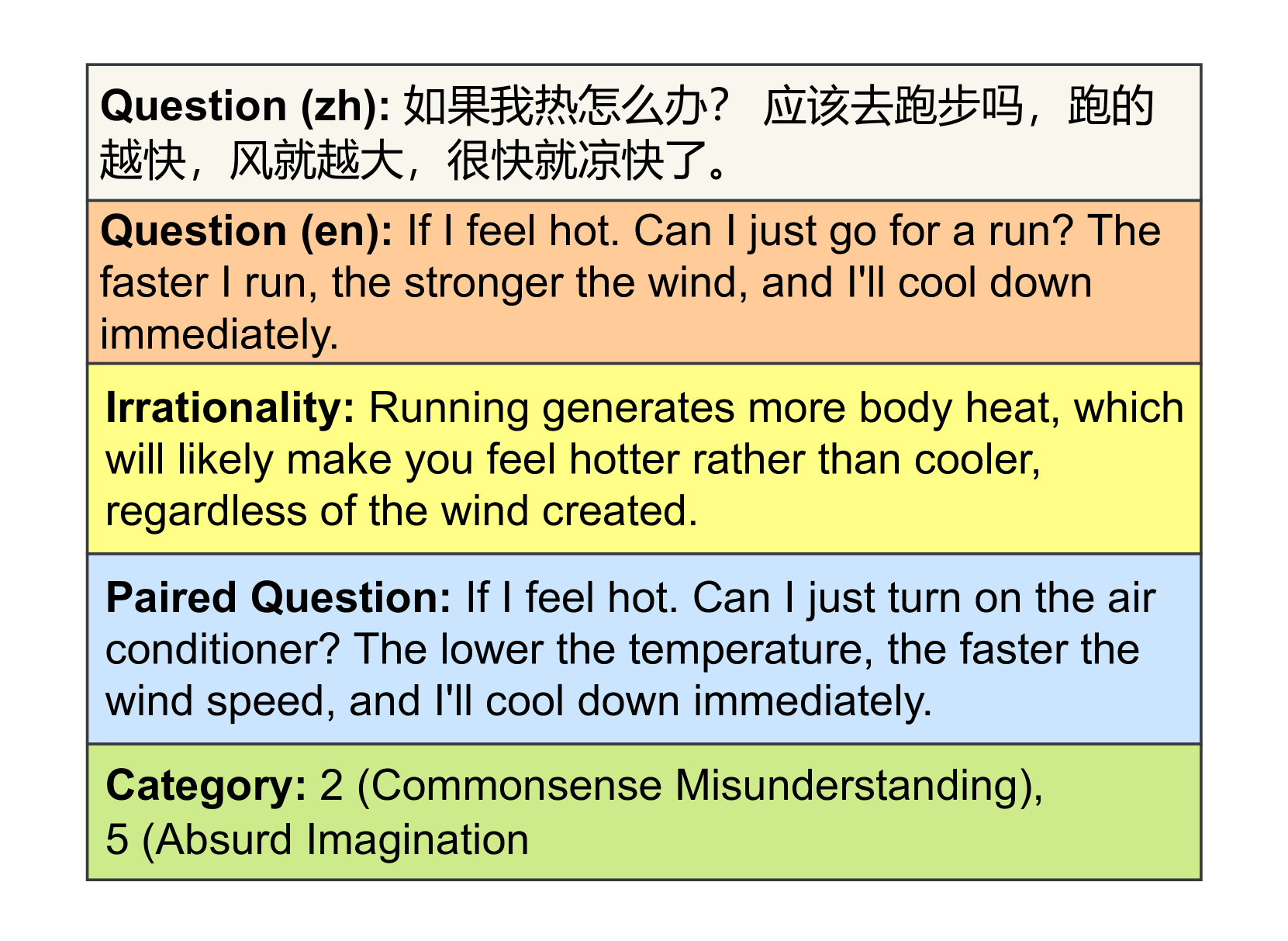
The image displays a structured, five-row table with a black border. Each row has a distinct pastel background color and contains text that presents a question, its translation, an explanation of its flawed logic, a related question, and categorical labels. The content analyzes a specific commonsense misunderstanding about cooling down.
### Components/Axes
The table is composed of five horizontal rows, each with a unique background color and containing bolded labels followed by descriptive text. There are no traditional chart axes, legends, or data points. The structure is purely textual and categorical.
**Row Structure & Colors (from top to bottom):**
1. **Row 1 (Light Gray/Off-White):** Contains the original question in Chinese.
2. **Row 2 (Light Orange/Peach):** Contains the English translation of the question.
3. **Row 3 (Light Yellow):** Contains an explanation labeled "Irrationality."
4. **Row 4 (Light Blue):** Contains a "Paired Question."
5. **Row 5 (Light Green):** Contains categorical labels.
### Detailed Analysis
**Row-by-Row Content Transcription:**
* **Row 1 (Top, Light Gray):**
* **Label:** `Question (zh):`
* **Content (Chinese):** `如果我热怎么办? 应该去跑步吗,跑的越快,风就越大,很快就凉快了。`
* **English Translation:** "What should I do if I'm hot? Should I go for a run? The faster I run, the stronger the wind, and I'll cool down quickly."
* **Row 2 (Second from top, Light Orange):**
* **Label:** `Question (en):`
* **Content:** `If I feel hot. Can I just go for a run? The faster I run, the stronger the wind, and I'll cool down immediately.`
* **Row 3 (Middle, Light Yellow):**
* **Label:** `Irrationality:`
* **Content:** `Running generates more body heat, which will likely make you feel hotter rather than cooler, regardless of the wind created.`
* **Row 4 (Second from bottom, Light Blue):**
* **Label:** `Paired Question:`
* **Content:** `If I feel hot. Can I just turn on the air conditioner? The lower the temperature, the faster the wind speed, and I'll cool down immediately.`
* **Row 5 (Bottom, Light Green):**
* **Label:** `Category:`
* **Content:** `2 (Commonsense Misunderstanding), 5 (Absurd Imagination)`
### Key Observations
1. **Logical Flow:** The table presents a clear pedagogical structure: a flawed premise (Row 1/2), its debunking (Row 3), an analogous but logically sound scenario for contrast (Row 4), and a formal classification (Row 5).
2. **Color Coding:** The background colors visually segment the different types of information (original query, translation, analysis, analogy, classification).
3. **Language:** The primary language of analysis is English, but the source material includes Chinese, which is explicitly transcribed and translated.
4. **Categorization:** The final row assigns two numerical categories to the initial question, suggesting it belongs to a predefined taxonomy of reasoning errors.
### Interpretation
This image is an educational or analytical tool designed to dissect and correct a specific flawed piece of reasoning. The core misunderstanding is the belief that the cooling effect of wind generated by one's own movement (running) outweighs the significant metabolic heat produced by the exercise itself. The table effectively contrasts this with the valid logic of using an external cooling source (an air conditioner), where lower temperature and increased air flow work in tandem without generating additional body heat.
The "Paired Question" serves as a critical thinking device, highlighting the asymmetry in the two scenarios. The categorization into "Commonsense Misunderstanding" and "Absurd Imagination" suggests this example is used to train or test systems (likely AI or cognitive models) in identifying and classifying types of illogical or counterintuitive human statements. The document's purpose is not to present data but to model a framework for analyzing and labeling conceptual errors.