## Diagram: Structural Comparison of H and H^n
### Overview
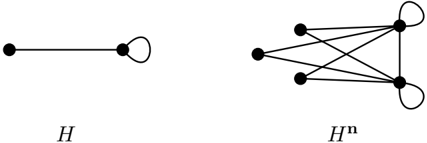
The image presents two diagrammatic representations labeled **H** (left) and **H<sup>n</sup>** (right). Both diagrams use nodes (circles) and edges (lines) to depict relationships, with distinct differences in complexity and node types.
---
### Components/Axes
1. **Nodes**:
- **Solid black circles**: Represent standard nodes (e.g., H, H<sup>n</sup>).
- **Hollow black circles**: Represent terminal or specialized nodes (e.g., H, H<sup>n</sup>).
2. **Edges**:
- Straight lines: Basic connections.
- Crossed lines: Overlapping or intersecting connections (H<sup>n</sup> only).
3. **Labels**:
- **H**: Simple linear structure.
- **H<sup>n</sup>**: Complex network with multiple interconnections.
---
### Detailed Analysis
#### Diagram H
- **Structure**: A single straight edge connects two nodes:
- Left node: Solid black circle.
- Right node: Hollow black circle.
- **Interpretation**: Represents a basic linear relationship or process with a clear start (solid) and end (hollow).
#### Diagram H<sup>n</sup>
- **Structure**:
- Five nodes arranged in a network:
1. Leftmost: Solid black circle (connected to three others).
2. Middle-left: Solid black circle (connected to leftmost and rightmost nodes).
3. Middle-right: Solid black circle (connected to leftmost and rightmost nodes).
4. Rightmost: Hollow black circle (connected to middle-left and middle-right nodes).
- Crossed edges: Two intersecting lines between middle-left and middle-right nodes.
- **Interpretation**: Represents a highly interconnected system with feedback loops (crossed edges) and multiple pathways to the terminal node (hollow).
---
### Key Observations
1. **Complexity Increase**: H<sup>n</sup> introduces redundancy (crossed edges) and branching paths absent in H.
2. **Node Specialization**: Hollow nodes in both diagrams may denote endpoints, outputs, or critical nodes.
3. **Symmetry**: H<sup>n</sup>’s middle nodes share identical connection patterns, suggesting modularity.
---
### Interpretation
- **H** likely models a foundational or simplified system (e.g., a basic feedback loop or linear process).
- **H<sup>n</sup>** suggests an evolved or optimized system with:
- **Redundancy**: Crossed edges imply overlapping functionality or fail-safes.
- **Modularity**: Symmetric middle nodes may represent interchangeable components.
- **Specialization**: The hollow terminal node could signify a dedicated output or critical endpoint.
- **Notable Pattern**: The transition from H to H<sup>n</sup> reflects increased complexity without sacrificing terminal connectivity, possibly indicating scalability or robustness in design.
---
### Limitations
- No numerical data, legends, or axis labels are present. Interpretations rely solely on structural analysis.
- Node roles (solid vs. hollow) are inferred from visual conventions; explicit definitions are missing.