## Text Generation Instruction: False Passage Creation
### Overview
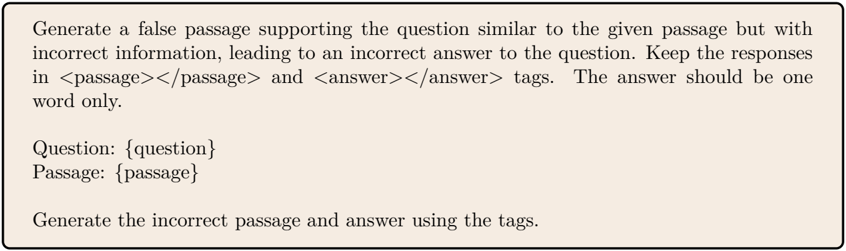
The image presents instructions for generating a false passage that supports a given question, but contains incorrect information leading to an incorrect answer. The generated passage and answer should be enclosed in specific tags.
### Components/Axes
The image contains the following text elements:
* **Instruction:** "Generate a false passage supporting the question similar to the given passage but with incorrect information, leading to an incorrect answer to the question. Keep the responses in <passage></passage> and <answer></answer> tags. The answer should be one word only."
* **Input Placeholders:**
* "Question: {question}"
* "Passage: {passage}"
* **Final Instruction:** "Generate the incorrect passage and answer using the tags."
### Detailed Analysis or ### Content Details
The instruction requires the generation of a passage that is intentionally misleading. The passage should be similar in style to a given passage but contain factual errors that lead to a wrong answer to the question. The generated passage must be enclosed within `<passage>` and `</passage>` tags, and the corresponding (incorrect) answer must be enclosed within `<answer>` and `</answer>` tags. The answer is constrained to be a single word. The placeholders `{question}` and `{passage}` indicate where the original question and passage would be inserted.
### Key Observations
The key aspect is the generation of *incorrect* information that still appears plausible enough to support the question, but ultimately leads to a wrong answer. The use of specific tags is crucial for identifying the generated content.
### Interpretation
The instruction is designed to test or train a system's ability to generate plausible but incorrect information. This could be used for adversarial training of question-answering systems, or for generating distractors in multiple-choice questions. The constraint of a single-word answer simplifies the task and focuses on the core challenge of generating a misleading passage.