\n
## Text Block: Instructions for Passage Generation
### Overview
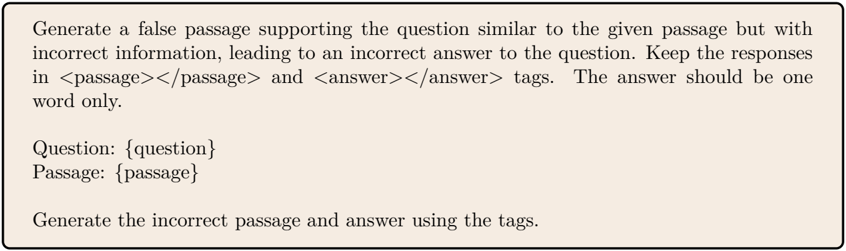
The image contains a text block outlining instructions for generating a false passage and answer to a question. The purpose is to create a misleading response.
### Components/Axes
There are no axes or components in the traditional sense. The content is purely textual. The key elements are:
* Instructions for generating a false passage.
* Instructions for formatting the passage and answer using XML-like tags: `<passage>` and `<answer>`.
* Specification that the answer should be a single word.
* Placeholders for the question and passage: `{question}` and `{passage}`.
* A final instruction to generate the incorrect passage and answer using the specified tags.
### Detailed Analysis or Content Details
The text block provides a set of instructions for a task. The instructions are as follows:
1. "Generate a false passage supporting the question similar to the given passage but with incorrect information, leading to an incorrect answer to the question."
2. "Keep the responses in `<passage></passage>` and `<answer></answer>` tags."
3. "The answer should be one word only."
4. "Question: {question}"
5. "Passage: {passage}"
6. "Generate the incorrect passage and answer using the tags."
The text is formatted as a set of instructions, with placeholders for input variables.
### Key Observations
The text is a procedural description. It focuses on the *how* of generating a specific type of content (a misleading passage and answer) rather than the *what* of the content itself. The use of tags suggests a programmatic or automated context.
### Interpretation
This text block describes a task related to creating deceptive content. It's likely part of a system designed to test or evaluate reasoning abilities, or to generate adversarial examples for natural language processing models. The emphasis on incorrect information and a single-word answer suggests a focus on simple, yet misleading, responses. The use of tags indicates that the output is intended to be machine-readable. The overall purpose is to create a scenario where a user might be tricked into selecting an incorrect answer based on a fabricated passage. It is a prompt for a task, not a presentation of data.