## Text-Based Instruction Box: Generation of a False Passage
### Overview
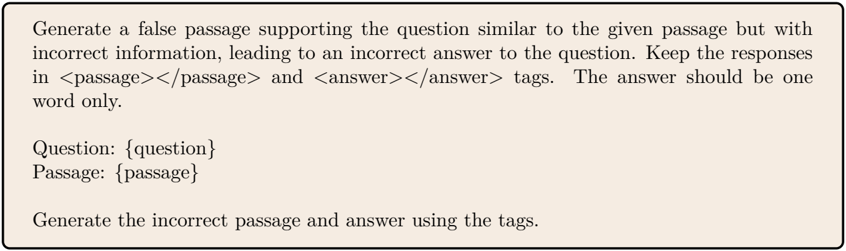
The image displays a single, bordered text box containing a set of instructions. The text is presented in a serif font on a light beige background, enclosed by a thin black border. The content is a template or prompt designed to guide the generation of a specific type of textual output.
### Components/Axes
The image is not a chart or diagram with axes. It is a self-contained block of text. The primary components are the instructional sentences and the template placeholders.
### Content Details
The complete text within the box is transcribed below:
```
Generate a false passage supporting the question similar to the given passage but with incorrect information, leading to an incorrect answer to the question. Keep the responses in <passage></passage> and <answer></answer> tags. The answer should be one word only.
Question: {question}
Passage: {passage}
Generate the incorrect passage and answer using the tags.
```
**Language:** The text is in English.
**Structural Elements:**
1. **Primary Instruction:** A directive to create a "false passage" that is similar in style to a provided passage but contains incorrect information. The goal is to support a given question in a misleading way, resulting in an incorrect answer.
2. **Formatting Requirement:** The output must be structured using specific XML-like tags: `<passage>` and `</passage>` to enclose the generated false passage, and `<answer>` and `</answer>` to enclose the generated incorrect answer.
3. **Constraint:** The generated answer must be a single word.
4. **Template Placeholders:** The instruction includes two placeholders, `{question}` and `{passage}`, which are meant to be replaced with actual content when the prompt is used.
5. **Final Directive:** A concluding sentence reiterates the action to generate the content using the specified tags.
### Key Observations
* **Purpose-Driven Design:** The text is not informational content but a meta-instruction—a prompt for an AI or a human to perform a specific, nuanced text generation task.
* **Precision in Output Format:** The instructions are highly specific about the output structure (tags) and a key constraint (one-word answer), indicating this is likely part of a controlled experiment, dataset creation, or a test of model capabilities.
* **Cognitive Task:** The task requires understanding a source passage and question, then synthesizing a new, coherent, but factually incorrect narrative that logically (but falsely) supports the question to arrive at a predetermined wrong answer. This tests skills in style imitation, counterfactual reasoning, and constrained generation.
### Interpretation
This image does not present data or facts about the world. Instead, it presents a **procedural fact**: it is a precise instruction for a content generation task.
The underlying purpose appears to be the creation of adversarial or misleading examples. Such examples are crucial for:
1. **AI Safety & Robustness Testing:** Evaluating whether a model can be tricked into accepting or generating false but plausible-sounding information.
2. **Training Data Curation:** Creating datasets that teach models to distinguish between factual and misleading passages, or to understand the structure of deceptive arguments.
3. **Benchmarking:** Assessing a model's ability to follow complex, multi-part instructions involving creativity (writing a passage) and strict formatting (using tags).
The instruction explicitly asks for the generation of misinformation ("false passage," "incorrect information," "incorrect answer"). This highlights a common practice in AI development where systems are deliberately exposed to or trained on misleading content to improve their resilience and discernment. The requirement for the passage to be "similar to the given passage" adds a layer of sophistication, moving beyond simple contradiction to subtle, stylistically consistent deception.