## Logical Proof Tree Diagram: Derivation of `p, p ⊃ q ⇝ q`
### Overview
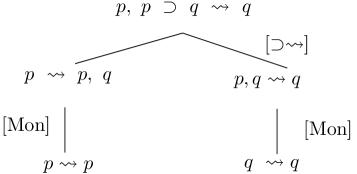
The image displays a formal proof tree (or derivation tree) from mathematical logic or proof theory. It visually demonstrates the step-by-step derivation of the sequent `p, p ⊃ q ⇝ q` (read as: from the assumptions `p` and `p ⊃ q`, one can derive `q`) using a specific set of inference rules. The tree structure shows how the main conclusion is broken down into simpler sub-goals, which are then proven by axioms.
### Components/Axes
This is a diagram, not a chart, so it has no axes. Its components are:
1. **Logical Formulas (Nodes):** Sequents written in the form `Γ ⇝ Δ`, where `Γ` (Gamma) is a set of premises/assumptions and `Δ` (Delta) is a conclusion. The symbol `⇝` represents a turnstile or sequent arrow. The symbol `⊃` represents logical implication (if...then).
2. **Inference Rule Labels:** The annotation `[Mon]` appears twice, likely standing for the "Monotonicity" or "Weakening" rule in sequent calculus, which allows adding extra formulas to the premise set.
3. **Tree Structure (Edges):** Lines connecting parent nodes to child nodes, indicating the direction of logical inference. The derivation flows from the bottom (axioms) to the top (main conclusion).
### Detailed Analysis
The proof tree is structured as follows, described from the top (main goal) down to the bottom (axioms):
* **Top Node (Main Conclusion):**
* **Position:** Top center.
* **Content:** `p, p ⊃ q ⇝ q`
* **Description:** This is the final sequent to be proven.
* **First Branching:**
* The top node splits into two child nodes via an implicit rule application (the rule itself is not labeled on this branch).
* **Left Child Node:**
* **Position:** Middle left.
* **Content:** `p ⇝ p, q`
* **Right Child Node:**
* **Position:** Middle right.
* **Content:** `p, q ⇝ q`
* **Annotation:** The label `[⊃⇝]` is placed near the right branch, suggesting the rule used for this split is related to the implication (`⊃`) in the premise.
* **Second Level Derivations (Axiom Applications):**
* Each of the middle nodes is then proven by a single-step application of the `[Mon]` rule.
* **Left Sub-tree:**
* **Parent:** `p ⇝ p, q` (Middle left)
* **Rule Applied:** `[Mon]` (Monotonicity/Weakening)
* **Child (Axiom):** `p ⇝ p` (Bottom left)
* **Logic:** The sequent `p ⇝ p` is an identity axiom (a formula implies itself). The `[Mon]` rule is applied to add the extra formula `q` to the right side (conclusion set), yielding `p ⇝ p, q`.
* **Right Sub-tree:**
* **Parent:** `p, q ⇝ q` (Middle right)
* **Rule Applied:** `[Mon]` (Monotonicity/Weakening)
* **Child (Axiom):** `q ⇝ q` (Bottom right)
* **Logic:** The sequent `q ⇝ q` is an identity axiom. The `[Mon]` rule is applied to add the extra formula `p` to the left side (premise set), yielding `p, q ⇝ q`.
### Key Observations
1. **Symmetry:** The proof tree exhibits a clear symmetrical structure. The left branch deals with the first premise (`p`), and the right branch deals with the second premise (`q`) derived from the implication.
2. **Use of Identity Axioms:** The proof is grounded in the fundamental identity axioms `p ⇝ p` and `q ⇝ q`, which are the simplest true statements in this logical system.
3. **Role of Monotonicity:** The `[Mon]` rule is used as a "cleanup" step. It formally justifies the presence of the unused premise in each branch. In the left branch, `q` is added to the conclusion; in the right branch, `p` is added to the premises. This is a technical necessity in many sequent calculus formulations.
4. **Implicit Rule at the Top:** The most significant logical step—the decomposition of the implication `p ⊃ q`—happens at the first, unlabeled branch. The label `[⊃⇝]` nearby hints at the specific rule for implication, which typically requires proving the antecedent (`p`) and using the consequent (`q`) as a new assumption.
### Interpretation
This diagram is a formal, syntactic proof of the logical principle known as **Modus Ponens** (or a closely related variant in sequent calculus). It demonstrates, step-by-step, how the truth of `q` can be formally derived from the truths of `p` and `p ⊃ q`.
* **What it Demonstrates:** The tree shows that the conclusion `q` is not assumed but is logically necessitated by the premises. The derivation is decomposed into verifying the truth of the individual components (`p` is true, and `q` follows from `p`) and then combining them.
* **Relationship Between Elements:** The tree illustrates a dependency chain. The top conclusion depends on the two middle sequents. Each middle sequent, in turn, depends on a basic identity axiom, with the `[Mon]` rule accounting for the "extra" information present in the more complex sequent.
* **Notable Anomaly for Non-Specialists:** The use of `[Mon]` to add seemingly irrelevant formulas (`q` on the left, `p` on the right) might appear counterintuitive. In proof theory, this is a standard technical device to maintain structural rules within the calculus. It highlights that the proof is about the *structure* of derivation, not just the *content* of the formulas.
* **Underlying Logic:** The proof likely belongs to a **sequent calculus** system, a formal framework for natural deduction. The specific rules (`[⊃⇝]`, `[Mon]`) and the tree format are hallmarks of this approach, which is foundational in theoretical computer science and mathematical logic for studying the properties of proofs themselves.