## Diagram: Memory Hierarchy and Compute Core Architecture
### Overview
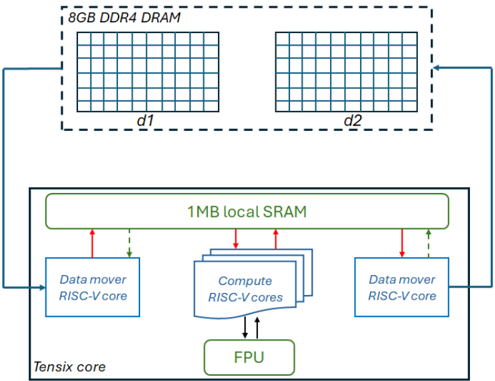
The diagram illustrates a memory hierarchy and compute core architecture, featuring DDR4 DRAM, local SRAM, RISC-V cores, and an FPU. It emphasizes data flow between memory layers and processing units, with spatial grounding of components.
### Components/Axes
- **Top Section**:
- **8GB DDR4 DRAM**: Divided into two regions labeled `d1` and `d2`, represented as grid structures.
- **Connections**: Blue lines link DDR4 DRAM to the lower section (SRAM and cores).
- **Middle Section**:
- **1MB Local SRAM**: Central horizontal green rectangle.
- **Data Mover RISC-V Cores**: Two blue rectangles on the left and right, labeled "Data mover RISC-V core."
- **Compute RISC-V Cores**: Stacked blue rectangles in the center, labeled "Compute RISC-V cores."
- **Bottom Section**:
- **FPU**: Green rectangle at the base, connected to the compute cores.
- **Tensix Core**: Blue rectangle on the far left, connected to the left data mover.
### Detailed Analysis
- **Memory Hierarchy**:
- **DDR4 DRAM (8GB)**: Topmost layer, split into `d1` and `d2` (no explicit size breakdown provided).
- **Local SRAM (1MB)**: Intermediate layer, acting as a cache between DDR4 and compute units.
- **Compute Units**:
- **Data Movers**: Facilitate data transfer between DDR4 and SRAM (left and right sides).
- **Compute RISC-V Cores**: Central processing units, stacked to indicate parallelism.
- **FPU**: Floating-point unit at the bottom, receiving processed data from compute cores.
- **Flow**:
- Data moves from DDR4 (`d1`/`d2`) to SRAM via data movers.
- SRAM supplies data to compute cores, which process it and send results to the FPU.
- The Tensix core orchestrates the system, connected to the left data mover.
### Key Observations
- **Spatial Grounding**:
- DDR4 DRAM is positioned at the top, SRAM in the middle, and FPU at the bottom, reflecting a vertical hierarchy.
- Data movers flank the compute cores, emphasizing their role in data transfer.
- **Color Coding**:
- Blue: DDR4 DRAM, data movers, Tensix core.
- Green: Local SRAM, FPU.
- Red: Arrows indicating data flow (not explicitly labeled in the diagram).
- **Component Relationships**:
- The Tensix core initiates operations, directing data to the left data mover.
- Compute cores are centrally located, suggesting their critical role in processing.
### Interpretation
The diagram represents a **memory-centric compute architecture** optimized for efficiency. The 8GB DDR4 DRAM serves as the primary memory, with 1MB local SRAM acting as a high-speed cache to reduce latency. The data movers (RISC-V cores) bridge DDR4 and SRAM, minimizing direct access to slower main memory. The compute cores and FPU form the processing layer, handling parallel tasks and floating-point operations. The Tensix core likely acts as the system controller, coordinating data flow and task scheduling. This architecture prioritizes minimizing data movement bottlenecks, a common challenge in high-performance computing. The absence of explicit clock speeds or latency metrics suggests the focus is on structural design rather than performance benchmarks.