# Technical Document: Conductance Analysis of MoSe₂ and WSe₂ under Twisting Angles
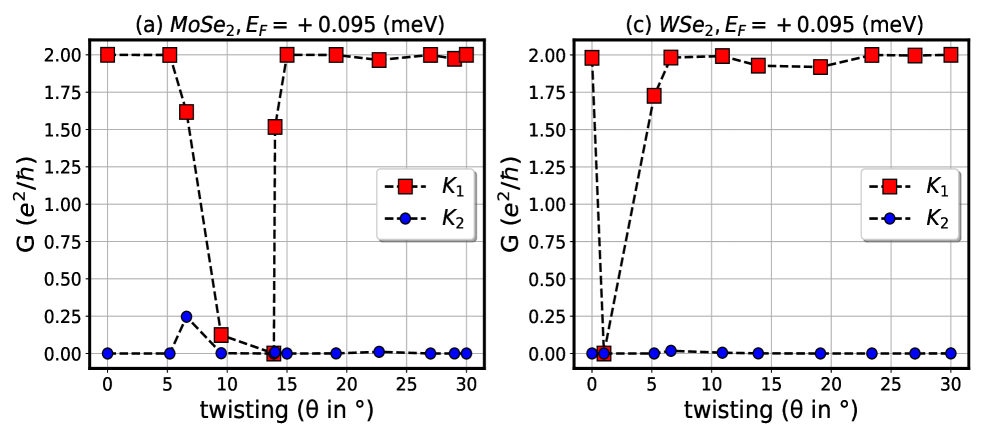
## Graph (a): MoSe₂, E_F = +0.095 meV
- **Title**: (a) MoSe₂, E_F = +0.095 (meV)
- **X-axis**: Twisting angle (θ in °), ranging from 0° to 30° in 5° increments.
- **Y-axis**: Conductance (G) in units of e²/h, ranging from 0.00 to 2.00.
- **Legend**:
- **K₁**: Red squares (■)
- **K₂**: Blue circles (●)
- **Key Trends**:
- **K₁**:
- Peaks at 0°, 5°, 10°, 15°, 20°, 25°, and 30°.
- Sharp drop at 10° and 15°, with conductance values decreasing to ~0.00 e²/h.
- Stabilizes at ~2.00 e²/h after 15°.
- **K₂**:
- Single peak at 5° (~0.25 e²/h).
- Remains near 0.00 e²/h for all other angles (0°, 10°–30°).
## Graph (c): WSe₂, E_F = +0.095 meV
- **Title**: (c) WSe₂, E_F = +0.095 (meV)
- **X-axis**: Twisting angle (θ in °), ranging from 0° to 30° in 5° increments.
- **Y-axis**: Conductance (G) in units of e²/h, ranging from 0.00 to 2.00.
- **Legend**:
- **K₁**: Red squares (■)
- **K₂**: Blue circles (●)
- **Key Trends**:
- **K₁**:
- Sharp drop at 5° (~0.00 e²/h).
- Stabilizes at ~2.00 e²/h for angles 10°–30°.
- **K₂**:
- Flat line at ~0.00 e²/h for all angles (0°–30°).
## Cross-Reference: Legend Consistency
- **K₁** (Red squares) corresponds to higher conductance values in both materials, with distinct angular dependencies.
- **K₂** (Blue circles) shows minimal conductance in both materials, with only a transient peak in MoSe₂ at 5°.
## Observations
1. **Material-Specific Behavior**:
- MoSe₂ exhibits multi-peak conductance for K₁, suggesting complex electronic interactions under twisting.
- WSe₂ shows a single sharp drop for K₁, indicating a threshold-like response to twisting.
2. **Fermi Energy Impact**:
- Both materials are analyzed at E_F = +0.095 meV, suggesting a controlled doping or energy level alignment.
3. **Twisting Sensitivity**:
- Conductance in K₁ is highly sensitive to twisting angles, with critical transitions at specific angles (e.g., 5°, 10°, 15°).
4. **K-Point Differentiation**:
- K₁ and K₂ exhibit divergent behaviors, highlighting the importance of valleytronics in transition metal dichalcogenides (TMDs).
## Conclusion
The graphs demonstrate that MoSe₂ and WSe₂ exhibit distinct conductance responses to twisting angles at the K₁ and K₂ points. These results underscore the role of structural modulation (twisting) in tuning electronic properties in TMDs, with potential applications in valleytronic devices.