\n
## Diagram: Tool-Environment-Agent (TEA) Framework
### Overview
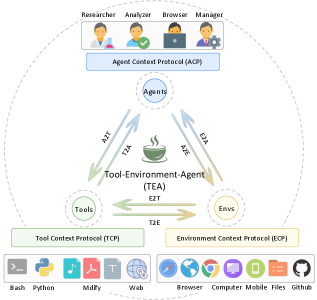
The image depicts a diagram illustrating the Tool-Environment-Agent (TEA) framework. It shows the interactions between Agents, Tools, and Environments, mediated by various context protocols. The diagram is structured with a central TEA component and surrounding elements representing the actors and communication channels.
### Components/Axes
The diagram consists of the following key components:
* **Agents:** Represented by a circular node labeled "Agents" in the center-top of the diagram.
* **Tools:** Represented by a circular node labeled "Tools" in the bottom-left of the diagram.
* **Environments (Envs):** Represented by a circular node labeled "Envs" in the bottom-right of the diagram.
* **TEA:** A central triangular shape labeled "Tool-Environment-Agent (TEA)" containing an image of a coffee cup.
* **Context Protocols:**
* Agent Context Protocol (ACP): A rectangular box above the "Agents" node.
* Tool Context Protocol (TCP): A rectangular box below the "Tools" node.
* Environment Context Protocol (ECP): A rectangular box below the "Envs" node.
* **Actors:** Four individual icons representing roles: Researcher, Analyzer, Browser, and Manager, positioned above the "Agent Context Protocol".
* **Tool Icons:** Icons representing specific tools: Bash, Python, Midify, Text, Web.
* **Environment Icons:** Icons representing environments: Browser, Computer, Mobile Files, Github.
* **Interaction Arrows:** Arrows indicating the flow of information between components, labeled as follows:
* A2T: Agent to Tool
* T2A: Tool to Agent
* E2T: Environment to Tool
* T2E: Tool to Environment
* A2E: Agent to Environment
* E2A: Environment to Agent
### Detailed Analysis or Content Details
The diagram illustrates a cyclical interaction between Agents, Tools, and Environments.
* **Agents:** The "Agents" node is connected to the TEA component via bidirectional arrows labeled A2T and A2E. This suggests agents can both utilize tools and interact directly with environments. The actors above the "Agent Context Protocol" represent different types of agents.
* **Tools:** The "Tools" node is connected to the TEA component via bidirectional arrows labeled T2A and T2E. This indicates tools receive input from agents and provide output to environments. The tool icons at the bottom represent specific tools available.
* **Environments:** The "Environments" node is connected to the TEA component via bidirectional arrows labeled E2T and E2A. This shows environments provide input to tools and receive output from agents. The environment icons at the bottom represent different environments.
* **TEA Component:** The central TEA component acts as a mediator, facilitating the interaction between Agents, Tools, and Environments. The coffee cup image within the TEA component may symbolize the framework's role in "brewing" solutions or facilitating complex processes.
* **Context Protocols:** The context protocols (ACP, TCP, ECP) likely define the rules and standards for communication between the respective components.
### Key Observations
* The bidirectional arrows suggest a dynamic and iterative process where information flows freely between Agents, Tools, and Environments.
* The central TEA component highlights the importance of integrating these three elements for effective operation.
* The specific tools and environments listed provide concrete examples of the framework's applicability.
* The diagram emphasizes the role of context protocols in ensuring seamless communication.
### Interpretation
The TEA framework appears to be a system designed to enable intelligent agents to interact with and utilize various tools and environments. The framework's strength lies in its ability to facilitate a closed-loop system where agents can leverage tools to manipulate environments and receive feedback, allowing for continuous learning and adaptation. The context protocols are crucial for ensuring that these interactions are meaningful and effective. The diagram suggests a flexible and modular architecture, where different agents, tools, and environments can be easily integrated into the framework. The inclusion of specific tools and environments (Bash, Python, Web, Github) indicates the framework's potential applications in areas such as software development, data analysis, and automation. The overall design emphasizes a holistic approach to agent-based systems, recognizing the importance of considering the interplay between agents, tools, and the surrounding environment.