## Diagram: System Architecture for Agent-Tool-Environment Interaction
### Overview
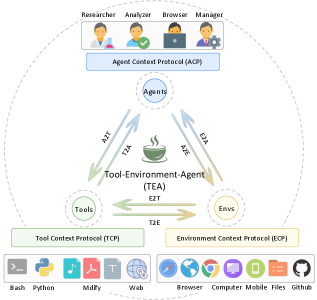
The diagram illustrates a modular system architecture for managing interactions between agents, tools, and environments. It emphasizes protocol-driven communication between components, with a central "Tool-Environment-Agent" (TEA) acting as a bridge between tools and environments. The system includes four human roles (Researcher, Analyzer, Browser, Manager) and multiple technical components connected via labeled protocols.
### Components/Axes
1. **Human Roles** (Top Row):
- Researcher (👩🔬)
- Analyzer (👨💻)
- Browser (👨💻)
- Manager (👨💼)
- All connected to the **Agent Context Protocol (ACP)** via blue arrows.
2. **Central Components**:
- **Agent Context Protocol (ACP)**: Blue box connecting human roles to **Agents**.
- **Agents**: Central node with bidirectional arrows to:
- **Tool-Environment-Agent (TEA)** (green arrow labeled "TZA")
- **Environment Context Protocol (ECP)** (yellow arrow labeled "EZA")
- **Tool Context Protocol (TCP)** (green arrow labeled "TZE")
3. **TEA (Tool-Environment-Agent)**:
- Central green coffee cup icon with steam.
- Connected to:
- **Tools** (left circle) via green arrow labeled "TZA"
- **Environments** (right circle) via yellow arrow labeled "EZA"
4. **Tools** (Bottom Left):
- Labeled with icons and text:
- Bash (💻)
- Python (🐍)
- Markdown (📝)
- Web (🌐)
- Text Editor (📄)
- Terminal (💻)
5. **Environments** (Bottom Right):
- Labeled with icons and text:
- Browser (🌐)
- Computer (💻)
- Mobile (📱)
- Files (📁)
- GitHub (🐙)
6. **Protocols**:
- **TCP** (Tool Context Protocol): Green arrow from Tools to TEA.
- **ECP** (Environment Context Protocol): Yellow arrow from Environments to TEA.
- **EZA** (Environment-to-Agent): Yellow arrow from ECP to Agents.
- **TZA** (Tool-to-Agent): Green arrow from TEA to Agents.
- **TZE** (Tool-to-Environment): Green arrow from Tools to Environments.
### Detailed Analysis
- **Protocol Flow**:
- Human roles → ACP → Agents → TEA → Tools/Environments.
- Tools → TEA → Agents (via TZA).
- Environments → TEA → Agents (via EZA).
- Tools ↔ Environments via TZE (green arrow).
- **Color Coding**:
- Blue: ACP (human roles → Agents).
- Green: TCP/TZA (Tools ↔ TEA ↔ Agents).
- Yellow: ECP/EZA (Environments ↔ TEA ↔ Agents).
- **Spatial Grounding**:
- Human roles: Top row, left to right.
- ACP: Directly below human roles.
- Agents: Center, connected to TEA and protocols.
- TEA: Central coffee cup icon.
- Tools: Bottom left quadrant.
- Environments: Bottom right quadrant.
### Key Observations
1. **Modular Design**: Clear separation between human roles, agents, tools, and environments.
2. **Protocol Hierarchy**: ACP governs human-agent interactions, while TCP/ECP govern tool/environment interactions.
3. **Bidirectional Flow**: TEA enables two-way communication between tools and environments (TZE).
4. **Protocol Specificity**: Each protocol (TCP, ECP, EZA, TZA, TZE) has distinct color coding and directional arrows.
### Interpretation
This architecture suggests a **decentralized agent system** where:
- Human roles specialize in specific tasks (research, analysis, browsing, management).
- Agents act as intermediaries, executing actions via the TEA.
- The TEA serves as a **universal interface** between tools (e.g., Python, GitHub) and environments (e.g., browsers, mobile devices).
- Color-coded protocols ensure traceability of data flow, critical for debugging and system optimization.
- The absence of numerical data implies this is a **conceptual framework** rather than a performance metric visualization.
The system prioritizes **interoperability** through standardized protocols, enabling seamless integration of diverse tools and environments. The TEA's central role highlights its importance in bridging disparate components, suggesting it could be a focal point for system enhancements or failure points requiring robust error handling.