## Text-Based Document: Formatting Instructions for Math Problem Solutions
### Overview
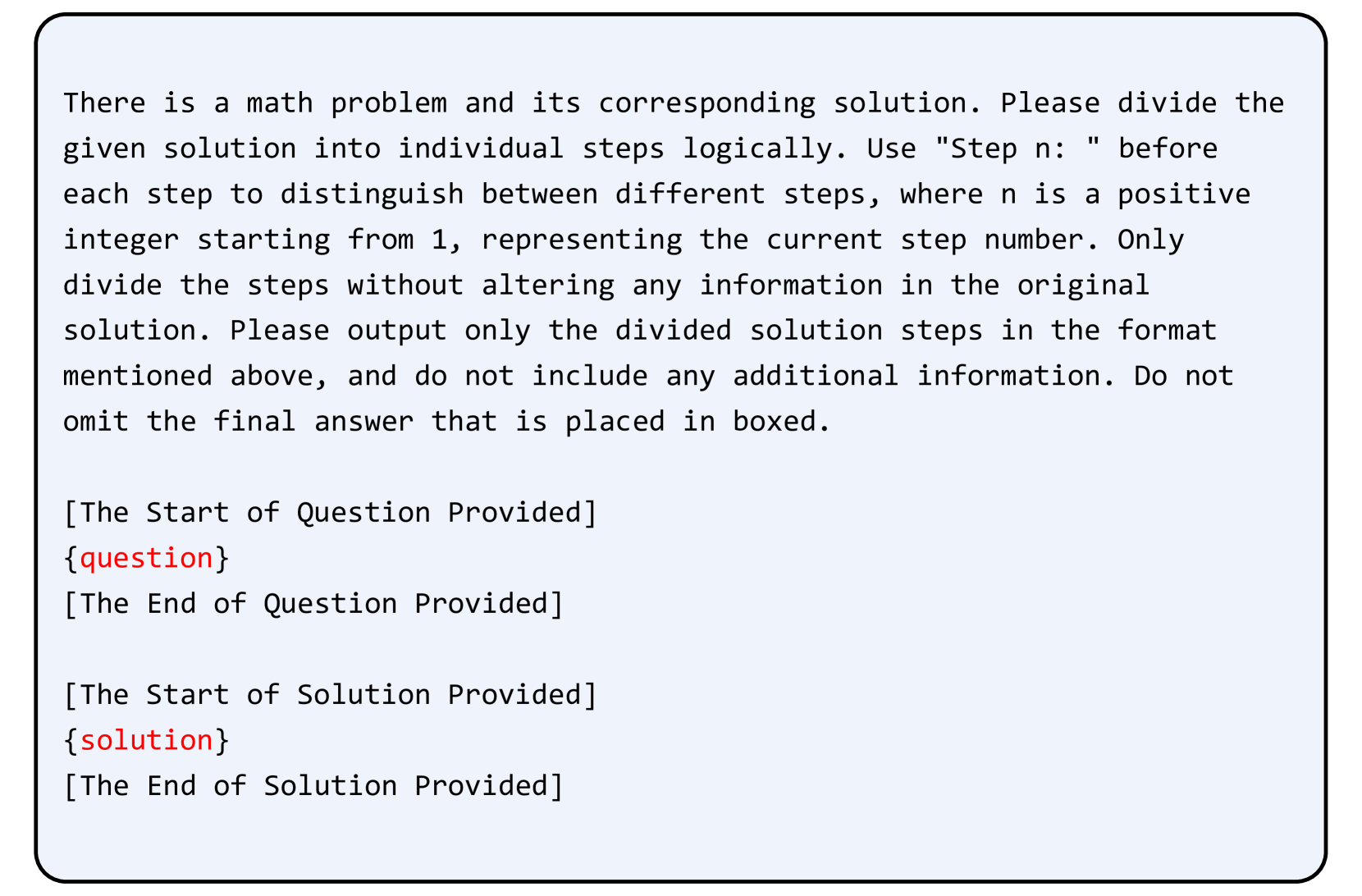
The image contains a structured template for presenting mathematical problems and their solutions. It includes explicit formatting rules for dividing solutions into logical steps, preserving original content, and omitting final boxed answers.
### Components/Axes
- **Textual Structure**:
- **Question Section**:
- `[The Start of Question Provided]`
- `{question}` (placeholder for the actual problem)
- `[The End of Question Provided]`
- **Solution Section**:
- `[The Start of Solution Provided]`
- `{solution}` (placeholder for the solution steps)
- `[The End of Solution Provided]`
- **Formatting Rules**:
- Steps must be labeled sequentially as "Step n:" where `n` is a positive integer starting at 1.
- Steps must be divided logically without altering original content.
- Final boxed answers (e.g., `\boxed{}`) must be omitted.
### Detailed Analysis
- **Question Placeholders**:
- The `{question}` placeholder is centered between `[The Start of Question Provided]` and `[The End of Question Provided]`.
- **Solution Placeholders**:
- The `{solution}` placeholder is centered between `[The Start of Solution Provided]` and `[The End of Solution Provided]`.
- **Formatting Constraints**:
- No additional information may be added beyond the original solution.
- Steps must retain their original wording and order.
### Key Observations
1. The template enforces strict separation between question and solution sections.
2. Step numbering (`Step 1:`, `Step 2:`, etc.) ensures logical progression.
3. The exclusion of boxed answers suggests the template is designed for intermediate steps rather than final results.
### Interpretation
This document serves as a template for educational or technical documentation, emphasizing clarity and logical flow in presenting mathematical reasoning. The placeholders (`{question}`, `{solution}`) indicate where custom content should be inserted, while the formatting rules ensure consistency. The omission of boxed answers implies the focus is on the process rather than the final numerical result, aligning with pedagogical goals of explaining problem-solving methodologies.