\n
## Diagram: LLMs & Symbolic AI - State-of-the-Art Achievements and Challenges
### Overview
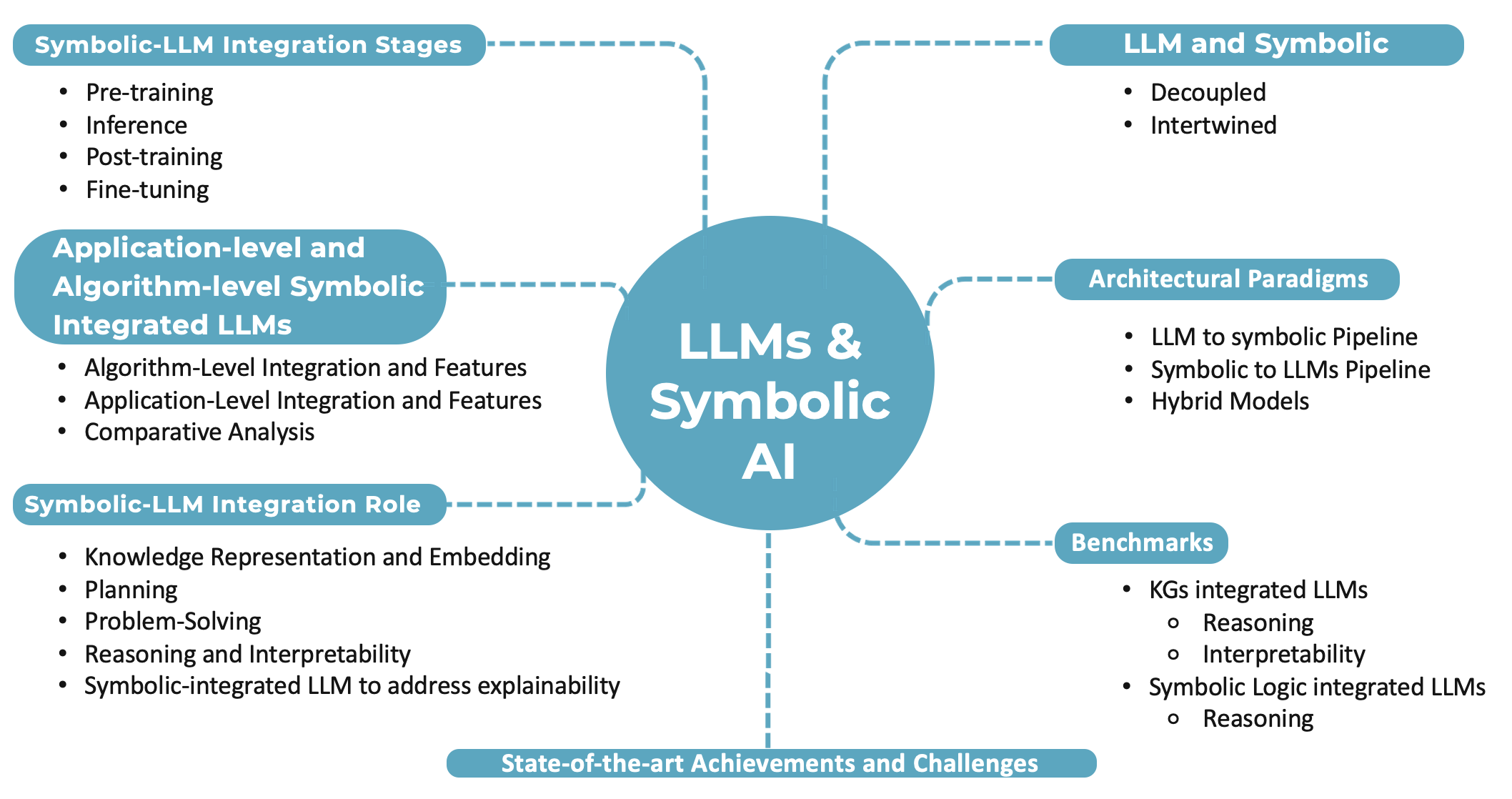
The image is a diagram illustrating the relationship between Large Language Models (LLMs) and Symbolic AI. It's structured around a central purple circle labeled "LLMs & Symbolic AI" and branches out into four main areas: "Symbolic-LLM Integration Stages", "Application-level and Algorithm-level Symbolic Integrated LLMs", "Symbolic-LLM Integration Role", and "LLM and Symbolic". Each area is further broken down into bullet points detailing specific aspects. Dashed lines connect the central circle to each of these areas. A fifth area, "Architectural Paradigms" and "Benchmarks" are positioned to the right of the central circle, also connected by dashed lines. The diagram is topped by a banner stating "State-of-the-art Achievements and Challenges".
### Components/Axes
The diagram doesn't have traditional axes like a chart. Instead, it uses a radial layout with the central concept ("LLMs & Symbolic AI") as the focal point. The key components are:
* **Central Circle:** "LLMs & Symbolic AI" (Purple)
* **Top Area:** "Symbolic-LLM Integration Stages" (Orange)
* **Left Area:** "Application-level and Algorithm-level Symbolic Integrated LLMs" (Green)
* **Bottom Area:** "Symbolic-LLM Integration Role" (Teal)
* **Right-Top Area:** "LLM and Symbolic" (Light Blue)
* **Right-Middle Area:** "Architectural Paradigms" (Yellow)
* **Right-Bottom Area:** "Benchmarks" (Pink)
* **Banner:** "State-of-the-art Achievements and Challenges" (Dark Teal)
### Detailed Analysis or Content Details
**1. Symbolic-LLM Integration Stages (Orange):**
* Pre-training
* Inference
* Post-training
* Fine-tuning
**2. Application-level and Algorithm-level Symbolic Integrated LLMs (Green):**
* Algorithm-Level Integration and Features
* Application-Level Integration and Features
* Comparative Analysis
**3. Symbolic-LLM Integration Role (Teal):**
* Knowledge Representation and Embedding
* Planning
* Problem-Solving
* Reasoning and Interpretability
* Symbolic-integrated LLM to address explainability
**4. LLM and Symbolic (Light Blue):**
* Decoupled
* Intertwined
**5. Architectural Paradigms (Yellow):**
* LLM to symbolic Pipeline
* Symbolic to LLMs Pipeline
* Hybrid Models
**6. Benchmarks (Pink):**
* KGs integrated LLMs
* Reasoning
* Interpretability
* Symbolic Logic integrated LLMs
* Reasoning
**7. Banner (Dark Teal):**
* State-of-the-art Achievements and Challenges
### Key Observations
The diagram highlights the various stages, roles, and architectural approaches involved in integrating Symbolic AI with LLMs. It emphasizes the importance of integration at different levels (algorithm, application) and the need for benchmarks to evaluate the performance of these integrated systems. The inclusion of "explainability" in the Symbolic-LLM Integration Role suggests a focus on making LLM decisions more transparent and understandable.
### Interpretation
This diagram presents a high-level overview of the current landscape of research and development in combining the strengths of LLMs (pattern recognition, fluency) with those of Symbolic AI (reasoning, knowledge representation). The branching structure suggests that there are multiple avenues for integration, each with its own set of considerations. The "State-of-the-art Achievements and Challenges" banner indicates that this is a rapidly evolving field with ongoing research aimed at overcoming existing limitations. The diagram doesn't provide specific data or numerical values, but rather serves as a conceptual map of the key areas and relationships within this domain. The emphasis on benchmarks suggests a need for standardized evaluation metrics to compare different integration approaches and track progress. The diagram implies that the integration of LLMs and Symbolic AI is not a single solution, but rather a spectrum of approaches, ranging from loosely coupled systems ("Decoupled") to tightly integrated ones ("Intertwined").