## Conceptual Diagram: LLMs & Symbolic AI Integration
### Overview
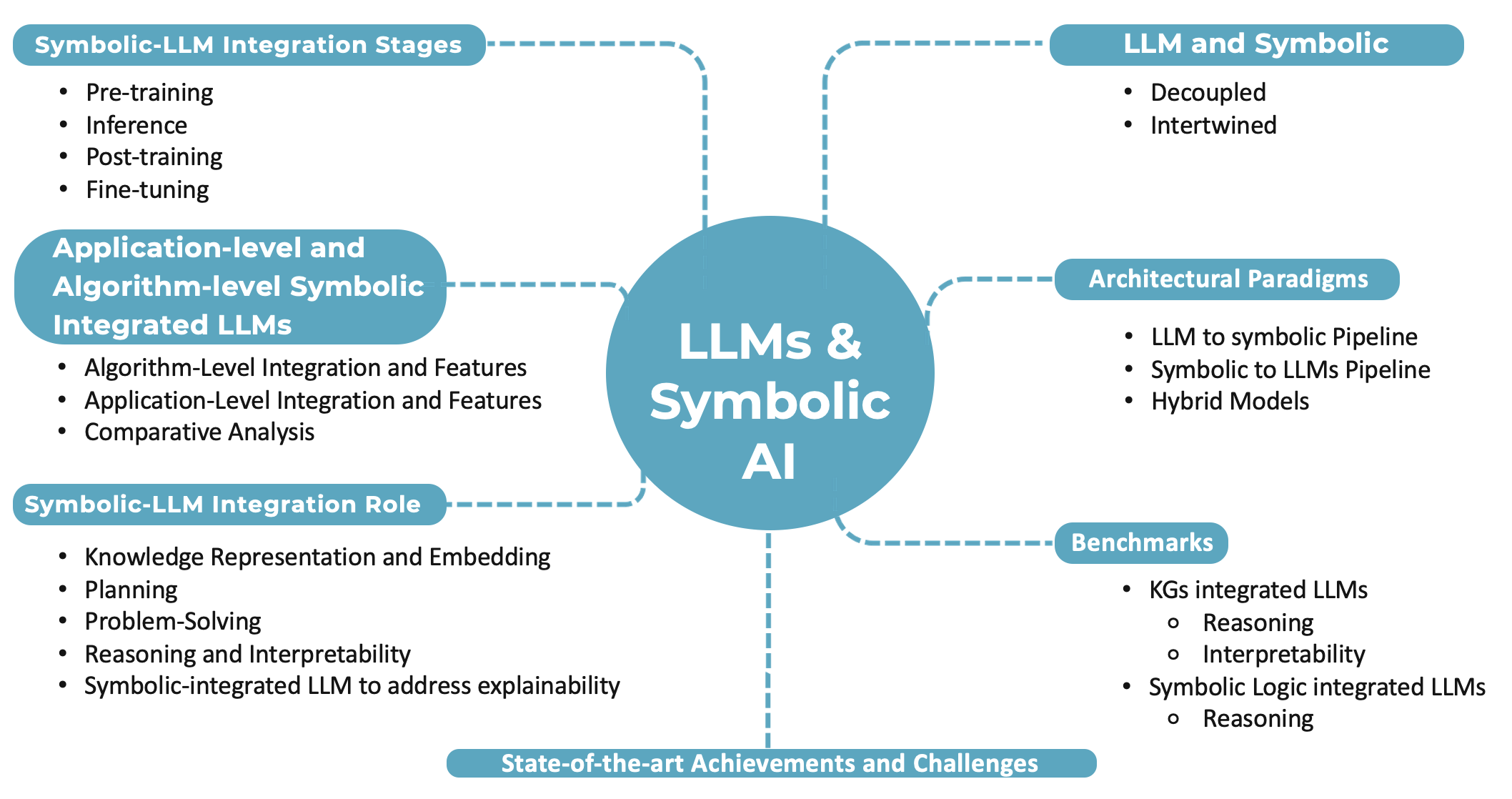
This image is a conceptual diagram illustrating the multifaceted relationship and integration points between Large Language Models (LLMs) and Symbolic AI. It features a central node connected to six surrounding thematic categories, each containing specific sub-points. The diagram serves as a taxonomy or map of the research and development landscape for hybrid neuro-symbolic systems.
### Components/Axes
The diagram is structured as a hub-and-spoke model.
* **Central Node:** A large, teal-colored circle positioned in the center of the image. It contains the primary subject text: **"LLMs & Symbolic AI"**.
* **Surrounding Categories:** Six teal-colored, rounded rectangular boxes are arranged around the central node. Each is connected to the center by a dashed teal line. The categories and their spatial positions are:
1. **Top-Left:** "Symbolic-LLM Integration Stages"
2. **Top-Right:** "LLM and Symbolic"
3. **Right (Upper-Middle):** "Architectural Paradigms"
4. **Right (Lower-Middle):** "Benchmarks"
5. **Bottom:** "State-of-the-art Achievements and Challenges"
6. **Left (Lower-Middle):** "Symbolic-LLM Integration Role"
7. **Left (Upper-Middle):** "Application-level and Algorithm-level Symbolic Integrated LLMs"
### Detailed Analysis
Each category box contains a list of bullet points detailing its specific focus area.
**1. Symbolic-LLM Integration Stages (Top-Left)**
* Pre-training
* Inference
* Post-training
* Fine-tuning
**2. LLM and Symbolic (Top-Right)**
* Decoupled
* Intertwined
**3. Architectural Paradigms (Right, Upper-Middle)**
* LLM to symbolic Pipeline
* Symbolic to LLMs Pipeline
* Hybrid Models
**4. Benchmarks (Right, Lower-Middle)**
* KGs integrated LLMs
* Reasoning
* Interpretability
* Symbolic Logic integrated LLMs
* Reasoning
**5. State-of-the-art Achievements and Challenges (Bottom)**
* This is a standalone label with no sub-bullets listed in the diagram. It is connected directly to the central node.
**6. Symbolic-LLM Integration Role (Left, Lower-Middle)**
* Knowledge Representation and Embedding
* Planning
* Problem-Solving
* Reasoning and Interpretability
* Symbolic-integrated LLM to address explainability
**7. Application-level and Algorithm-level Symbolic Integrated LLMs (Left, Upper-Middle)**
* Algorithm-Level Integration and Features
* Application-Level Integration and Features
* Comparative Analysis
### Key Observations
* **Symmetrical Layout:** The diagram is organized with three categories on the left and three on the right, creating a balanced visual structure around the central theme.
* **Taxonomic Function:** The diagram does not present quantitative data or trends. Its purpose is to categorize and list concepts, methodologies, and evaluation areas within the field.
* **Integration Focus:** The content heavily emphasizes the *process* and *methods* of integration (Stages, Role, Architectural Paradigms) rather than just the outcomes.
* **Evaluation Emphasis:** The "Benchmarks" category specifically calls out evaluation criteria (Reasoning, Interpretability) for two different types of integrated systems (KG-based and Logic-based).
* **Dual-Level Analysis:** The "Application-level and Algorithm-level" category explicitly separates integration concerns into two distinct layers of abstraction.
### Interpretation
This diagram provides a structured framework for understanding the interdisciplinary field combining connectionist (LLM) and symbolic AI approaches. It suggests that research in this area is not monolithic but spans multiple dimensions:
1. **Temporal Dimension:** Integration can occur at different stages of the model lifecycle (Pre-training to Fine-tuning).
2. **Structural Dimension:** Systems can be architected in fundamentally different ways (Pipelines vs. Hybrids).
3. **Functional Dimension:** The integration serves specific roles, such as enhancing knowledge representation, planning, or explainability.
4. **Evaluative Dimension:** Progress is measured using specialized benchmarks that test for capabilities like reasoning and interpretability, which are traditional strengths of symbolic systems.
The standalone "State-of-the-art Achievements and Challenges" node at the bottom acts as a capstone, implying that the collective research across all the listed categories defines the current frontier and the open problems in the field. The diagram effectively argues that achieving robust neuro-symbolic AI requires concurrent progress across all these interconnected facets.