## Diagram: Logical Inference Tree
### Overview
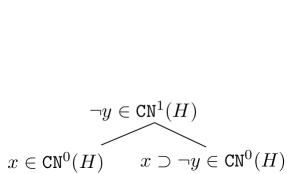
The image depicts a logical inference tree, showing the derivation of a statement involving negation and set membership. The tree structure illustrates how a conclusion is reached from two premises.
### Components/Axes
* **Nodes:** The tree consists of three nodes, each representing a statement.
* **Root Node (Top):** ¬y ∈ CN¹(H)
* **Leaf Nodes (Bottom):**
* x ∈ CN⁰(H)
* x ⊃ ¬y ∈ CN⁰(H)
* **Branches:** Two branches connect the leaf nodes to the root node, indicating the inference steps.
### Detailed Analysis
* **Root Node:** The statement at the root node is "¬y ∈ CN¹(H)". This indicates that the negation of 'y' (¬y) is an element of the set CN¹(H).
* **Leaf Nodes:**
* The left leaf node states "x ∈ CN⁰(H)", meaning 'x' is an element of the set CN⁰(H).
* The right leaf node states "x ⊃ ¬y ∈ CN⁰(H)", meaning 'x' implies the negation of 'y' (x ⊃ ¬y) is an element of the set CN⁰(H).
* **Inference:** The tree structure implies that if 'x' is in CN⁰(H) and 'x' implies '¬y' is in CN⁰(H), then '¬y' is in CN¹(H).
### Key Observations
* The diagram represents a logical deduction.
* The sets CN⁰(H) and CN¹(H) are involved.
* The implication operator (⊃) and negation operator (¬) are used.
### Interpretation
The diagram illustrates a basic inference rule within a formal system. It shows how membership in CN¹(H) can be derived from membership in CN⁰(H) and an implication involving negation. The specific meaning of CN⁰(H) and CN¹(H) would depend on the context of the larger document or theory this diagram is part of. The diagram suggests a hierarchical relationship between these sets, where CN¹(H) might represent a higher-level or derived set based on elements and relationships within CN⁰(H).