\n
## Image: Handwritten Digit Samples
### Overview
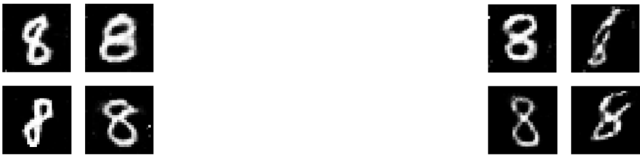
The image displays six individual samples of handwritten digits, arranged in a 2x3 grid. Each digit is presented within a square frame against a dark background. The digits appear to be variations of the numbers 8 and 6. There are no axes, legends, or explicit labels present. This appears to be a dataset sample for handwritten digit recognition.
### Components/Axes
There are no axes or legends. The components are simply the six individual digit images.
### Detailed Analysis or Content Details
The image contains the following digits:
* **Top-Left:** A relatively clear, standard-looking "8".
* **Top-Center:** A slightly rounded "8", appearing almost like a circle.
* **Top-Right:** A somewhat slanted and elongated "6".
* **Bottom-Left:** A more curved and open "8".
* **Bottom-Center:** A very rounded "8", similar to the top-center sample.
* **Bottom-Right:** A "6" with a more pronounced loop.
The digits are all white against a black background. The quality of the handwriting varies slightly between samples.
### Key Observations
The samples demonstrate the variability in handwriting. Even for the same digit (e.g., "8"), there are noticeable differences in shape, thickness, and curvature. The "6" samples also show variation in the size and shape of the loop.
### Interpretation
This image likely represents a small subset of a larger dataset used for training or testing a machine learning model designed for handwritten digit recognition. The variations in handwriting highlight the challenges involved in such tasks, as the model must be able to generalize and accurately identify digits despite differences in style and quality. The presence of both "8" and "6" suggests the model needs to distinguish between digits that can be visually similar, especially given the variations shown. The image demonstrates the need for a robust and adaptable algorithm to handle the inherent ambiguity of human handwriting.