## Handwritten Digit Samples Grid: "8" Variations
### Overview
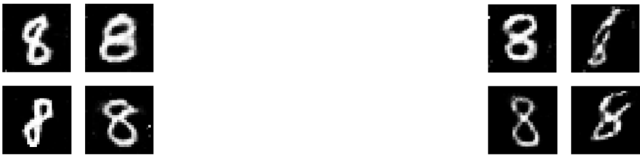
The image displays a collection of eight grayscale, low-resolution images of handwritten digits, arranged in two distinct 2x2 grids separated by a central white space. All samples appear to represent the numeral "8," showcasing variations in handwriting style, stroke thickness, slant, and clarity. The background of each individual digit cell is black, with the digit rendered in white or light gray pixels.
### Components/Axes
* **Layout:** Two separate 2x2 grids.
* **Left Grid:** Contains four digit samples.
* **Right Grid:** Contains four digit samples.
* **Content:** Each cell contains a single handwritten digit image. There are no axis labels, titles, legends, or numerical scales present in the image.
* **Language:** No textual language is present. The content is purely pictorial representations of a numeral.
### Detailed Analysis
**Left Grid (2x2):**
* **Top-Left:** A relatively clear, upright "8" with balanced loops.
* **Top-Right:** A slightly wider "8" with a more pronounced top loop.
* **Bottom-Left:** A thinner, more vertically oriented "8" with a slight leftward slant.
* **Bottom-Right:** A standard "8" with moderate stroke thickness.
**Right Grid (2x2):**
* **Top-Left:** A clear "8" similar to the top-left sample in the left grid.
* **Top-Right:** A heavily slanted "8," leaning significantly to the right. The strokes are thinner.
* **Bottom-Left:** A standard "8" with a slightly thicker stroke.
* **Bottom-Right:** A distorted "8" with a very thin, almost broken stroke on the lower-left side and a pronounced rightward slant.
### Key Observations
1. **Consistency of Class:** All eight samples are intended to represent the same character class: the digit "8."
2. **Stylistic Variance:** Significant variation exists in:
* **Slant:** Ranging from nearly upright to heavily right-slanted (most extreme in the right grid, top-right and bottom-right samples).
* **Stroke Weight:** From thin, faint lines to thicker, more confident strokes.
* **Proportion:** Differences in the relative size and balance of the top and bottom loops.
* **Distortion:** The bottom-right sample in the right grid shows notable distortion and potential stroke fragmentation.
3. **Grouping:** The separation into two grids may imply a comparison (e.g., training vs. test samples, correct vs. ambiguous samples) or simply be a layout choice. No explicit labels define the groups.
### Interpretation
This image is a classic example of data from a handwritten digit recognition dataset, such as MNIST. Its primary purpose is to illustrate the **intra-class variability** that machine learning models must handle. The "8" is a particularly interesting digit because it can be written with one continuous stroke or two separate loops, and its topology (two closed loops) can be distorted.
The variations demonstrate key challenges for Optical Character Recognition (OCR) and classification algorithms:
* **Slant Invariance:** The model must recognize the digit regardless of its tilt.
* **Stroke Width Invariance:** Performance should not depend on the pen pressure or thickness.
* **Robustness to Distortion:** The model needs to generalize from clean samples to poorly written or noisy ones, like the bottom-right example.
The side-by-side grids could be used to prompt analysis: Are the right-hand samples more difficult? Do they represent a different writer? Without additional context, the grouping's meaning is ambiguous, but the visual comparison highlights the spectrum of quality and style within a single digit class. This type of visualization is fundamental in the exploratory data analysis phase of building and debugging character recognition systems.