## Handwritten Digit Classification Examples
### Overview
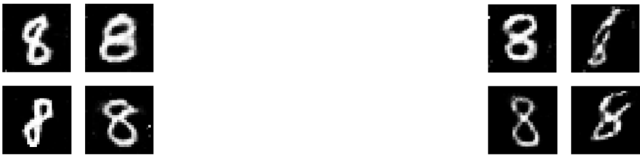
The image displays a 2x4 grid of eight handwritten digit samples on a black background. The digits are rendered in white, with variations in stroke thickness and curvature. No additional labels, axes, or legends are present.
### Components/Axes
- **Grid Structure**:
- 2 rows (top and bottom)
- 4 columns (left to right)
- **Digit Representation**:
- All digits are handwritten, with no standardized font or style.
- Background: Solid black (no grid lines or separators).
- **Color Scheme**:
- Digits: White (high contrast against black background).
- No other colors or annotations.
### Detailed Analysis
1. **Top Row (Left to Right)**:
- **Position 1 (Top-Left)**: Digit "8" with a closed loop and two horizontal strokes.
- **Position 2 (Top-Middle-Left)**: Digit "8" with a slightly open lower loop.
- **Position 3 (Top-Middle-Right)**: Digit "8" with a thicker upper stroke.
- **Position 4 (Top-Right)**: Digit "8" with a more angular, less curved form.
2. **Bottom Row (Left to Right)**:
- **Position 5 (Bottom-Left)**: Digit "8" with a minimalist, almost circular shape.
- **Position 6 (Bottom-Middle-Left)**: Digit "8" with a pronounced diagonal stroke.
- **Position 7 (Bottom-Middle-Right)**: Digit "8" with a wavy, irregular lower loop.
- **Position 8 (Bottom-Right)**: Digit "6" with a single loop and a short tail.
### Key Observations
- **Dominance of "8"**: Seven out of eight digits are "8", emphasizing its prevalence in the dataset.
- **Single "6" Anomaly**: The bottom-right digit ("6") is the only non-"8", suggesting a focus on distinguishing similar shapes.
- **Handwriting Variability**: Significant differences in stroke thickness, curvature, and closure (e.g., open vs. closed loops in "8").
### Interpretation
This image likely serves as a test case for handwritten digit recognition systems. The variations in "8" demonstrate challenges in normalizing handwriting styles, while the inclusion of a "6" highlights the importance of distinguishing visually similar digits. The lack of standardization in stroke patterns suggests real-world data complexity, where models must account for human variability rather than rigid templates. The single "6" may act as a stress test for algorithms trained primarily on "8"-dominated datasets.