## Diagram: Causal Graph of Educational, Demographic, and Performance Factors
### Overview
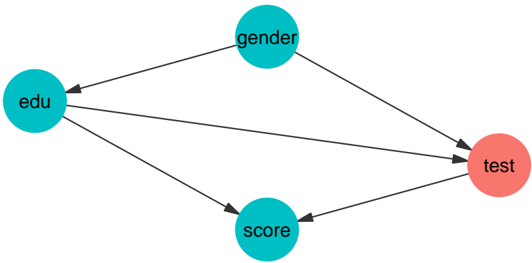
This image displays a directed graph, commonly known as a causal diagram or a directed acyclic graph (DAG), illustrating hypothesized relationships between four variables: "edu", "gender", "score", and "test". The variables are represented by colored circular nodes, and the relationships or influences are indicated by directed arrows.
### Components/Axes
The diagram consists of four distinct nodes and five directed edges. As this is a relational diagram, there are no traditional axes, legends, or scales.
**Nodes (Circles):**
* **"edu"**: A teal-colored circular node, positioned on the far-left side of the diagram, approximately at the vertical center.
* **"gender"**: A teal-colored circular node, positioned in the top-center region of the diagram.
* **"score"**: A teal-colored circular node, positioned in the bottom-center region of the diagram.
* **"test"**: A salmon/coral-colored circular node, positioned on the far-right side of the diagram, approximately at the vertical center.
**Edges (Directed Arrows):**
The arrows indicate the direction of influence or a causal relationship from a source node to a destination node.
1. An arrow originates from the "edu" node (left-center) and points towards the "gender" node (top-center).
2. An arrow originates from the "edu" node (left-center) and points towards the "score" node (bottom-center).
3. An arrow originates from the "edu" node (left-center) and points directly towards the "test" node (right-center).
4. An arrow originates from the "gender" node (top-center) and points towards the "test" node (right-center).
5. An arrow originates from the "score" node (bottom-center) and points towards the "test" node (right-center).
### Detailed Analysis
The diagram illustrates a network where "edu" acts as a primary upstream variable, influencing multiple other factors. "gender" and "score" appear to be intermediate or mediating variables, while "test" is the ultimate outcome variable.
**Node Placement and Connections:**
* **"edu" (teal, left-center):** This node serves as a central originating point for three distinct paths. It directly influences "gender" (via an upward-right arrow), "score" (via a downward-right arrow), and "test" (via a straight-right arrow).
* **"gender" (teal, top-center):** This node is influenced by "edu" and, in turn, directly influences "test" (via a downward-right arrow).
* **"score" (teal, bottom-center):** This node is also influenced by "edu" and directly influences "test" (via an upward-right arrow).
* **"test" (salmon/coral, right-center):** This node is the terminal point in the diagram, receiving direct influence from "edu", "gender", and "score". No arrows originate from "test", indicating it is the final dependent variable in this model.
### Key Observations
* **Color Coding:** The nodes are color-coded: "edu", "gender", and "score" are teal, while "test" is salmon/coral. This distinction likely categorizes the variables, possibly differentiating independent/mediating variables from the primary dependent variable or outcome.
* **"edu" as a Common Cause:** "edu" is a highly connected node, acting as a common cause or upstream factor for "gender", "score", and "test".
* **Mediating Roles:** "gender" and "score" appear to function as mediating variables, as they are influenced by "edu" and subsequently influence "test".
* **"test" as the Sole Outcome:** "test" is the only node that receives incoming arrows but has no outgoing arrows, establishing it as the ultimate outcome or dependent variable in this model.
* **Unidirectional Relationships:** All relationships are strictly unidirectional, indicated by single-headed arrows, implying a clear direction of influence or causality.
* **No Self-Loops:** No node points to itself.
### Interpretation
This diagram presents a hypothesized causal model for understanding a "test" outcome.
1. **"edu" as a Foundational Factor:** Education ("edu") is posited as a foundational variable that directly impacts the "test" outcome and also influences other factors that, in turn, affect the "test".
2. **Mediated Pathways to "test":** The model suggests that the effect of "edu" on "test" is partly mediated through "gender" and "score". For instance, education might influence an individual's "score" (e.g., academic performance), and this "score" then contributes to their "test" performance. Similarly, education might influence aspects related to "gender" (e.g., social roles, opportunities, or even how gender is perceived in relation to education), which then impacts the "test" outcome.
3. **"test" as the Primary Dependent Variable:** The "test" variable is clearly the central outcome of interest, with all other variables either directly or indirectly contributing to its value. This structure is typical in studies aiming to explain or predict a specific performance measure or result.
4. **Significance of Color Coding:** The teal nodes ("edu", "gender", "score") could represent explanatory variables, predictors, or intermediate steps, while the salmon/coral node ("test") highlights the target or response variable that the model seeks to understand.
5. **Conceptual Considerations:** The arrow from "edu" to "gender" warrants careful consideration. If "gender" refers to biological sex, this relationship is biologically implausible as education does not cause biological sex. However, if "gender" refers to a social construct, gender identity, or a demographic variable that is influenced by or correlated with educational attainment in a specific social context (e.g., educational opportunities influencing gender roles or self-identification in certain studies), then the arrow might represent such a complex interaction or a selection effect. Alternatively, it could represent a misconceptualization in the diagram's design.
In essence, the diagram outlines a multi-faceted influence model where education plays a pivotal role, both directly and indirectly, in shaping an individual's performance on a "test", with "gender" and "score" acting as important intermediate factors.