## Directed Acyclic Graph (DAG): Causal Model of Test Score Determinants
### Overview
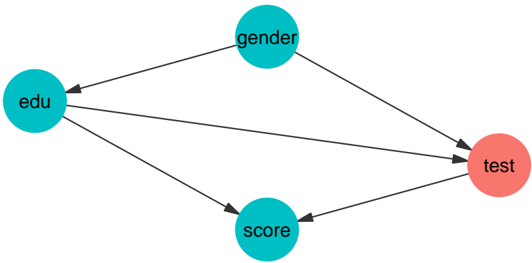
The image displays a directed acyclic graph (DAG), a type of diagram used in statistics and causal inference to represent hypothesized causal relationships between variables. The diagram consists of four nodes (variables) connected by directed edges (arrows) indicating the direction of proposed causal influence. The graph suggests a model where a final outcome, "test," is influenced by multiple pathways involving gender, education, and score.
### Components/Axes
* **Nodes (Variables):**
1. `gender` (Teal circle, top-center)
2. `edu` (Teal circle, left)
3. `score` (Teal circle, bottom-center)
4. `test` (Red circle, right)
* **Edges (Causal Pathways):** The arrows represent direct causal effects. The direction is from the tail (cause) to the arrowhead (effect).
* `gender` → `edu`
* `gender` → `test`
* `edu` → `score`
* `edu` → `test`
* `score` → `test`
### Detailed Analysis
The diagram maps out the following causal structure:
1. **Direct Effects on `test`:** The variable `test` (highlighted in red) is the terminal node, receiving direct causal inputs from three other variables:
* From `gender` (top-right diagonal arrow).
* From `edu` (horizontal arrow from left to right).
* From `score` (bottom-left diagonal arrow).
2. **Indirect Effects and Mediation:**
* `gender` has an indirect effect on `test` through two mediated pathways:
* `gender` → `edu` → `test`
* `gender` → `edu` → `score` → `test`
* `edu` has an indirect effect on `test` through the mediator `score` (`edu` → `score` → `test`).
3. **Spatial Layout:** The nodes are arranged in a rough diamond or kite shape. `gender` is positioned at the top apex, `edu` on the left, `score` at the bottom, and `test` on the right. This layout visually separates the predictor variables (left/top) from the outcome variable (right).
### Key Observations
* **Variable Highlighting:** The `test` node is colored red, while all others (`gender`, `edu`, `score`) are teal. This visual distinction strongly suggests that `test` is the primary outcome or dependent variable of interest in this model.
* **Complete Mediation:** The model proposes that the effect of `gender` on `score` is *fully mediated* by `edu`. There is no direct arrow from `gender` to `score`.
* **Multiple Pathways:** The outcome `test` is influenced by a combination of direct effects and complex, intertwined indirect effects. For example, `gender` influences `test` both directly and through the education pathway.
* **No Cycles:** As a DAG, the graph contains no feedback loops (e.g., `test` does not point back to `gender`), which is a requirement for standard causal modeling techniques.
### Interpretation
This DAG represents a theoretical causal model for understanding the determinants of a test outcome. It posits that:
1. **Gender is a fundamental exogenous variable.** It is not influenced by other factors in the model but exerts influence downstream. Its effect on the final test is both direct and channeled through educational attainment (`edu`).
2. **Education (`edu`) is a key mediator and a cause in its own right.** It transmits part of the effect of gender to both the intermediate `score` and the final `test`. It also has its own direct effect on `test`.
3. **`score` is an intermediate outcome.** It is caused by education and, in turn, causes the final test result. It serves as one of the pathways through which education affects the test.
4. **The model's purpose is likely for statistical adjustment.** In an observational study, this graph would guide analysis. For instance, to estimate the *total* effect of `gender` on `test`, one would not control for `edu` or `score`, as they are mediators. To estimate the *direct* effect of `gender` on `test` (not through education), one would need to condition on `edu`. The graph makes these assumptions explicit.
**Notable Implication:** The absence of an arrow is as meaningful as the presence of one. For example, the model assumes there is no direct effect of `score` on `edu` (which would be a logical reverse causation) and no direct effect of `gender` on `score` bypassing `edu`. These are strong, testable assumptions about the data-generating process.