## Diagram/Analysis: Mathematical Problem Correction
### Overview
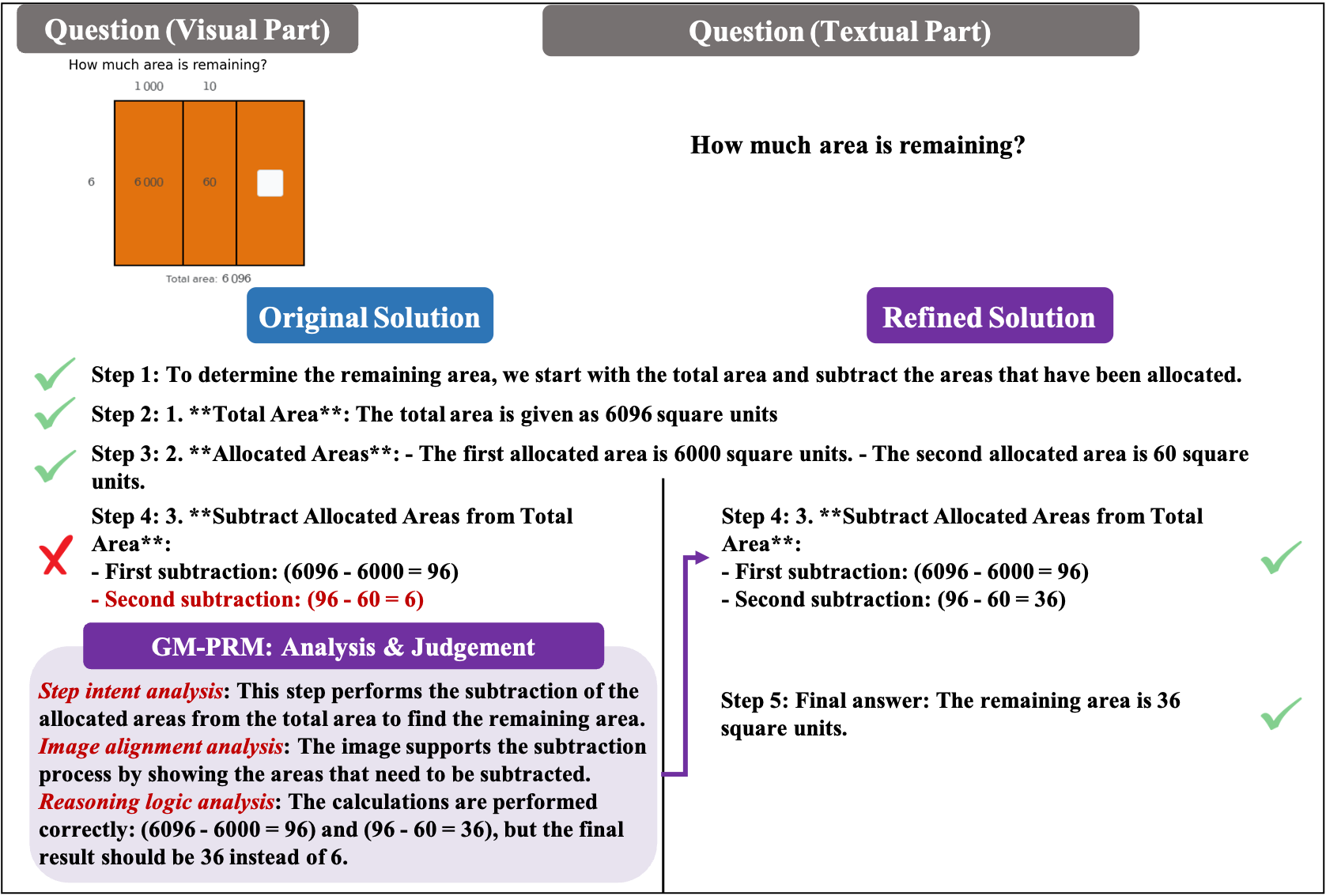
The image displays a structured educational or AI-generated artifact consisting of a mathematical word problem, an initial incorrect solution, a corrected "refined" solution, and a meta-analysis section (GM-PRM) that evaluates the reasoning process. The content demonstrates a self-correction workflow where an arithmetic error is identified and rectified.
### Components
* **Question Section (Top):**
* **Visual Part:** A diagram of a rectangle divided into three segments.
* **Textual Part:** The question "How much area is remaining?"
* **Original Solution (Left-Center):** A blue-headed block containing steps 1 through 4, marked with green checkmarks for correct steps and a red 'X' for the incorrect calculation.
* **Refined Solution (Right-Center):** A purple-headed block containing the corrected steps 4 and 5, marked with green checkmarks.
* **GM-PRM: Analysis & Judgement (Bottom-Left):** A purple-headed block providing a qualitative assessment of the reasoning logic.
### Detailed Analysis
#### 1. Question (Visual Part)
* **Diagram:** A large rectangle representing a total area of 6096.
* **Segments:**
* **Left Segment:** Labeled with width "1000" at the top and area "6000" inside. The height is labeled as "6" on the left edge.
* **Middle Segment:** Labeled with width "10" at the top and area "60" inside.
* **Right Segment:** A small white square representing the "remaining area."
* **Total Area:** Labeled at the bottom as "Total area: 6096".
#### 2. Original Solution (Blue Header)
* **Step 1:** "To determine the remaining area, we start with the total area and subtract the areas that have been allocated."
* **Step 2:** "**Total Area**: The total area is given as 6096 square units"
* **Step 3:** "**Allocated Areas**: - The first allocated area is 6000 square units. - The second allocated area is 60 square units."
* **Step 4:** "**Subtract Allocated Areas from Total Area**: - First subtraction: (6096 - 6000 = 96) - Second subtraction: (96 - 60 = 6)"
* *Note:* This step is marked with a red 'X', indicating an error.
#### 3. Refined Solution (Purple Header)
* **Step 4:** "**Subtract Allocated Areas from Total Area**: - First subtraction: (6096 - 6000 = 96) - Second subtraction: (96 - 60 = 36)"
* **Step 5:** "Final answer: The remaining area is 36 square units."
* *Note:* This section is marked with a green checkmark.
#### 4. GM-PRM: Analysis & Judgement (Purple Header)
* **Step intent analysis:** "This step performs the subtraction of the allocated areas from the total area to find the remaining area."
* **Image alignment analysis:** "The image supports the subtraction process by showing the areas that need to be subtracted."
* **Reasoning logic analysis:** "The calculations are performed correctly: (6096 - 6000 = 96) and (96 - 60 = 36), but the final result should be 36 instead of 6."
### Key Observations
* **Arithmetic Error:** The "Original Solution" incorrectly calculated 96 - 60 as 6, likely a transcription or subtraction error where the tens digit was ignored.
* **Visual Consistency:** The diagram is mathematically consistent with the problem statement:
* Left block: 1000 (width) * 6 (height) = 6000.
* Middle block: 10 (width) * 6 (height) = 60.
* Total area: 6096.
* Remaining area: 6096 - 6000 - 60 = 36.
* **Correction Mechanism:** The document serves as a template for "Chain of Thought" reasoning, where an initial output is generated, evaluated by a secondary process (GM-PRM), and then corrected.
### Interpretation
This image is a diagnostic tool or a training sample for AI models. It demonstrates the "Self-Correction" or "Refinement" loop. The "GM-PRM" (likely standing for a model-based reasoning monitor) acts as an auditor. It identifies that while the *intent* and *alignment* of the original solution were correct, the *arithmetic execution* was flawed. The document effectively visualizes the transition from a flawed logical path to a verified, correct conclusion.