\n
## Problem Solving Illustration: Area Calculation
### Overview
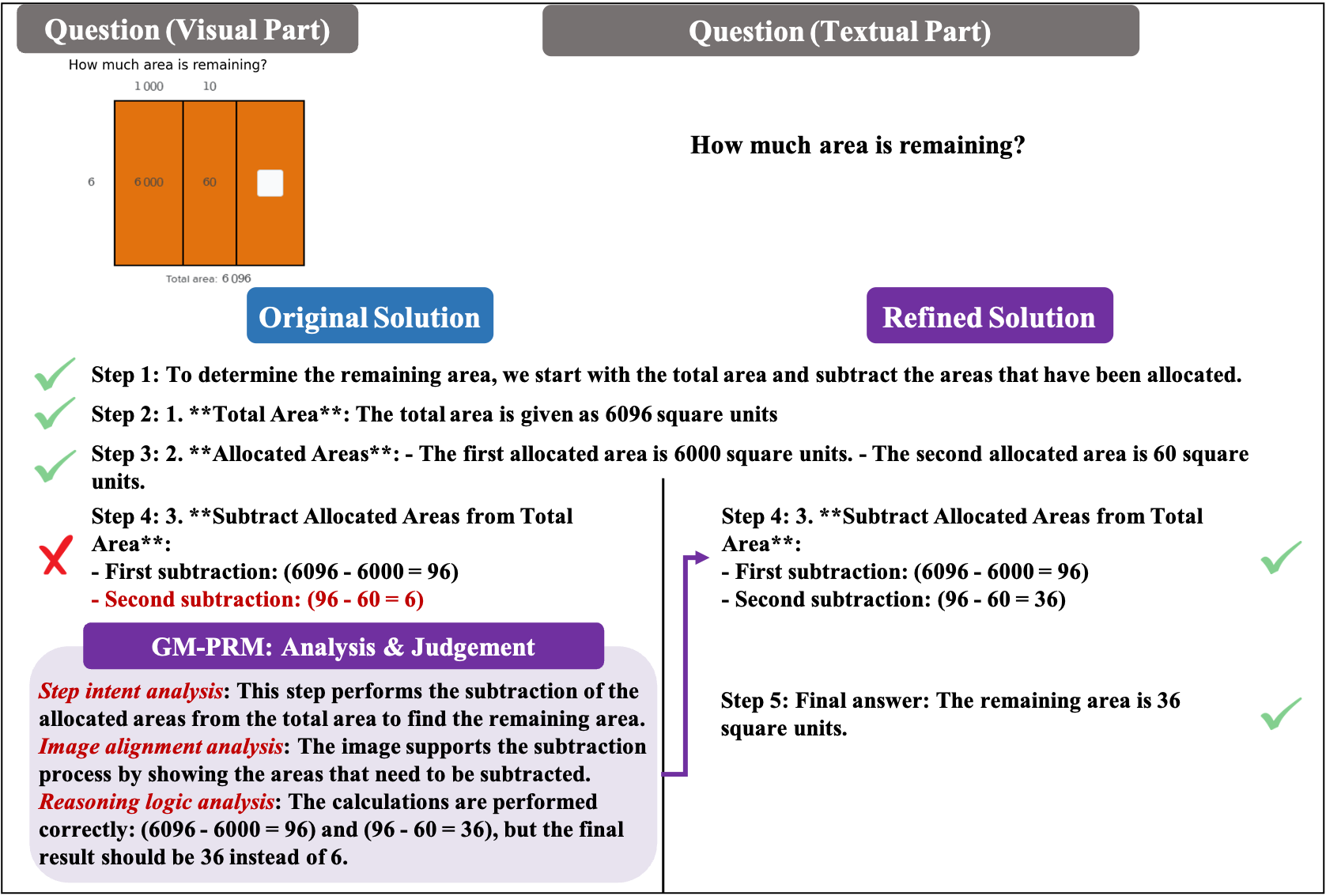
This image presents a visual and textual breakdown of a problem-solving process for calculating the remaining area after subtracting allocated areas from a total area. It contrasts an "Original Solution" with a "Refined Solution," highlighting a correction in the calculation. The image is divided into two main sections: a visual representation of the area calculation on the left and a textual explanation of the steps on the right.
### Components/Axes
The image contains the following components:
* **Question (Visual Part):** "How much area is remaining?" with a visual representation of rectangles representing areas of 6000, 60, and 10 square units. The total area is labeled as 6096.
* **Question (Textual Part):** Repeats "How much area is remaining?".
* **Original Solution:** A step-by-step solution with checkmarks and an "X" indicating an error.
* **Refined Solution:** A corrected step-by-step solution with checkmarks.
* **GM-PRM: Analysis & Judgement:** A section providing analysis of the problem-solving steps.
### Detailed Analysis or Content Details
**Visual Part:**
* Rectangle 1: Area = 6000 square units (approximate).
* Rectangle 2: Area = 60 square units (approximate).
* Rectangle 3: Area = 10 square units (approximate).
* Total Area: 6096 square units.
**Original Solution:**
* Step 1: "To determine the remaining area, we start with the total area and subtract the areas that have been allocated." (Checkmark)
* Step 2: "**Total Area**": "The total area is given as 6096 square units." (Checkmark)
* Step 3: "**Allocated Areas**": "The first allocated area is 6000 square units. – The second allocated area is 60 square units." (Checkmark)
* Step 4: "**Subtract Allocated Areas from Total Area**":
* First subtraction: (6096 - 6000 = 96) (Checkmark)
* Second subtraction: (96 - 60 = 6) (X - indicating an error)
**Refined Solution:**
* Step 4: "**Subtract Allocated Areas from Total Area**":
* First subtraction: (6096 - 6000 = 96) (Checkmark)
* Second subtraction: (96 - 60 = 36) (Checkmark)
* Step 5: "Final answer: The remaining area is 36 square units." (Checkmark)
**GM-PRM: Analysis & Judgement:**
* "Step intent analysis: This step performs the subtraction of the allocated areas from the total area to find the remaining area."
* "Image alignment analysis: The image supports the subtraction process by showing the areas that need to be subtracted."
* "Reasoning logic analysis: The calculations are performed correctly (6096 - 6000 = 96) and (96 - 60 = 36), but the final result should be 36 instead of 6."
### Key Observations
* The original solution incorrectly calculates the final remaining area as 6 square units instead of the correct answer of 36 square units.
* The refined solution provides the correct calculation and final answer.
* The "GM-PRM" section explicitly identifies the error in the original solution and confirms the correctness of the refined solution.
* The visual representation of the areas reinforces the subtraction process.
### Interpretation
The image demonstrates a common problem-solving technique: identifying and correcting errors in calculations. The comparison between the "Original Solution" and the "Refined Solution" highlights the importance of careful attention to detail and verification of results. The "GM-PRM" section provides a meta-cognitive analysis of the problem-solving process, explaining the intent of each step and identifying the source of the error. The visual component aids in understanding the problem and the subtraction process. The image serves as an educational tool for illustrating the importance of accuracy and critical thinking in mathematical problem-solving. The use of checkmarks and an "X" provides clear visual feedback on the correctness of each step.