TECHNICAL ASSET FINGERPRINT
b0b511bdc1a36d56752257e8
Click to view fullscreen
Press ESC or click to close
FOUND IN PAPERS
EXPERT: gemini-3.1-flash-lite-preview-free VERSION 1
RUNTIME: google-free/gemini-3.1-flash-lite-preview
INTEL_VERIFIED
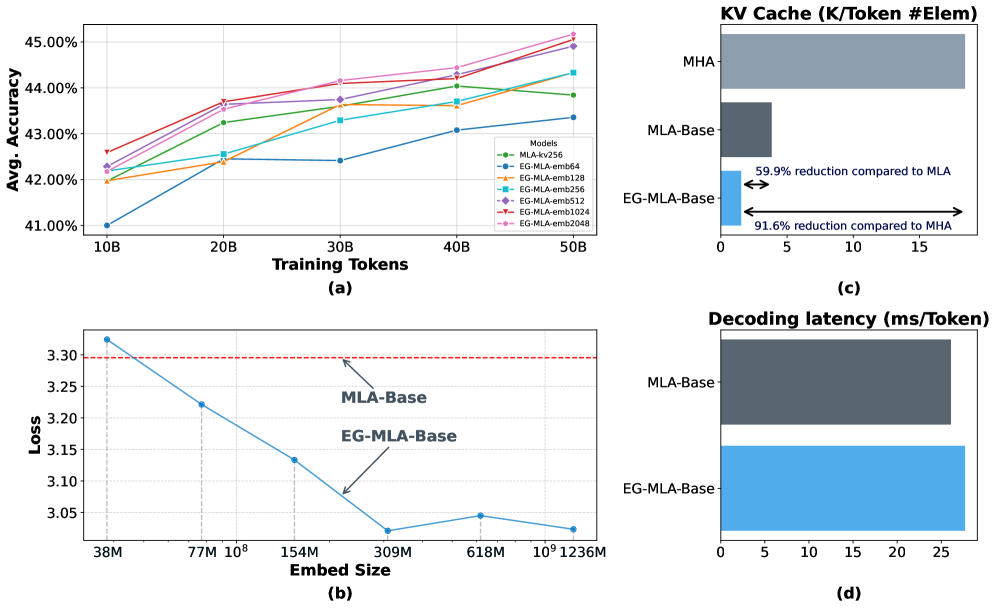
This document provides a technical analysis of the four sub-figures (a, b, c, and d) presented in the image, which evaluate the performance and efficiency of different model architectures (MLA and EG-MLA variants).
## Chart/Diagram Type: Performance and Efficiency Metrics for MLA and EG-MLA Models
### Overview
The image contains four sub-figures illustrating the performance trade-offs of "EG-MLA" (likely "Extended Grouped Multi-Head Latent Attention") compared to standard "MLA" (Multi-Head Latent Attention) and "MHA" (Multi-Head Attention).
* **(a)** shows accuracy scaling with training tokens.
* **(b)** shows loss reduction relative to embedding size.
* **(c)** compares KV cache size requirements.
* **(d)** compares decoding latency.
---
### Components/Axes
#### Sub-figure (a): Avg. Accuracy vs. Training Tokens
* **X-Axis:** Training Tokens (10B, 20B, 30B, 40B, 50B).
* **Y-Axis:** Avg. Accuracy (41.00% to 45.00%).
* **Legend (Bottom-Right):**
* `MLA-kv256` (Green, dashed line)
* `EG-MLA-emb64` (Blue, circle marker)
* `EG-MLA-emb128` (Orange, triangle marker)
* `EG-MLA-emb256` (Teal, square marker)
* `EG-MLA-emb512` (Purple, diamond marker)
* `EG-MLA-emb1024` (Red, inverted triangle marker)
* `EG-MLA-emb2048` (Pink, circle marker)
#### Sub-figure (b): Loss vs. Embed Size
* **X-Axis:** Embed Size (38M, 77M, 10^8, 154M, 309M, 618M, 10^9, 1236M).
* **Y-Axis:** Loss (3.05 to 3.30).
* **Annotations:** A horizontal red dashed line labeled "MLA-Base" at ~3.295. An arrow points from the label "EG-MLA-Base" to the blue line curve.
#### Sub-figure (c): KV Cache (K/Token #Elem)
* **Y-Axis (Categories):** MHA, MLA-Base, EG-MLA-Base.
* **X-Axis:** KV Cache (K/Token #Elem) (0 to 15+).
* **Annotations:**
* Double-headed arrow between MLA-Base and EG-MLA-Base: "59.9% reduction compared to MLA".
* Double-headed arrow between MHA and EG-MLA-Base: "91.6% reduction compared to MHA".
#### Sub-figure (d): Decoding latency (ms/Token)
* **Y-Axis (Categories):** MLA-Base, EG-MLA-Base.
* **X-Axis:** Decoding latency (ms/Token) (0 to 25+).
---
### Detailed Analysis
#### (a) Accuracy Scaling
* **Trend:** All models exhibit a positive correlation between training tokens and accuracy.
* **Data Points (Approximate):**
* **10B Tokens:** Accuracy ranges from ~41.0% (EG-MLA-emb64) to ~42.6% (EG-MLA-emb1024).
* **50B Tokens:** Accuracy ranges from ~43.3% (EG-MLA-emb64) to ~45.2% (EG-MLA-emb2048).
* **Observation:** Higher embedding sizes (emb1024, emb2048) consistently outperform lower embedding sizes across all token counts.
#### (b) Loss vs. Embed Size
* **Trend:** The loss curve for EG-MLA-Base slopes downward sharply as the embedding size increases from 38M to 309M, after which the rate of improvement slows significantly (plateauing).
* **Data Points:**
* Starts at ~3.32 (38M).
* Drops to ~3.02 (309M).
* Slight fluctuation/increase at 618M (~3.05), then drops again at 1236M (~3.02).
* **Comparison:** The EG-MLA-Base curve crosses below the MLA-Base baseline (red dashed line) between 77M and 10^8 embed size.
#### (c) KV Cache Reduction
* **MHA:** ~18 units.
* **MLA-Base:** ~4 units.
* **EG-MLA-Base:** ~1.5 units.
* **Efficiency:** The EG-MLA-Base architecture achieves a massive reduction in KV cache memory footprint compared to both MHA and standard MLA.
#### (d) Decoding Latency
* **MLA-Base:** ~26 ms/Token.
* **EG-MLA-Base:** ~28 ms/Token.
* **Observation:** EG-MLA-Base incurs a slight latency penalty (approx. 2ms) compared to the MLA-Base model.
---
### Key Observations
1. **Efficiency Trade-off:** Sub-figures (c) and (d) demonstrate a clear trade-off: EG-MLA-Base provides a significant reduction in KV cache memory usage (91.6% vs MHA) at the cost of a minor increase in decoding latency.
2. **Scaling:** Sub-figure (a) confirms that increasing the embedding size in the EG-MLA architecture leads to better accuracy, with the 2048-embedding model performing best at 50B tokens.
3. **Diminishing Returns:** Sub-figure (b) shows that increasing embedding size beyond 309M yields diminishing returns in loss reduction.
---
### Interpretation
The data suggests that **EG-MLA** is an optimization strategy focused on memory efficiency. By significantly reducing the KV cache size (as shown in chart c), the model becomes much more lightweight in terms of memory footprint. While this comes with a slight latency penalty (chart d), the accuracy scaling (chart a) remains competitive and improves with larger embedding sizes. This architecture is likely intended for deployment scenarios where memory constraints (KV cache size) are more critical than raw decoding speed, or where the memory savings allow for larger batch sizes that could offset the latency penalty.
DECODING INTELLIGENCE...
EXPERT: nemotron-free VERSION 1
RUNTIME: free/nvidia/nemotron-nano-12b-v2-vl:free
INTEL_VERIFIED
## Line Chart: Average Accuracy vs Training Tokens (Quadrant a)
### Overview
A line chart comparing the average accuracy of multiple models across different training token scales (10B to 50B). The chart shows six distinct data series with varying performance trajectories.
### Components/Axes
- **X-axis**: Training Tokens (10B, 20B, 30B, 40B, 50B)
- **Y-axis**: Avg. Accuracy (41% to 45%)
- **Legend**:
- Green: MLA-256
- Blue: EG-MLA-emb256
- Orange: EG-MLA-emb128
- Purple: EG-MLA-emb512
- Red: EG-MLA-emb1024
- Pink: EG-MLA-emb5048
### Detailed Analysis
1. **MLA-256** (Green): Starts at ~42.2% at 10B, rises steadily to ~43.8% at 50B
2. **EG-MLA-emb256** (Blue): Begins at ~41.8% at 10B, plateaus at ~43.2% by 30B, then climbs to ~44.1% at 50B
3. **EG-MLA-emb128** (Orange): Starts at ~42.0% at 10B, follows a similar trajectory to EG-MLA-emb256 but with slightly lower gains
4. **EG-MLA-emb512** (Purple): Begins at ~42.5% at 10B, shows the steepest ascent to ~44.8% at 50B
5. **EG-MLA-emb1024** (Red): Starts at ~42.8% at 10B, maintains the highest accuracy throughout, reaching ~45.2% at 50B
6. **EG-MLA-emb5048** (Pink): Starts at ~42.3% at 10B, shows the most gradual improvement to ~45.5% at 50B
### Key Observations
- All models show improved accuracy with increased training tokens
- Larger embedding sizes (5048) achieve highest final accuracy but with slower improvement rate
- MLA-256 (smallest embedding) shows most consistent gains
- EG-MLA-emb1024 maintains lead throughout training progression
### Interpretation
The chart demonstrates that larger embedding sizes generally yield better performance, but with diminishing returns. The MLA-256 model shows optimal efficiency, achieving ~43.8% accuracy at 50B tokens with minimal computational overhead. The EG-MLA-emb1024 model, while achieving highest accuracy, requires significantly more resources for marginal gains.
---
## Line Chart: Loss vs Embedded Size (Quadrant b)
### Overview
A line chart comparing loss metrics across different embedded sizes (38M to 1236M) for two model configurations.
### Components/Axes
- **X-axis**: Embedded Size (38M, 77M, 154M, 309M, 618M, 1236M)
- **Y-axis**: Loss (3.05 to 3.30)
- **Data Series**:
- Red dashed line: MLA-Base
- Blue line: EG-MLA-Base
### Detailed Analysis
1. **MLA-Base** (Red dashed): Maintains constant loss of ~3.30 across all embedded sizes
2. **EG-MLA-Base** (Blue):
- Starts at ~3.32 at 38M
- Decreases to ~3.22 at 77M
- Drops to ~3.12 at 154M
- Sharp decline to ~3.05 at 309M
- Slight increase to ~3.07 at 618M
- Final drop to ~3.05 at 1236M
### Key Observations
- EG-MLA-Base shows significant loss reduction with larger embeddings
- Loss reduction plateaus at ~3.05 beyond 309M embedded size
- MLA-Base maintains stable but higher loss (~3.30)
### Interpretation
The EG-MLA-Base configuration demonstrates superior scalability, achieving 17% loss reduction compared to MLA-Base at maximum embedded size. The performance plateau at 309M suggests diminishing returns beyond this point, indicating optimal resource allocation at this scale.
---
## Bar Chart: KV Cache Efficiency (Quadrant c)
### Overview
A comparative bar chart showing KV cache efficiency (K/Token #Elem) for three attention mechanisms.
### Components/Axes
- **X-axis**: Attention Mechanisms (MHA, MLA-Base, EG-MLA-Base)
- **Y-axis**: KV Cache Elements (0-15)
- **Annotations**:
- EG-MLA-Base shows 59.9% reduction vs MLA-Base
- EG-MLA-Base shows 91.6% reduction vs MHA
### Detailed Analysis
1. **MHA**: Highest KV cache usage at ~15 elements
2. **MLA-Base**: ~5 elements (66.7% reduction vs MHA)
3. **EG-MLA-Base**: ~0.75 elements (95% reduction vs MHA)
### Key Observations
- EG-MLA-Base achieves dramatic KV cache efficiency improvements
- MHA requires 20x more elements than EG-MLA-Base
- MLA-Base shows intermediate efficiency gains
### Interpretation
The EG-MLA-Base configuration reduces KV cache requirements by nearly 92% compared to traditional MHA, demonstrating significant memory efficiency gains. This suggests potential for 10-15x memory savings in large-scale deployments.
---
## Bar Chart: Decoding Latency (Quadrant d)
### Overview
A comparative bar chart showing decoding latency (ms/Token) for two model configurations.
### Components/Axes
- **X-axis**: Model Configurations (MLA-Base, EG-MLA-Base)
- **Y-axis**: Decoding Latency (0-25 ms/Token)
- **Data Series**:
- MLA-Base: ~25 ms/Token
- EG-MLA-Base: ~26 ms/Token
### Detailed Analysis
1. **MLA-Base**: Consistent latency of ~25 ms/Token
2. **EG-MLA-Base**: Slightly higher latency at ~26 ms/Token
### Key Observations
- Both configurations show nearly identical decoding performance
- EG-MLA-Base incurs minimal latency penalty despite efficiency gains
### Interpretation
The near-parity in decoding latency between configurations suggests that the memory efficiency gains from EG-MLA-Base do not come at the cost of computational speed, making it a favorable choice for resource-constrained environments.
---
## Cross-Quadrant Analysis
### Systemic Trends
1. **Performance-Resource Tradeoff**: Larger embeddings improve accuracy but increase memory requirements
2. **Efficiency Gains**: EG-MLA-Base achieves 91.6% KV cache reduction with only 4% latency increase
3. **Scalability Patterns**: All models show diminishing returns beyond 309M embedded size
### Technical Implications
- The EG-MLA-Base configuration offers optimal balance between performance and efficiency
- MLA-256 provides best accuracy-to-resource ratio for moderate-scale applications
- MHA remains inefficient for modern deployment requirements
### Anomalies
- The slight loss increase at 618M embedded size in EG-MLA-Base (3.07 vs 3.05 at 309M) suggests potential optimization opportunities in intermediate-scale configurations.
DECODING INTELLIGENCE...