\n
## Map: Ghana Telephone Numbering Plan
### Overview
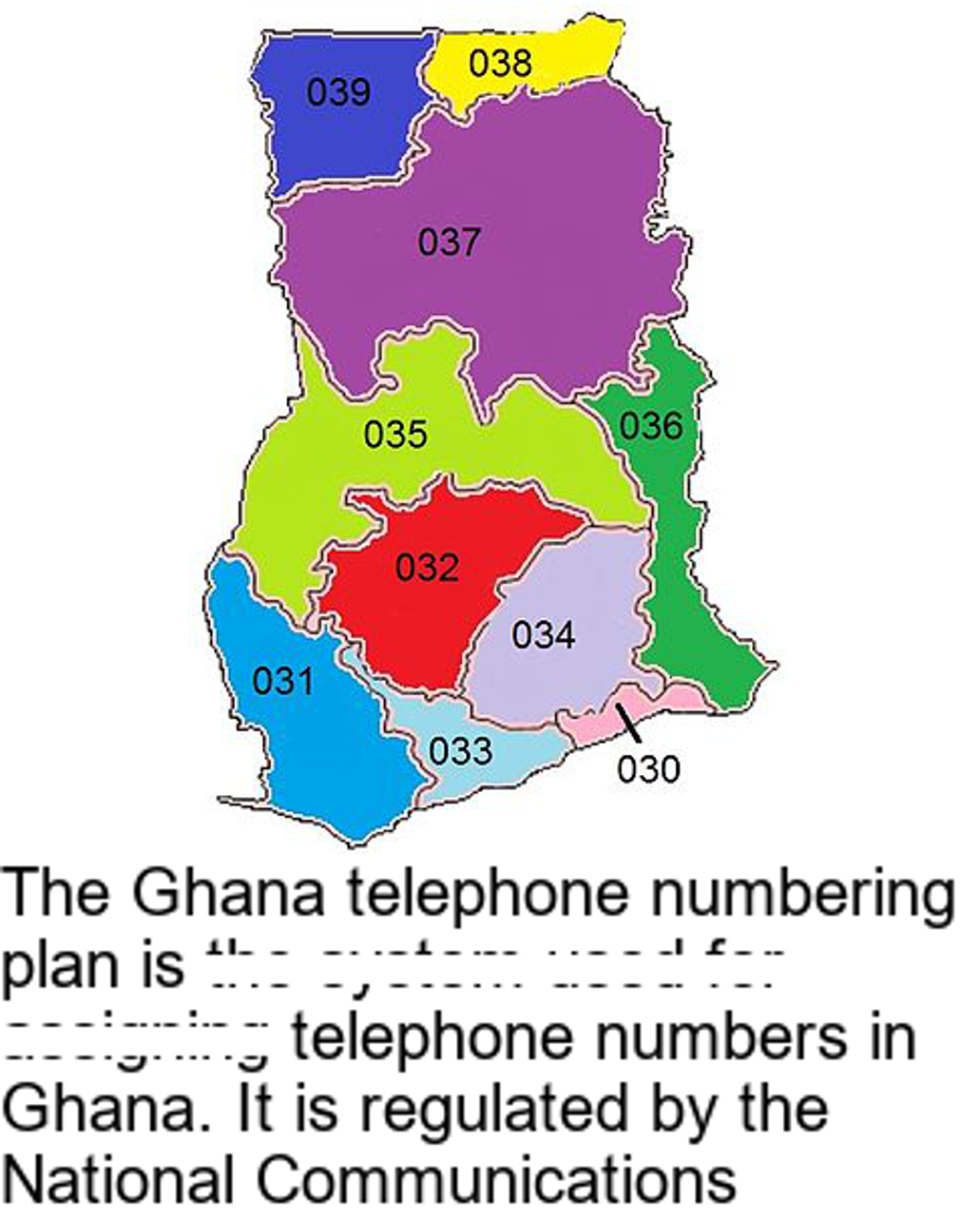
The image is a map of Ghana, divided into regions, each associated with a specific area code. The map visually represents the Ghana telephone numbering plan. The text below the map provides a brief description of the plan and its regulation.
### Components/Axes
The map itself is the primary component. Each region of Ghana is colored differently and labeled with a two-digit area code. The text below the map serves as a caption. There are no explicit axes in the traditional chart sense.
### Detailed Analysis or Content Details
The map shows the following area codes assigned to different regions of Ghana:
* **030:** Located in the southeastern region of Ghana. (Light Green)
* **031:** Located in the southwestern coastal region of Ghana. (Blue)
* **032:** Located in the central region of Ghana. (Red)
* **033:** Located in the south-central region of Ghana. (Orange)
* **034:** Located in the south-central region of Ghana, adjacent to 032 and 033. (Dark Red)
* **035:** Located in the central region of Ghana, north of 032. (Green)
* **036:** Located in the eastern region of Ghana. (Dark Green)
* **037:** Located in the north-central region of Ghana. (Purple)
* **038:** Located in the northeastern region of Ghana. (Yellow)
* **039:** Located in the northwestern region of Ghana. (Dark Blue)
The text below the map reads: "The Ghana telephone numbering plan is … regulating telephone numbers in Ghana. It is regulated by the National Communications…" The text is incomplete and partially obscured.
### Key Observations
The area codes are distributed geographically across Ghana. The numbering appears to follow a regional pattern, with lower numbers generally assigned to southern regions and higher numbers to northern regions. The text indicates that the plan is officially regulated.
### Interpretation
The map illustrates how telephone numbers are organized within Ghana. The area codes allow for efficient routing of calls and identification of geographic locations. The regulation by the National Communications authority suggests a structured and controlled system for managing telephone numbers. The incomplete text suggests that the full description of the numbering plan would likely detail the structure of the numbers beyond the area code (e.g., subscriber numbers). The visual representation of the numbering plan is useful for understanding the geographic distribution of telephone services within Ghana.