\n
## Line Chart: Rate-Distortion: Meta-Token vs. Last-token VIB
### Overview
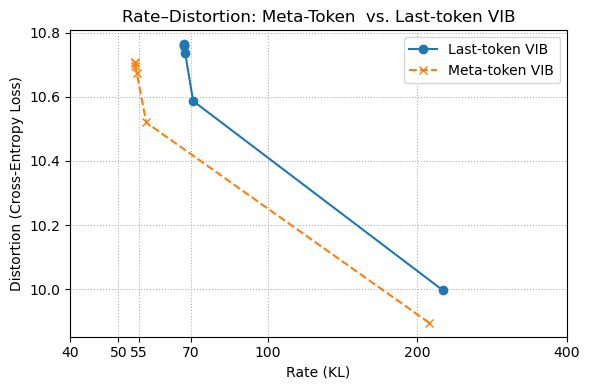
The image presents a line chart comparing the rate-distortion performance of two Variational Information Bottleneck (VIB) models: "Last-token VIB" and "Meta-token VIB". The chart plots Distortion (Cross-Entropy Loss) against Rate (KL divergence).
### Components/Axes
* **Title:** Rate-Distortion: Meta-Token vs. Last-token VIB
* **X-axis:** Rate (KL) - Scale ranges from approximately 40 to 400.
* **Y-axis:** Distortion (Cross-Entropy Loss) - Scale ranges from approximately 10.0 to 10.8.
* **Legend:** Located in the top-right corner.
* "Last-token VIB" - Represented by a solid blue line with circular markers.
* "Meta-token VIB" - Represented by a dashed orange line with 'x' markers.
* **Gridlines:** Present to aid in reading values.
### Detailed Analysis
**Last-token VIB (Blue Line):**
The blue line exhibits a clear downward trend, indicating that as the Rate (KL) increases, the Distortion (Cross-Entropy Loss) decreases.
* At Rate ≈ 50, Distortion ≈ 10.75.
* At Rate ≈ 70, Distortion ≈ 10.6.
* At Rate ≈ 200, Distortion ≈ 10.05.
**Meta-token VIB (Orange Dashed Line):**
The orange dashed line also shows a downward trend, but it is less pronounced than the blue line.
* At Rate ≈ 55, Distortion ≈ 10.55.
* At Rate ≈ 70, Distortion ≈ 10.45.
* At Rate ≈ 200, Distortion ≈ 10.1.
### Key Observations
* The "Last-token VIB" consistently achieves lower distortion values than the "Meta-token VIB" across the observed range of rates.
* Both models demonstrate a trade-off between rate and distortion: increasing the rate (KL divergence) leads to a reduction in distortion (Cross-Entropy Loss).
* The rate of distortion reduction appears to be higher for the "Last-token VIB" model, especially at lower rates.
### Interpretation
The chart suggests that the "Last-token VIB" model is more efficient at compressing information while maintaining a lower level of distortion compared to the "Meta-token VIB" model. This implies that the "Last-token VIB" approach is better at capturing the essential information in the data, resulting in a more effective compression. The downward trend for both lines confirms the fundamental principle of rate-distortion theory: increasing the allowed rate (bits per symbol) allows for a more accurate representation of the original data (lower distortion). The steeper slope of the "Last-token VIB" line indicates a more favorable trade-off between rate and distortion, suggesting a more optimized compression strategy. The initial values at lower rates show that the "Meta-token VIB" starts with a slightly higher distortion, but the gap narrows as the rate increases. This could indicate that the "Meta-token VIB" requires a higher rate to achieve comparable performance to the "Last-token VIB".