## Line Chart: Rate-Distortion: Meta-Token vs. Last-token VIB
### Overview
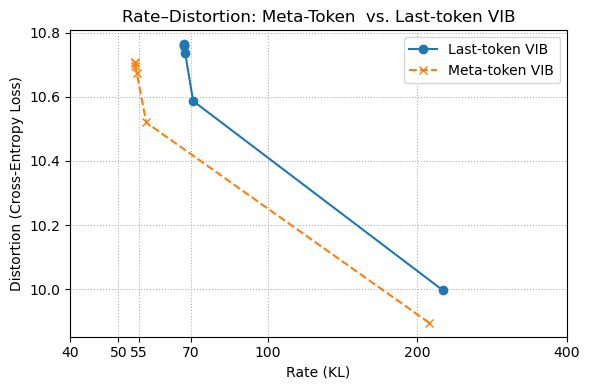
The chart compares the relationship between **Rate (KL)** and **Distortion (Cross-Entropy Loss)** for two types of Vector Quantization (VIB) methods: **Last-token VIB** (solid blue line with circles) and **Meta-token VIB** (dashed orange line with crosses). The x-axis represents the quantization rate (KL), while the y-axis represents distortion in cross-entropy loss. Both lines show a general downward trend, indicating reduced distortion as the rate increases.
---
### Components/Axes
- **Title**: "Rate-Distortion: Meta-Token vs. Last-token VIB"
- **X-axis**:
- Label: "Rate (KL)"
- Scale: 40 to 400 (logarithmic spacing implied by axis markers)
- **Y-axis**:
- Label: "Distortion (Cross-Entropy Loss)"
- Scale: 10.0 to 10.8
- **Legend**:
- Position: Top-right corner
- Entries:
- **Last-token VIB**: Solid blue line with circle markers
- **Meta-token VIB**: Dashed orange line with cross markers
---
### Detailed Analysis
#### Last-token VIB (Blue Line)
- **Data Points**:
- (70 KL, 10.75)
- (100 KL, 10.6)
- (200 KL, 10.0)
- **Trend**:
- Steady linear decrease in distortion as rate increases.
- Slope: Approximately -0.015 per KL (calculated from (70, 10.75) to (200, 10.0)).
#### Meta-token VIB (Orange Line)
- **Data Points**:
- (50 KL, 10.7)
- (55 KL, 10.65)
- (200 KL, 10.1)
- **Trend**:
- Initial sharp decline (50–55 KL: -0.05 per KL), then gradual decline (-0.0045 per KL from 55–200 KL).
- Converges with Last-token VIB at 200 KL (10.1 vs. 10.0).
---
### Key Observations
1. **Divergence at Low Rates**:
- Meta-token VIB starts with higher distortion than Last-token VIB at lower rates (e.g., 50 KL: 10.7 vs. 10.6 at 70 KL).
2. **Convergence at High Rates**:
- Both methods achieve similar distortion levels at 200 KL (10.0 vs. 10.1).
3. **Efficiency Trade-off**:
- Meta-token VIB sacrifices initial performance for better scalability at higher rates.
---
### Interpretation
The chart demonstrates a **rate-distortion trade-off** between the two VIB methods. **Last-token VIB** performs better at lower quantization rates, making it suitable for applications requiring high fidelity at minimal compression. Conversely, **Meta-token VIB** becomes more efficient as the rate increases, suggesting it is better suited for scenarios prioritizing compression over absolute distortion. The convergence at 200 KL implies that both methods achieve near-optimal performance at high rates, but the choice depends on the specific rate requirements of the application. The steeper initial decline of Meta-token VIB highlights its potential for rapid distortion reduction when rate flexibility is available.