## Diagram: Conceptual Mapping
### Overview
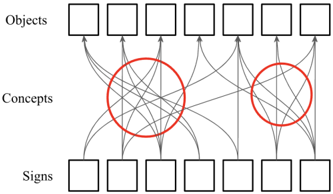
The image is a diagram illustrating a conceptual mapping between "Signs," "Concepts," and "Objects." It shows how multiple signs can relate to multiple concepts, and how those concepts, in turn, relate to objects. The diagram uses boxes to represent individual signs, concepts, and objects, and curved lines to represent the relationships between them. Two red circles highlight clusters of interconnected concepts.
### Components/Axes
* **Vertical Layers (from bottom to top):**
* Signs: The bottom layer, consisting of 8 boxes.
* Concepts: The middle layer, consisting of 2 clusters of interconnected boxes, each circled in red.
* Objects: The top layer, consisting of 8 boxes.
* **Connections:** Curved lines connect boxes in the "Signs" layer to boxes in the "Concepts" layer, and boxes in the "Concepts" layer to boxes in the "Objects" layer.
### Detailed Analysis
* **Signs Layer:** There are 8 boxes representing individual signs. Each box is connected to one or more boxes in the "Concepts" layer.
* **Concepts Layer:** This layer is divided into two clusters, each enclosed in a red circle. The left cluster appears to have more connections to both the "Signs" and "Objects" layers than the right cluster.
* **Objects Layer:** There are 8 boxes representing individual objects. Each box is connected to one or more boxes in the "Concepts" layer.
* **Connections:** The connections between the layers are not one-to-one. A single sign can be associated with multiple concepts, and a single concept can be associated with multiple objects. The connections are represented by curved lines, indicating a relationship or mapping between the elements.
### Key Observations
* The diagram emphasizes the interconnectedness of signs, concepts, and objects.
* The red circles highlight the clustering of concepts, suggesting that certain concepts are more closely related to each other than others.
* The density of connections varies between the two concept clusters, indicating that some concepts may be more central or influential in the mapping process.
### Interpretation
The diagram illustrates a model of how signs, concepts, and objects are related. It suggests that meaning is not a direct relationship between a sign and an object, but rather a mediated relationship through concepts. The clustering of concepts suggests that knowledge is organized into interconnected networks, and that understanding a sign involves activating a network of related concepts. The varying density of connections suggests that some concepts are more central to this network than others. This model could be used to explain how people understand language, how they categorize objects, or how they form beliefs.