## Diagram: Tripartite Semiotic Relationship Model
### Overview
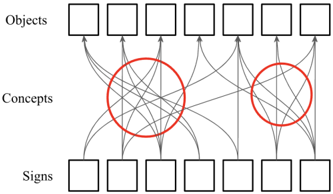
The image displays a conceptual diagram illustrating a three-tiered relational model between "Objects," "Concepts," and "Signs." It visually maps the connections and pathways between these layers, with specific emphasis on clustered relationships within the central "Concepts" layer, highlighted by two red circles.
### Components/Axes
The diagram is organized into three distinct horizontal layers, labeled on the left side:
| Layer | Label | Content |
| :--- | :--- | :--- |
| **Top** | **"Objects"** | A row of 7 empty, equally spaced squares. |
| **Middle** | **"Concepts"** | A row of 7 empty, equally spaced squares. Two large, red, overlapping circles are drawn over this layer, highlighting two distinct clusters of squares and their interconnections. |
| **Bottom** | **"Signs"** | A row of 7 empty, equally spaced squares. |
**Connections:** A network of thin, gray, curved lines connects squares between the layers. The lines primarily flow from the "Signs" layer upward to the "Concepts" layer, and from the "Concepts" layer upward to the "Objects" layer. Some lines also connect squares within the "Concepts" layer itself.
### Detailed Analysis
* **Flow Direction:** The primary visual flow is upward, from "Signs" to "Concepts" to "Objects," suggesting a process of interpretation or representation where signs point to concepts, which in turn refer to objects.
* **Cluster Analysis (Red Circles):**
* **Left Circle:** Encompasses approximately the 2nd, 3rd, and 4th squares from the left in the "Concepts" layer. This cluster shows a dense web of connections:
* Multiple lines from various "Signs" squares converge onto these three "Concepts" squares.
* These "Concepts" squares are heavily interconnected with each other.
* Lines from this cluster connect to multiple "Objects" squares above.
* **Right Circle:** Encompasses approximately the 6th and 7th squares from the left in the "Concepts" layer. This cluster also shows dense connectivity:
* It receives connections from several "Signs" squares.
* The two squares within this circle are connected to each other.
* Lines from this cluster connect to several "Objects" squares.
* **Inter-Cluster Connection:** At least one clear line connects a square from the left cluster (Concepts) to a square in the right cluster (Concepts), indicating a relationship between the two conceptual groupings.
* **Central Square:** The 5th square in the "Concepts" layer (between the two circles) appears to have fewer direct connections compared to the circled clusters, acting as a potential bridge or independent node.
### Key Observations
1. **Non-Linear Mapping:** The connections are not one-to-one. A single "Sign" can connect to multiple "Concepts," and a single "Concept" can connect to multiple "Objects." This demonstrates a many-to-many relationship model.
2. **Conceptual Clustering:** The red circles explicitly identify two primary clusters or categories within the "Concepts" layer. The density of lines within these circles suggests these are tightly integrated conceptual frameworks or domains.
3. **Cross-Cluster Linkage:** The connection between the two circled clusters is a critical feature, indicating that the two conceptual domains are not isolated but interact or share relationships.
4. **Spatial Grounding:** The legend (the red circles) is placed directly over the data (the "Concepts" squares) it describes, in the center of the diagram. The labels ("Objects," "Concepts," "Signs") are positioned to the far left of their respective rows.
### Interpretation
This diagram is a visual model of a **semiotic or cognitive system**. It illustrates how **signs** (words, symbols, icons) are linked to **concepts** (mental representations, categories), which are then linked to **objects** (things in the world or abstract referents).
* **What it demonstrates:** The model argues against a simple, linear chain of signification. Instead, it presents a complex, networked architecture. The clustering suggests that concepts are not stored as isolated units but form interconnected networks or schemas. The cross-cluster link implies that different areas of knowledge or meaning systems are interrelated.
* **Why it matters:** This structure explains how language and thought can be flexible and context-dependent. A single sign (e.g., the word "bank") can activate different conceptual clusters (financial institution vs. river's edge) depending on context, each leading to different objects or interpretations. The model is foundational for fields like linguistics, cognitive science, artificial intelligence (knowledge representation), and philosophy of language.
* **Notable Anomaly:** The central, un-circled "Concepts" square is noteworthy. Its relative isolation could represent a core, abstract concept that links the two clusters, or conversely, a concept that is less integrated into the primary networks shown.