## Diagram: Lattice Basis Vectors
### Overview
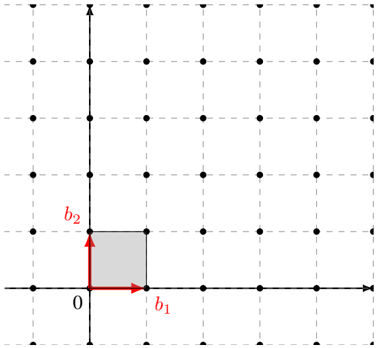
The image depicts a two-dimensional lattice with basis vectors b1 and b2. The lattice points are represented by black dots on a grid. The basis vectors are shown as red arrows originating from the origin (0). A shaded gray square represents the unit cell defined by the basis vectors.
### Components/Axes
* **Axes:** Two orthogonal axes are shown, with the horizontal axis representing the direction of vector b1 and the vertical axis representing the direction of vector b2.
* **Origin:** The origin of the coordinate system is labeled as "0".
* **Basis Vectors:**
* b1: A red arrow pointing along the horizontal axis.
* b2: A red arrow pointing along the vertical axis.
* **Lattice Points:** Black dots arranged in a grid pattern, representing the lattice points.
* **Unit Cell:** A shaded gray square formed by the basis vectors b1 and b2.
* **Grid Lines:** Dashed gray lines forming a grid to visually guide the lattice structure.
### Detailed Analysis
The lattice points are arranged in a regular grid pattern. The basis vectors b1 and b2 define the unit cell of the lattice. The unit cell is a square in this case, as the basis vectors are orthogonal and of equal length. The lattice points are located at integer multiples of the basis vectors.
### Key Observations
* The lattice is a simple square lattice.
* The basis vectors are orthogonal.
* The unit cell is a square.
### Interpretation
The diagram illustrates the concept of a lattice and its basis vectors. The basis vectors define the fundamental repeating unit of the lattice, which is the unit cell. The lattice points are located at integer multiples of the basis vectors, forming a regular grid pattern. This type of lattice is commonly found in crystalline materials. The diagram provides a visual representation of the mathematical concept of a lattice and its properties.