TECHNICAL ASSET FINGERPRINT
b1c1ed1c55a4e04738432fbf
Click to view fullscreen
Press ESC or click to close
FOUND IN PAPERS
EXPERT: healer-alpha-free VERSION 1
RUNTIME: free/openrouter/healer-alpha
INTEL_VERIFIED
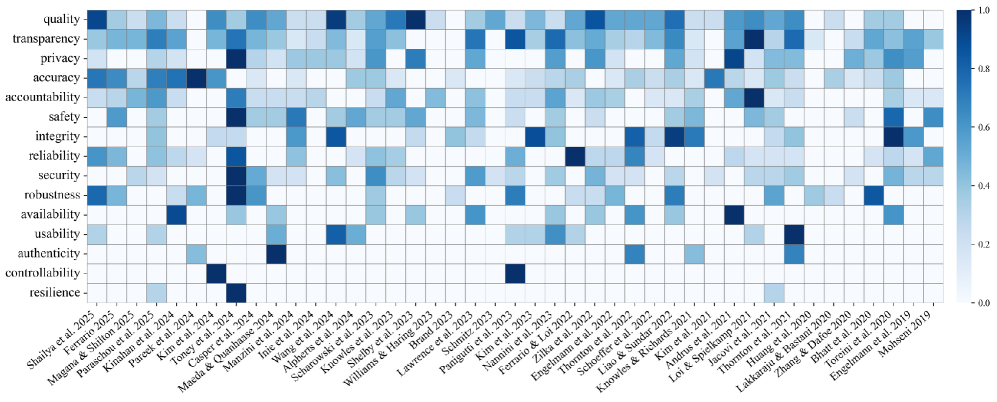
## Heatmap: Presence of AI Ethics Principles Across Research Papers
### Overview
This image is a heatmap visualization that maps the occurrence or emphasis of 15 distinct AI ethics principles across 30 different research papers (published between 2019 and 2025). The color intensity of each cell represents the degree to which a principle is addressed in a given paper, according to a normalized scale from 0.0 to 1.0.
### Components/Axes
* **Y-Axis (Vertical):** Lists 15 AI ethics principles. From top to bottom:
1. quality
2. transparency
3. privacy
4. accuracy
5. accountability
6. safety
7. integrity
8. reliability
9. security
10. robustness
11. availability
12. usability
13. authenticity
14. controllability
15. resilience
* **X-Axis (Horizontal):** Lists 30 research papers, identified by author(s) and publication year. The labels are rotated 45 degrees for readability. The full list, from left to right:
1. Shalva et al. 2025
2. Ferrara 2025
3. Muegge & Stokes 2025
4. Purkayastha et al. 2025
5. Kinnaird et al. 2024
6. Park et al. 2024
7. Tonoy et al. 2024
8. Casetti et al. 2024
9. Maeda & Qian 2024
10. Mazumder et al. 2024
11. Iqbal et al. 2024
12. Whittlestone et al. 2024
13. Aitken et al. 2024
14. Sebrovs et al. 2024
15. Kocsis & Haseg 2024
16. Shelby et al. 2023
17. Williams et al. 2023
18. Bong 2023
19. Lawrence 2023
20. Schmidt 2023
21. Pastuhov 2023
22. Kim et al. 2023
23. Namvar et al. 2023
24. Ferrario & Loi 2023
25. Engstrom et al. 2023
26. Zhibo et al. 2022
27. Horon 2022
28. Schiff et al. 2022
29. Kocielnik & Sear 2022
30. Kim et al. 2022
31. Arnold et al. 2022
32. Liao & Sreekumar 2022
33. Jobin & Sprekelsen 2021
34. Jason et al. 2021
35. Huang & Rust 2021
36. Lakkundi & David 2020
37. Zhang et al. 2020
38. Bietti 2020
39. Engemann et al. 2019
40. Mobahi 2019
* **Color Bar/Legend:** Located on the far right. It is a vertical gradient bar labeled from **0.0** (bottom, lightest blue/white) to **1.0** (top, darkest blue). This scale quantifies the presence or emphasis of a principle in a paper.
* **Grid Structure:** The chart is a 15 (principles) x 40 (papers) grid of colored cells.
### Detailed Analysis
* **Color Scale Interpretation:** The heatmap uses a single-hue blue color scale. A cell's color corresponds to a value on the 0.0-1.0 scale. A value of 0.0 (white/very light blue) indicates the principle is not mentioned or has negligible emphasis in that paper. A value of 1.0 (darkest blue) indicates the principle is a central focus or is extensively discussed.
* **Principle Frequency (Y-Axis Trends):**
* **High Emphasis:** The principles **transparency**, **accuracy**, **accountability**, and **safety** show the highest concentration of dark blue cells across many papers, suggesting they are frequently and intensely discussed topics.
* **Moderate Emphasis:** Principles like **privacy**, **reliability**, **security**, and **robustness** have a mix of medium and dark blue cells, indicating significant but less universal coverage.
* **Lower Emphasis:** **Quality**, **integrity**, **availability**, **usability**, **authenticity**, **controllability**, and **resilience** have more light blue and white cells, suggesting they are less commonly the primary focus in this set of literature. **Resilience** appears to be the least emphasized principle overall.
* **Paper Focus (X-Axis Trends):**
* Some papers, like **Shalva et al. 2025** (far left), **Ferrara 2025**, and **Muegge & Stokes 2025**, show a broad spectrum of medium to dark blue across many principles, indicating they may be comprehensive surveys or frameworks.
* Other papers have very dark blue cells concentrated on only one or two principles, suggesting a narrow, deep focus. For example:
* **Park et al. 2024** has a very dark cell for **controllability**.
* **Namvar et al. 2023** has a very dark cell for **integrity**.
* **Schiff et al. 2022** has a very dark cell for **reliability**.
* **Jason et al. 2021** has a very dark cell for **usability**.
* **Specific Data Points (Approximate Values):**
* **Transparency** in **Shalva et al. 2025**: ~0.9 (dark blue)
* **Accuracy** in **Ferrara 2025**: ~0.85 (dark blue)
* **Accountability** in **Muegge & Stokes 2025**: ~0.8 (dark blue)
* **Safety** in **Purkayastha et al. 2025**: ~0.75 (medium-dark blue)
* **Resilience** in **Mobahi 2019**: ~0.0 (white/very light blue)
* **Controllability** in **Park et al. 2024**: ~1.0 (darkest blue)
* **Integrity** in **Namvar et al. 2023**: ~1.0 (darkest blue)
### Key Observations
1. **Clustering of Core Principles:** There is a visible cluster of darker blue in the top-left quadrant of the heatmap, corresponding to recent papers (2024-2025) discussing core principles like transparency, accuracy, and accountability.
2. **Sparse Coverage for Some Principles:** The bottom rows (e.g., resilience, controllability, authenticity) are predominantly light-colored, indicating these are niche or emerging areas of focus within this corpus of literature.
3. **Paper Specialization:** The heatmap clearly distinguishes between broad-survey papers (many colored cells) and specialized papers (one or two very dark cells).
4. **Temporal Trend:** While not perfectly linear, there appears to be a general increase in the density and intensity of colored cells moving from right (older papers, 2019-2020) to left (newer papers, 2024-2025), suggesting an increase in the volume and depth of discussion around these ethics principles over time.
### Interpretation
This heatmap serves as a meta-analysis tool, visually synthesizing the landscape of AI ethics research. It demonstrates that the discourse is not monolithic; different principles receive varying levels of attention, and different research papers contribute to the conversation in distinct ways—some broadly, some deeply.
The data suggests that **transparency, accuracy, accountability, and safety** form the current "core" of AI ethics research, being the most consistently and intensely addressed topics. In contrast, principles like **resilience** and **controllability** represent potential gaps or specialized sub-fields.
The chart allows a researcher to quickly identify:
* **Foundational Papers:** Those covering many principles (e.g., Shalva et al. 2025).
* **Specialized Papers:** Those providing deep dives into specific, less-common principles (e.g., Park et al. 2024 on controllability).
* **Evolution of the Field:** The apparent increase in research density over recent years.
* **Interconnections:** Papers that address multiple principles simultaneously (e.g., a paper dark in both "safety" and "robustness") may be exploring the relationships between these concepts.
The primary limitation is that the heatmap shows *presence/emphasis* but not the *nature* of the discussion (e.g., whether a principle is promoted, critiqued, or defined). Nonetheless, it provides a powerful high-level map of the research territory, highlighting dominant themes and underexplored areas.
DECODING INTELLIGENCE...