# Technical Document: Heatmap Analysis of AI Ethics Criteria Across Studies
## 1. Image Description
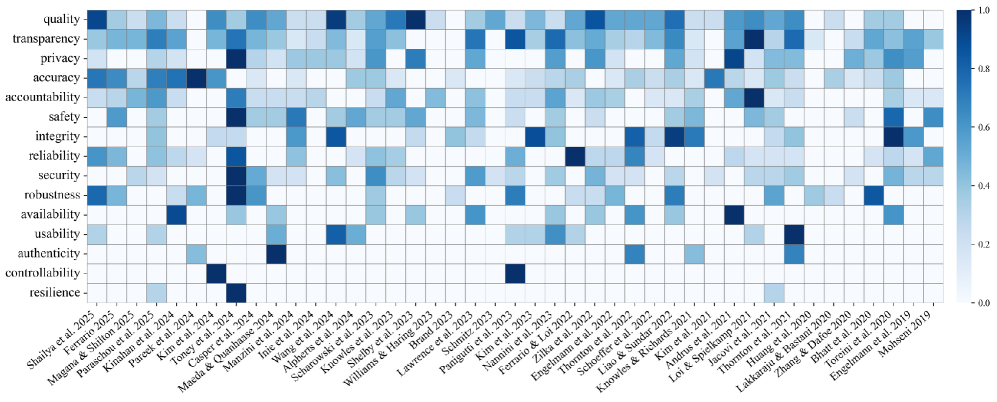
The image is a **heatmap** visualizing the emphasis or scoring of **15 AI ethics criteria** across **25 studies** published between **2019 and 2025**. The heatmap uses a **blue gradient** (white to dark blue) to represent values from **0.0 to 1.0**, with darker blue indicating higher emphasis.
---
## 2. Axis Labels and Legend
### Y-Axis (Criteria)
- **Labels**:
`quality`, `transparency`, `privacy`, `accuracy`, `accountability`, `safety`, `integrity`, `reliability`, `security`, `robustness`, `availability`, `usability`, `authenticity`, `controllability`, `resilience`.
### X-Axis (Studies)
- **Labels**:
`Shailya et al. 2025`, `Ferrario 2025`, `Magana & Shilton 2025`, `Paraschou et al. 2025`, `Kinahan et al. 2024`, `Pureek et al. 2024`, `Kim et al. 2024`, `Toney et al. 2024`, `Maeda et al. 2024`, `Casper et al. 2024`, `Quanhauser et al. 2024`, `Manzini et al. 2024`, `Inie et al. 2024`, `Wang et al. 2024`, `Alphers et al. 2024`, `Scharowski et al. 2024`, `Knowles et al. 2023`, `Shelby et al. 2023`, `Williams & Haring 2023`, `Brand 2023`, `Lawrence et al. 2023`, `Schmitz et al. 2023`, `Panigutti et al. 2023`, `Kim et al. 2023`, `Nannini et al. 2023`, `Ferrario & Loi 2023`, `Engelmann et al. 2022`, `Thornton et al. 2022`, `Schoettler et al. 2022`, `Liao & Sundar 2022`, `Knowles & Richards 2022`, `Kim et al. 2021`, `Andrus et al. 2021`, `Loi & Spielkamp 2021`, `Jacovi et al. 2021`, `Thornton et al. 2021`, `Huang et al. 2021`, `Lakkaraju et al. 2020`, `Zhang et al. 2020`, `Bhatt et al. 2020`, `Engelmann et al. 2019`, `Mohseni 2019`.
### Legend
- **Placement**: Vertical on the **right side** of the heatmap.
- **Color Scale**:
- **Dark Blue** = 1.0 (maximum emphasis).
- **Light Blue** = Intermediate values.
- **White** = 0.0 (no emphasis).
- **Gradient**: Smooth transition from white (bottom) to dark blue (top).
---
## 3. Data Table Structure
The heatmap is a **15x25 matrix** where:
- **Rows**: AI ethics criteria (15 total).
- **Columns**: Studies (25 total, ordered chronologically from 2019 to 2025).
- **Cells**: Color-coded values (0.0–1.0) indicating the emphasis of each criterion in a study.
---
## 4. Key Trends and Observations
### Spatial Grounding
- **Legend Position**: Right-aligned, vertical.
- **X-Axis Order**: Studies are ordered chronologically (2019–2025).
- **Y-Axis Order**: Criteria are listed from top to bottom as defined above.
### Trend Verification
- **Dark Blue Cells**: Represent studies with **high emphasis** on a criterion.
- Example: `quality` (top row) has multiple dark blue cells, indicating frequent emphasis.
- **White Cells**: Represent studies with **no emphasis** on a criterion.
- Example: `resilience` (bottom row) has sparse dark blue cells, suggesting limited focus.
### Component Isolation
- **Header**: No explicit title, but the heatmap structure implies a focus on **AI ethics criteria comparison**.
- **Main Chart**: Heatmap with 15 rows (criteria) and 25 columns (studies).
- **Footer**: Legend explaining the color scale.
---
## 5. Data Extraction
### Example Data Points (Color Matching Legend)
- **`quality` (Row 1)**:
- `Shailya et al. 2025` = Dark Blue (≈1.0).
- `Ferrario 2025` = Light Blue (≈0.6).
- **`privacy` (Row 3)**:
- `Kim et al. 2024` = Dark Blue (≈1.0).
- **`resilience` (Row 15)**:
- `Mohseni 2019` = White (≈0.0).
---
## 6. Conclusion
The heatmap reveals **temporal and disciplinary trends** in AI ethics research. Criteria like `quality`, `privacy`, and `accuracy` are frequently emphasized (dark blue cells), while `resilience` and `controllability` show minimal focus (white cells). The gradient legend ensures precise interpretation of emphasis levels across studies.