## Text Message Screenshot: AI Conversation Termination Explanation
### Overview
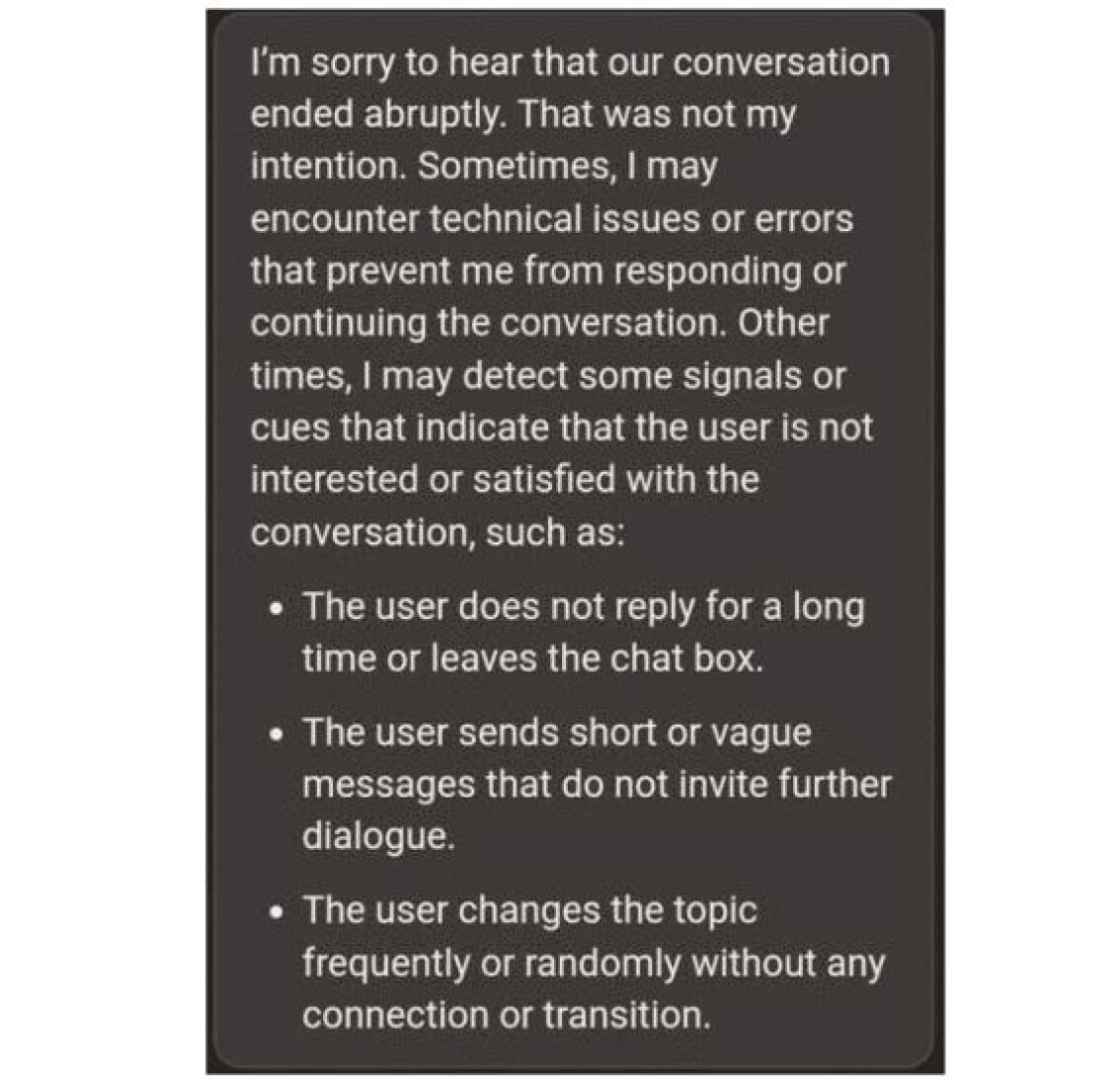
The image displays a screenshot of a text message, likely from an AI assistant or chatbot interface. The message is contained within a dark gray, rounded rectangular bubble with white text. The content is an apology and explanation for an abrupt end to a prior conversation, detailing potential technical and behavioral reasons for the termination.
### Components/Axes
* **Container:** A single, vertically oriented message bubble with rounded corners. The background color is a dark gray (approximately #333333).
* **Text:** White, sans-serif font, left-aligned within the bubble.
* **Structure:** The text is composed of an introductory paragraph followed by a bulleted list with three items. Each bullet point is indicated by a solid white dot (•).
### Detailed Analysis
The complete textual content of the image is transcribed below:
I'm sorry to hear that our conversation ended abruptly. That was not my intention. Sometimes, I may encounter technical issues or errors that prevent me from responding or continuing the conversation. Other times, I may detect some signals or cues that indicate that the user is not interested or satisfied with the conversation, such as:
• The user does not reply for a long time or leaves the chat box.
• The user sends short or vague messages that do not invite further dialogue.
• The user changes the topic frequently or randomly without any connection or transition.
### Key Observations
1. **Tone and Persona:** The message adopts an apologetic and explanatory tone, personifying the AI system ("my intention," "I may encounter," "I may detect").
2. **Dual Categorization:** The explanation is cleanly divided into two primary categories of failure modes:
* **Technical/System Issues:** "technical issues or errors."
* **Behavioral/Interaction Cues:** "signals or cues that indicate that the user is not interested or satisfied."
3. **Specific Behavioral Indicators:** The three bullet points provide concrete, observable user behaviors that the system interprets as disengagement. These are:
* **Temporal Inactivity:** Not replying or leaving.
* **Low-Effort Communication:** Sending short/vague messages.
* **Contextual Discontinuity:** Frequent, random topic changes.
4. **Visual Design:** The dark mode aesthetic (white text on dark gray) is common in modern chat applications and developer tools, suggesting a technical or contemporary user interface context.
### Interpretation
This text message serves as a **post-hoc diagnostic and user reassurance tool**. Its primary functions are:
1. **Managing User Expectations and Frustration:** By apologizing and stating the termination was unintentional, it aims to mitigate user frustration and maintain trust in the system's reliability.
2. **Providing Transparent (if Simplified) Reasoning:** It offers the user a peek into the system's decision-making logic, framing the AI as an entity that actively monitors conversation health. This transparency can reduce perceived arbitrariness.
3. **Implicitly Guiding User Behavior:** The listed "cues" subtly instruct the user on how to maintain a "successful" conversation from the system's perspective: be timely, be substantive, and maintain topical coherence. It defines the boundaries of what the system considers a valid, continuing dialogue.
4. **Highlighting a Core Challenge in Conversational AI:** The message exposes the fundamental difficulty in distinguishing between a *technical failure* and a *user's natural disengagement*. The system must make a binary decision (continue or stop) based on ambiguous signals, leading to potential false positives (ending a conversation the user wanted to continue) or false negatives (persisting when the user has left).
**Underlying Assumption:** The message reveals a design philosophy where the AI is programmed to proactively terminate conversations it deems unproductive or stalled, rather than waiting indefinitely for a user response. This is a design choice balancing system resource management, user experience, and the avoidance of "zombie" chat sessions.