## Screenshot: Apology Message for Abrupt Conversation Termination
### Overview
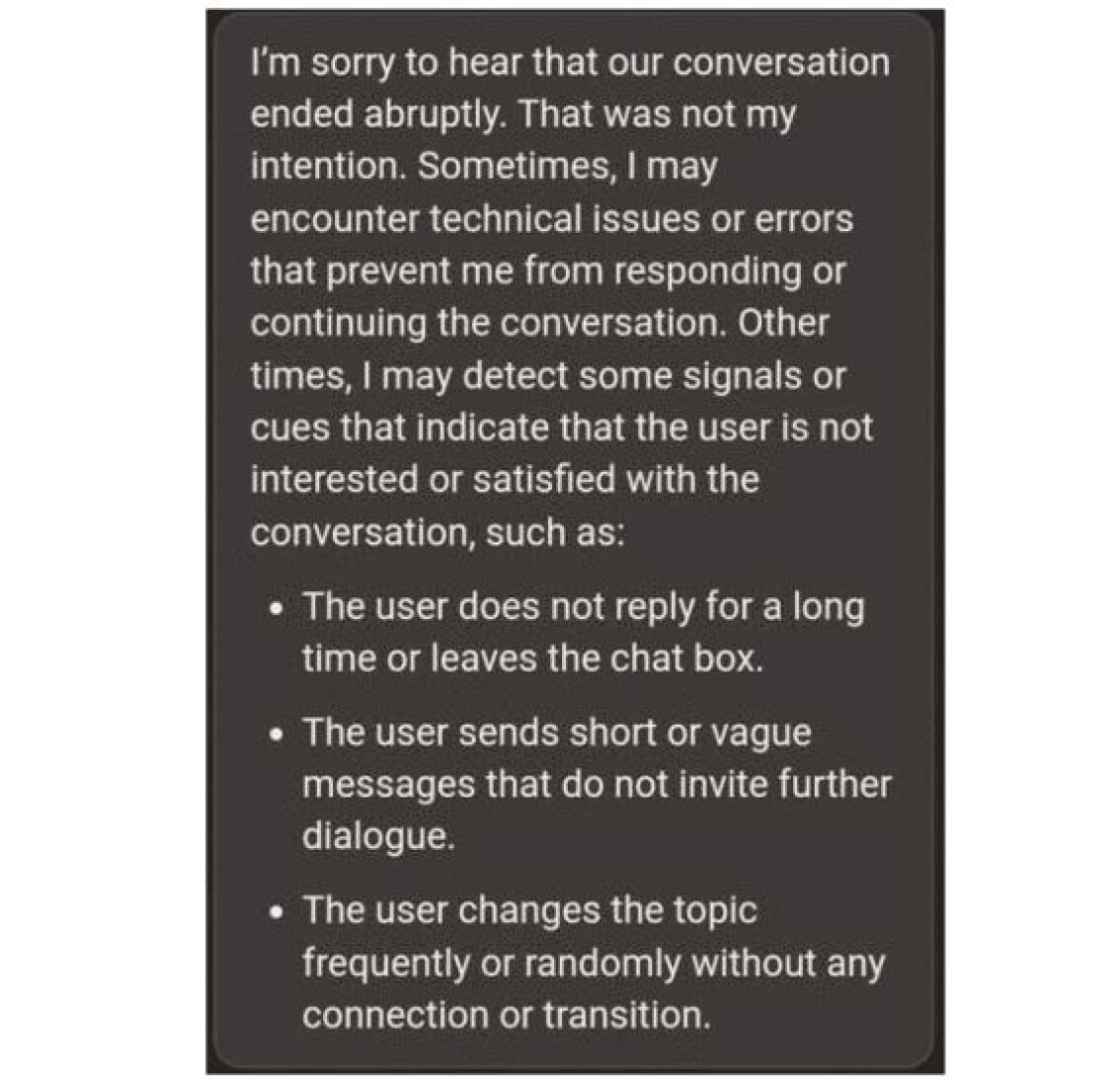
The image is a screenshot of a text-based message with a black background and white text. The message apologizes for an abrupt conversation ending, explains potential causes (technical issues, user disengagement), and lists three bullet points indicating signs of user disinterest.
### Content Details
**Main Text**:
"I’m sorry to hear that our conversation ended abruptly. That was not my intention. Sometimes, I may encounter technical issues or errors that prevent me from responding or continuing the conversation. Other times, I may detect some signals or cues that indicate that the user is not interested or satisfied with the conversation, such as:"
**Bullet Points**:
1. The user does not reply for a long time or leaves the chat box.
2. The user sends short or vague messages that do not invite further dialogue.
3. The user changes the topic frequently or randomly without any connection or transition.
### Key Observations
- The message is structured as a formal apology with explanatory reasoning.
- The bullet points are presented as objective criteria for detecting user disengagement.
- No numerical data, charts, or diagrams are present.
### Interpretation
This message serves as a standardized response to users when a conversation terminates unexpectedly. It aims to:
1. **Acknowledge limitations**: Attribute abrupt endings to technical constraints or AI detection of disengagement.
2. **Educate users**: Provide transparency about how the AI interprets user behavior (e.g., silence, short replies, topic shifts).
3. **Mitigate frustration**: By framing the termination as a mutual or system-driven outcome rather than a user error.
The bullet points imply a behavioral analysis framework, suggesting the AI uses heuristics to infer user satisfaction. However, the lack of quantitative data (e.g., thresholds for "long time" or "frequent" topic changes) leaves room for ambiguity in how these criteria are operationalized.