\n
## Visual Representation: Day-Night Color Spectrum with Architectural Imagery
### Overview
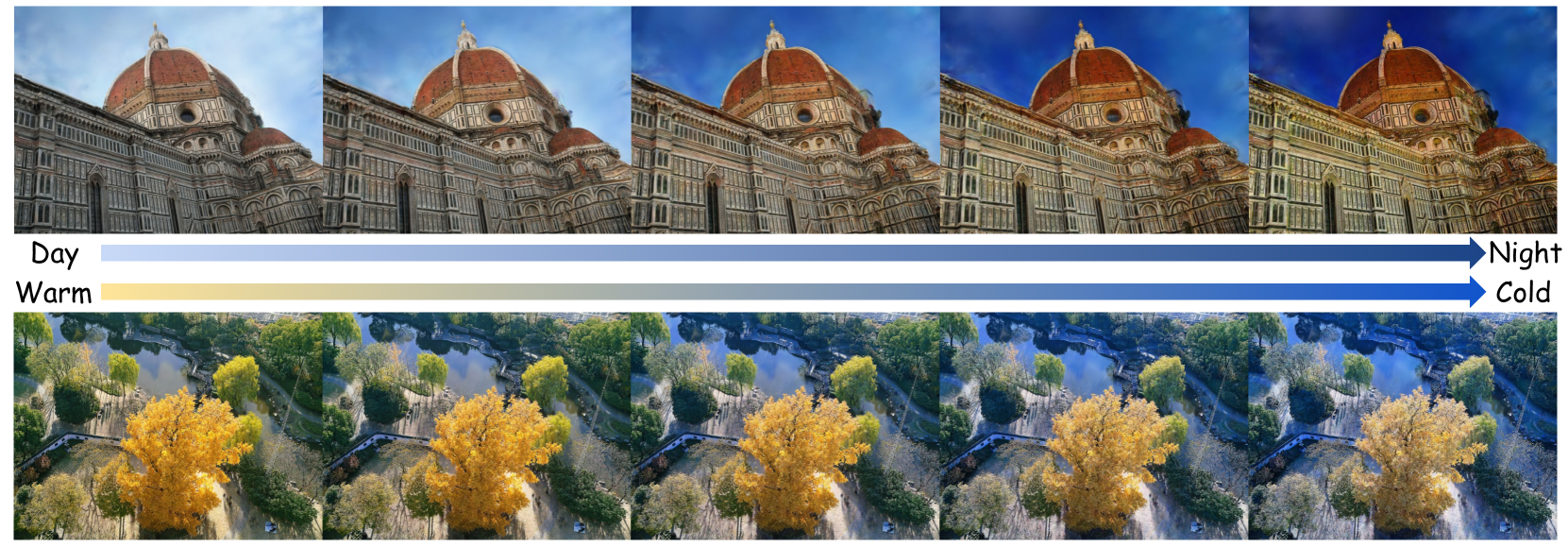
The image presents a visual spectrum demonstrating the shift in color temperature from day to night, represented by a gradient and illustrated with corresponding images of a building (likely a cathedral) and surrounding landscape. The top row shows the building, while the bottom row shows the landscape. The color gradient is positioned between the two rows.
### Components/Axes
The image features two primary visual components:
* **Color Gradient:** A horizontal gradient spanning from left to right. The left end is labeled "Day" and colored a warm yellow. The right end is labeled "Night" and colored a cold blue. An arrow indicates the direction of the gradient. Below the labels "Day" and "Night" are the labels "Warm" and "Cold" respectively.
* **Image Series:** Four images are arranged horizontally, two rows deep. The top row depicts a building with a large dome, while the bottom row shows a landscape with trees. The images progress from left to right, visually aligning with the color gradient.
### Detailed Analysis or Content Details
The image does not contain numerical data or precise measurements. It is a qualitative representation of color temperature change. However, we can describe the visual changes in the images:
* **Image 1 (Leftmost):** The building appears brightly lit with warm, yellowish tones. The landscape is similarly bathed in warm light.
* **Image 2:** The building's lighting is slightly cooler, with a more orange hue. The landscape shows a transition in color.
* **Image 3:** The building exhibits a cooler, bluer tone, with shadows becoming more pronounced. The landscape is also shifting towards cooler colors.
* **Image 4 (Rightmost):** The building is predominantly blue and dark, indicating nighttime. The landscape is dark with cooler tones.
The color gradient visually represents the transition from warm colors (yellow, orange) associated with daylight to cool colors (blue, indigo) associated with nighttime.
### Key Observations
The image demonstrates a clear correlation between time of day and color temperature. As the day progresses towards night, the color temperature shifts from warm to cold. The images effectively illustrate this shift in the context of an architectural scene and a natural landscape.
### Interpretation
The image is a visual metaphor for the changing light conditions throughout the day. It highlights how our perception of color is influenced by the time of day and the position of the sun. The use of a building and landscape provides a relatable context for understanding this phenomenon. The gradient serves as a continuous scale, emphasizing the gradual transition between warm and cold colors. The image could be used to illustrate concepts in photography, art, or environmental science, where understanding color temperature is crucial. The image does not contain any factual data, but rather a visual representation of a natural phenomenon. It is a demonstration of how light affects color perception.