## Photographic Series with Gradient Annotations: Florence Cathedral and Landscape
### Overview
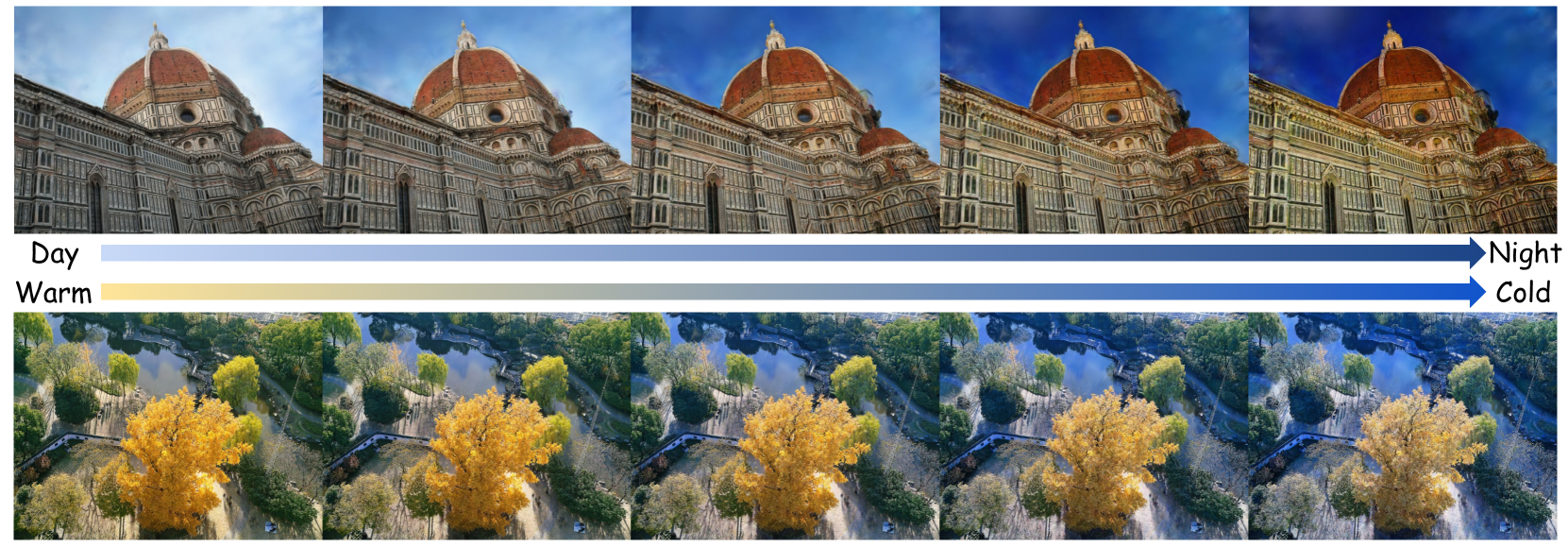
The image presents two sets of five photographs each, arranged horizontally. The top row features the Florence Cathedral (Baptistery of St. John) under varying lighting conditions, while the bottom row shows an aerial view of a landscape with autumn foliage. Each photograph is annotated with a horizontal gradient bar indicating temporal and thermal conditions.
### Components/Axes
1. **Top Row (Florence Cathedral)**
- **Gradient Bar**:
- Left label: "Day" (light blue)
- Right label: "Night" (dark blue)
- Color transition: Light blue → Dark blue
- **Photographs**:
- Five sequential images of the cathedral's dome and façade
- Lighting progression: Bright daylight → Dim nighttime
2. **Bottom Row (Landscape)**
- **Gradient Bar**:
- Top label: "Warm" (yellow)
- Bottom label: "Cold" (blue)
- Color transition: Yellow → Blue
- **Photographs**:
- Five aerial views of a riverine landscape
- Color progression: Vibrant autumn hues → Muted winter tones
### Detailed Analysis
**Florence Cathedral Series**:
- **Daytime Images (Leftmost 3)**:
- Clear blue sky visible
- Warm golden tones on the cathedral's marble façade
- High contrast between red-tiled dome and white stonework
- **Nighttime Images (Rightmost 2)**:
- Dark blue sky dominates
- Artificial lighting creates warm glows on architectural details
- Reduced visibility of distant elements
**Landscape Series**:
- **Warm Conditions (Top 3 Images)**:
- Dominant golden-yellow foliage
- Bright reflections on water surfaces
- Clear definition of tree canopies
- **Cold Conditions (Bottom 2 Images)**:
- Blue-toned vegetation
- Frozen water features visible
- Reduced saturation in overall color palette
### Key Observations
1. **Lighting Impact**: The cathedral's architectural details become more pronounced under artificial lighting at night, with warm tones persisting despite reduced natural light.
2. **Thermal Transition**: The landscape shows a clear shift from autumnal warmth (yellow/orange) to winter cold (blue/gray), with water features transitioning from liquid to frozen states.
3. **Color Consistency**: Both gradient bars use analogous color schemes (blue for time, yellow/blue for temperature), creating visual harmony between the two series.
### Interpretation
This composite image demonstrates:
1. **Photographic Adaptation**: How the same subject (cathedral) appears under different lighting conditions, emphasizing architectural form through controlled illumination.
2. **Seasonal Representation**: The landscape series effectively visualizes seasonal transition through color temperature shifts, with the gradient bar serving as a thermal metaphor.
3. **Visual Storytelling**: The dual-axis approach (time + temperature) creates a multidimensional narrative about environmental perception, suggesting that both temporal and thermal factors shape visual experiences.
The absence of numerical data prevents quantitative analysis, but the qualitative progression clearly illustrates how lighting and temperature affect visual perception of architectural and natural subjects.