## Diagram: Neural Association Model Conceptual Flow
### Overview
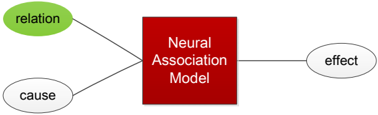
The image is a simple conceptual diagram illustrating the inputs and output of a "Neural Association Model." It uses basic shapes and connecting lines to represent a flow of information or causality. The diagram is minimal, containing only labeled shapes and connecting lines on a plain white background.
### Components/Axes
The diagram consists of four primary components connected by lines:
1. **Central Component:**
* **Shape:** Rectangle
* **Color:** Solid dark red fill.
* **Label Text:** "Neural Association Model" (white text, centered within the rectangle).
* **Position:** Center of the image.
2. **Input Component 1:**
* **Shape:** Oval (ellipse).
* **Color:** Solid light green fill.
* **Label Text:** "relation" (black text).
* **Position:** Top-left quadrant, connected by a line to the top-left corner of the central rectangle.
3. **Input Component 2:**
* **Shape:** Oval (ellipse).
* **Color:** White fill with a black outline.
* **Label Text:** "cause" (black text).
* **Position:** Bottom-left quadrant, connected by a line to the bottom-left corner of the central rectangle.
4. **Output Component:**
* **Shape:** Oval (ellipse).
* **Color:** White fill with a black outline.
* **Label Text:** "effect" (black text).
* **Position:** Right side of the image, connected by a line from the right side of the central rectangle.
**Connections:** Solid black lines connect the components, indicating a directional flow from the left-side inputs ("relation" and "cause") into the central model, and from the model to the right-side output ("effect").
### Detailed Analysis
* **Text Transcription:** All text is in English.
* "relation"
* "cause"
* "Neural Association Model"
* "effect"
* **Spatial Layout:** The diagram follows a left-to-right flow logic. The two input nodes ("relation" and "cause") are positioned on the left, feeding into the processing unit ("Neural Association Model") in the center, which then produces an output ("effect") on the right.
* **Color Coding:** The "relation" node is uniquely colored green, potentially highlighting it as a distinct type of input compared to the white "cause" node. The central model is emphasized with a bold red color.
### Key Observations
1. **Asymmetric Inputs:** The model takes two distinct inputs ("relation" and "cause") but produces a single, unified output ("effect").
2. **Visual Hierarchy:** The central red rectangle is the largest and most visually prominent element, clearly marking it as the core processing unit of the system.
3. **Directional Flow:** The connecting lines clearly define a unidirectional process: Inputs → Model → Output. There are no feedback loops or bidirectional arrows shown.
### Interpretation
This diagram presents a high-level, abstract model of a cognitive or computational process. It suggests that a "Neural Association Model" functions by integrating two fundamental pieces of information: a **cause** (an initiating event or factor) and a **relation** (the nature of the connection or context between entities). The model's purpose is to process this combined input to predict, generate, or explain an **effect** (the outcome or consequence).
The separation of "cause" and "relation" as distinct inputs is significant. It implies that simply knowing a cause is insufficient; the model must also understand the relational framework (e.g., temporal, spatial, causal strength) within which that cause operates to accurately determine the effect. This aligns with concepts in causal inference and relational learning in AI, where understanding the structure of relationships is as critical as identifying the variables themselves.
The simplicity of the diagram indicates it is a foundational or pedagogical illustration, meant to convey the core logic of the model without detailing its internal architecture, learning mechanisms, or the specific nature of the associations it forms. It answers "what" the model does (associates causes and relations to effects) but not "how" it does it.