## Diagram: Neural Association Model Architecture
### Overview
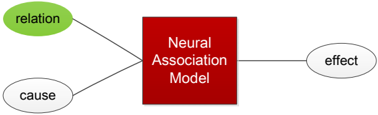
The diagram illustrates a conceptual model of neural association, depicting relationships between "cause," "relation," and "effect" through a central processing unit labeled "Neural Association Model."
### Components/Axes
- **Central Node**: A red square labeled "Neural Association Model" (positioned centrally).
- **Input Nodes**:
- Green oval labeled "relation" (top-left of the central node).
- White oval labeled "cause" (bottom-left of the central node).
- **Output Node**:
- White oval labeled "effect" (right of the central node).
- **Connections**:
- Black lines connect "relation" and "cause" to the central node.
- A single black line connects the central node to "effect."
### Detailed Analysis
- **Textual Labels**:
- "Neural Association Model" (central red square).
- "relation" (green oval, top-left).
- "cause" (white oval, bottom-left).
- "effect" (white oval, right).
- **Color Coding**:
- "relation" is uniquely green, while "cause" and "effect" are white.
- No explicit legend is present, but color differentiation suggests "relation" may represent a distinct input type.
### Key Observations
1. The model processes two inputs ("cause" and "relation") to produce a single output ("effect").
2. The green color of "relation" may imply a qualitative or contextual input, contrasting with the neutral white of "cause."
3. The unidirectional flow from inputs to output suggests a deterministic relationship.
### Interpretation
The diagram represents a simplified causal inference framework where the "Neural Association Model" integrates contextual ("relation") and direct ("cause") inputs to generate an "effect." The use of color (green for "relation") hints at potential prioritization or weighting of contextual factors in the model's processing. This structure aligns with cognitive science models of associative learning, where neural networks link stimuli (cause/relation) to outcomes (effect).
No numerical data or trends are present; the diagram focuses on conceptual relationships rather than quantitative analysis.