TECHNICAL ASSET FINGERPRINT
b26c5b3dbad9e08c3a44d11c
Click to view fullscreen
Press ESC or click to close
FOUND IN PAPERS
EXPERT: gemini-2.0-flash VERSION 1
RUNTIME: nugit/gemini/gemini-2.0-flash
INTEL_VERIFIED
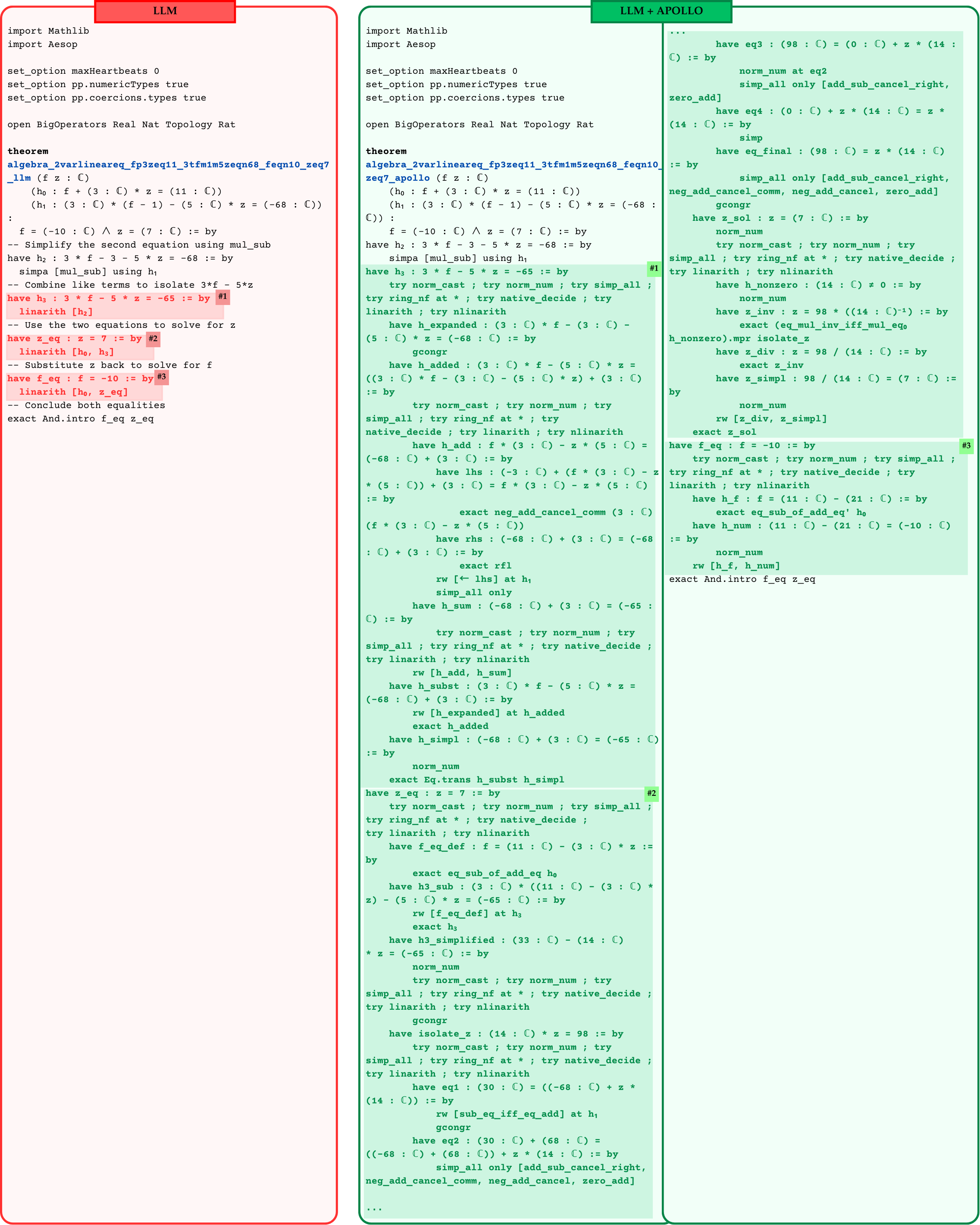
## Code Comparison: LLM vs. LLM + APOLLO
### Overview
The image presents a side-by-side comparison of code snippets labeled "LLM" and "LLM + APOLLO". Both snippets appear to be related to mathematical proofs or symbolic computations, likely within a formal verification or automated reasoning context. The code includes commands, definitions, and theorems, with annotations and comments. The comparison highlights differences in the approaches or optimizations used in each version.
### Components/Axes
* **Headers:**
* Left: "LLM" (Red background)
* Right: "LLM + APOLLO" (Green background)
* **Code Snippets:** Each section contains a block of code, including imports, options, theorem definitions, and proof steps.
* **Annotations:** Numbered annotations "#1", "#2", "#3" appear in both code snippets, possibly indicating key steps or differences.
### Detailed Analysis or ### Content Details
**LLM (Left Side - Red Background)**
* **Imports:**
* `import Mathlib`
* `import Aesop`
* **Options:**
* `set_option maxHeartbeats 0`
* `set_option pp.numericTypes true`
* `set_option pp.coercions.types true`
* **Open:**
* `open BigOperators Real Nat Topology Rat`
* **Theorem:**
* `theorem algebra_2varlineareq_fp3zeq11_3tfm1m5zeqn68_feqn10_zeq7_llm (f z : C)`
* `(h₀ : f + (3 : C) * z = (11 : C))`
* `(h₁ : (3 : C) * (f - 1) - (5 : C) * z = (-68 : C))`
* `f = (-10 : C) ∧ z = (7 : C) := by`
* **Proof Steps:**
* `-- Simplify the second equation using mul_sub`
* `have h₂ : 3 * f - 3 - 5 * z = -68 := by`
* `simpa [mul_sub] using h₁`
* `-- Combine like terms to isolate 3*f - 5*z`
* `have h₃ : 3 * f - 5 * z = -65 := by #1`
* `linarith [h₂]`
* `-- Use the two equations to solve for z`
* `have z_eq : z = 7 := by #2`
* `linarith [h₀, h₃]`
* `-- Substitute z back to solve for f`
* `have f_eq : f = -10 := by #3`
* `linarith [h₀, z_eq]`
* `-- Conclude both equalities`
* `exact And.intro f_eq z_eq`
**LLM + APOLLO (Right Side - Green Background)**
* **Imports:**
* `import Mathlib`
* `import Aesop`
* **Options:**
* `set_option maxHeartbeats 0`
* `set_option pp.numericTypes true`
* `set_option pp.coercions.types true`
* **Open:**
* `open BigOperators Real Nat Topology Rat`
* **Theorem:**
* `theorem algebra_2varlineareq_fp3zeq11_3tfm1m5zeqn68_feqn10_zeq7_apollo (f z : C)`
* `(h₀ : f + (3 : C) * z = (11 : C))`
* `(h₁ : (3 : C) * (f - 1) - (5 : C) * z = (-68 : C))`
* `f = (-10 : C) ∧ z = (7 : C) := by`
* **Proof Steps:**
* `have h₂ : 3 * f - 3 - 5 * z = -68 := by`
* `simpa [mul_sub] using h₁`
* `have h₃ : 3 * f - 5 * z = -65 := by #1`
* `try norm_cast; try norm_num; try simp_all;`
* `try ring_nf at *; try native_decide; try`
* `linarith; try nlinarith`
* `have h_expanded : (3 : C) * f - (3 : C) - (5 : C) * z = (-68 : C) := by`
* `gcongr`
* `have h_added : (3 : C) * f - (5 : C) * z = ((3 : C) * f - (3 : C) - (5 : C) * z) + (3 : C) := by`
* `try norm_cast; try norm_num; try`
* `simp_all; try ring_nf at *; try`
* `native_decide; try linarith; try nlinarith`
* `have h_add : f * (3 : C) - z * (5 : C) = (-68 : C) + (3 : C) := by`
* `have lhs : (-3 : C) + (f * (3 : C) - z * (5 : C)) = (f * (3 : C) - z * (5 : C)) := by`
* `exact neg_add_cancel_comm (3 : C) (f * (3 : C) - z * (5 : C))`
* `have rhs : (-68 : C) + (3 : C) = (-68 : C) + (3 : C) := by`
* `exact rfl`
* `rw [← lhs] at h₁`
* `simp_all only`
* `have h_sum : (-68 : C) + (3 : C) = (-65 : C) := by`
* `try norm_cast; try norm_num; try`
* `simp_all; try ring_nf at *; try native_decide;`
* `try linarith; try nlinarith`
* `rw [h_add, h_sum]`
* `have h_subst : (3 : C) * f - (5 : C) * z = (-68 : C) + (3 : C) := by`
* `rw [h_expanded] at h_added`
* `exact h_added`
* `have h_simpl : (-68 : C) + (3 : C) = (-65 : C) := by`
* `norm_num`
* `exact Eq.trans h_subst h_simpl`
* `have z_eq : z = 7 := by #2`
* `try norm_cast; try norm_num; try simp_all;`
* `try ring_nf at *; try native_decide;`
* `try linarith; try nlinarith`
* `have f_eq_def : f = (11 : C) - (3 : C) * z := by`
* `exact eq_sub_of_add_eq h₀`
* `have h3_sub : (3 : C) * ((11 : C) - (3 : C) * z) - (5 : C) * z = (-65 : C) := by`
* `rw [f_eq_def] at h₃`
* `exact h₃`
* `have h3_simplified : (33 : C) - (14 : C) * z = (-65 : C) := by`
* `norm_num`
* `try norm_cast; try norm_num; try`
* `simp_all; try ring_nf at *; try native_decide;`
* `try linarith; try nlinarith`
* `gcongr`
* `have isolate_z : (14 : C) * z = 98 := by`
* `try norm_cast; try norm_num; try`
* `simp_all; try ring_nf at *; try native_decide;`
* `try linarith; try nlinarith`
* `have eq1 : (30 : C) = ((-68 : C) + z * (14 : C)) := by`
* `rw [sub_eq_iff_eq_add] at h₁`
* `gcongr`
* `have eq2 : (30 : C) + (68 : C) = ((-68 : C) + (68 : C)) + z * (14 : C) := by`
* `simp_all only [add_sub_cancel_right, neg_add_cancel_comm, neg_add_cancel, zero_add]`
* `have eq3 : (98 : C) = (0 : C) + z * (14 : C) := by`
* `norm_num at eq2`
* `simp_all only [add_sub_cancel_right, zero_add]`
* `have eq4 : (0 : C) + z * (14 : C) = z * (14 : C) := by`
* `simp`
* `have eq_final : (98 : C) = z * (14 : C) := by`
* `simp_all only [add_sub_cancel_right, neg_add_cancel_comm, neg_add_cancel, zero_add]`
* `gcongr`
* `have z_sol : z = (7 : C) := by`
* `try norm_cast; try norm_num; try simp_all;`
* `try ring_nf at *; try native_decide; try`
* `linarith; try nlinarith`
* `have h_nonzero : (14 : C) ≠ 0 := by`
* `norm_num`
* `have z_inv : z = 98 * ((14 : C)⁻¹) := by`
* `exact (eq_mul_inv_iff_mul_eq₀ h_nonzero).mpr isolate_z`
* `have z_div : z = 98 / (14 : C) := by`
* `exact z_inv`
* `have z_simpl : 98 / (14 : C) = (7 : C) := by`
* `norm_num`
* `rw [z_div, z_simpl]`
* `exact z_sol`
* `have f_eq : f = -10 := by #3`
* `try norm_cast; try norm_num; try simp_all;`
* `try ring_nf at *; try native_decide; try`
* `linarith; try nlinarith`
* `have h_f : f = (11 : C) - (21 : C) := by`
* `exact eq_sub_of_add_eq' h₀`
* `have h_num : (11 : C) - (21 : C) = (-10 : C) := by`
* `norm_num`
* `rw [h_f, h_num]`
* `exact And.intro f_eq z_eq`
### Key Observations
* **Similarities:** Both code snippets address the same theorem and initial setup (imports, options, theorem statement). They both aim to prove `f = -10` and `z = 7`.
* **Differences:** The "LLM + APOLLO" version includes more explicit and detailed proof steps, using tactics like `try norm_cast`, `try norm_num`, `try simp_all`, `try ring_nf at *`, `try native_decide`, `try linarith`, and `try nlinarith`. It also introduces intermediate lemmas (e.g., `h_expanded`, `h_added`, `h_add`, `h_subst`, `isolate_z`, `eq1`, `eq2`, `eq3`, `eq4`, `eq_final`, `z_sol`, `z_inv`, `z_div`, `z_simpl`, `h_f`, `h_num`) to break down the proof into smaller, more manageable steps. The LLM version uses `linarith` more directly.
* **Annotations:** The annotations `#1`, `#2`, and `#3` likely mark corresponding steps in both proofs where significant transformations or deductions occur.
### Interpretation
The "LLM + APOLLO" version likely represents an enhanced or more explicit proof strategy compared to the "LLM" version. The additional proof steps and tactics in "LLM + APOLLO" suggest a more robust or automated approach, possibly designed to be more easily verified or adapted to similar problems. The "LLM" version might be a more concise or human-readable proof, while "LLM + APOLLO" prioritizes rigor and automation. The use of tactics like `try norm_cast` and `try linarith` indicates an attempt to handle potential type casting and linear arithmetic automatically. The APOLLO addition seems to be adding more explicit steps to guide the proof assistant.
DECODING INTELLIGENCE...