## Line Chart: Separation between true and false statements across layers
### Overview
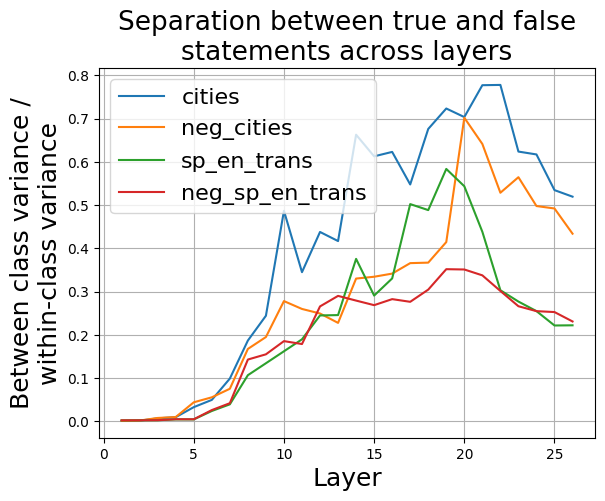
The image is a line chart displaying the ratio of "Between class variance / within-class variance" across 26 layers (0-25) for four different datasets or conditions. The chart illustrates how the separability between true and false statements evolves through the layers of a model, with higher values indicating greater separation.
### Components/Axes
* **Chart Title:** "Separation between true and false statements across layers"
* **Y-Axis Label:** "Between class variance / within-class variance"
* **Scale:** Linear, ranging from 0.0 to 0.8.
* **Major Ticks:** 0.0, 0.1, 0.2, 0.3, 0.4, 0.5, 0.6, 0.7, 0.8.
* **X-Axis Label:** "Layer"
* **Scale:** Linear, representing discrete layers from 0 to 25.
* **Major Ticks:** 0, 5, 10, 15, 20, 25.
* **Legend:** Located in the top-left corner of the chart area. It contains four entries, each associated with a colored line:
1. `cities` (Blue line)
2. `neg_cities` (Orange line)
3. `sp_en_trans` (Green line)
4. `neg_sp_en_trans` (Red line)
* **Grid:** A light gray grid is present, aligned with the major ticks on both axes.
### Detailed Analysis
The chart plots four data series, each showing a distinct trend across the layers.
**1. `cities` (Blue Line):**
* **Trend:** Starts near zero, begins a steep ascent around layer 5, exhibits high volatility with several local peaks and troughs, reaches its global maximum, then declines sharply after layer 20.
* **Key Data Points (Approximate):**
* Layer 0-4: ~0.0
* Layer 5: ~0.05
* Layer 10: ~0.48 (first major peak)
* Layer 11: ~0.35 (trough)
* Layer 14: ~0.66 (peak)
* Layer 17: ~0.55 (trough)
* Layer 20: ~0.78 (global maximum)
* Layer 21: ~0.77
* Layer 25: ~0.52
**2. `neg_cities` (Orange Line):**
* **Trend:** Follows a similar overall shape to the `cities` line but is consistently lower in value. It rises, peaks around the same layer as `cities`, and then declines.
* **Key Data Points (Approximate):**
* Layer 0-4: ~0.0
* Layer 5: ~0.05
* Layer 10: ~0.28
* Layer 14: ~0.33
* Layer 19: ~0.41
* Layer 20: ~0.70 (global maximum)
* Layer 21: ~0.53
* Layer 25: ~0.44
**3. `sp_en_trans` (Green Line):**
* **Trend:** Rises later than the `cities` lines, shows significant volatility, peaks earlier than the `cities` series, and then declines to a level similar to `neg_sp_en_trans`.
* **Key Data Points (Approximate):**
* Layer 0-6: ~0.0
* Layer 7: ~0.05
* Layer 10: ~0.18
* Layer 14: ~0.38 (peak)
* Layer 15: ~0.29 (trough)
* Layer 19: ~0.58 (global maximum)
* Layer 20: ~0.54
* Layer 25: ~0.22
**4. `neg_sp_en_trans` (Red Line):**
* **Trend:** The lowest and smoothest of the four lines. It shows a gradual, modest increase, a broad peak, and a gentle decline.
* **Key Data Points (Approximate):**
* Layer 0-6: ~0.0
* Layer 7: ~0.04
* Layer 10: ~0.19
* Layer 14: ~0.28
* Layer 19: ~0.35 (global maximum)
* Layer 20: ~0.34
* Layer 25: ~0.24
### Key Observations
1. **Hierarchy of Separation:** The `cities` condition consistently achieves the highest variance ratio, followed by `neg_cities`, then `sp_en_trans`, with `neg_sp_en_trans` being the lowest. This hierarchy holds for most layers beyond the initial ones.
2. **Peak Layer:** All four series reach their maximum value around layers 19-20, suggesting this is the point in the model where the distinction between true and false statements is most pronounced for these datasets.
3. **Effect of Negation:** For both the `cities` and `sp_en_trans` datasets, the negated versions (`neg_cities`, `neg_sp_en_trans`) show lower separation values than their non-negated counterparts across nearly all layers.
4. **Volatility:** The `cities` and `sp_en_trans` lines are more jagged, indicating greater layer-to-layer fluctuation in the separability metric compared to the smoother `neg_sp_en_trans` line.
5. **Convergence at End:** By layer 25, the separation values for `sp_en_trans` and `neg_sp_en_trans` converge to a similar low level (~0.22-0.24), while `cities` and `neg_cities` remain higher but are also declining.
### Interpretation
This chart likely visualizes the internal representations of a neural network processing factual statements. The metric "Between class variance / within-class variance" is a measure of how well the model's activations can distinguish (have high between-class variance) between true and false statements while keeping activations for the same class consistent (low within-class variance).
* **What the data suggests:** The model develops increasingly strong discriminative power between truth and falsehood as information propagates through its layers, peaking in the later layers (19-20). This discriminative ability is not uniform across data types; it is strongest for the `cities` dataset.
* **How elements relate:** The consistent gap between each dataset and its negated version implies that processing negation ("not true") complicates the model's internal representation, making the true/false distinction less clear-cut. The similar peak layer across all conditions suggests a common architectural point where high-level semantic features are most sharply defined.
* **Notable anomalies/trends:** The sharp decline after layer 20 for all series is notable. It could indicate that the very final layers are involved in a different type of processing (e.g., preparing for output generation) where this specific type of variance separation is no longer the primary objective. The high volatility in the `cities` line might reflect more complex or variable processing for that specific domain of knowledge.