## Bar Chart: Runtime Comparison Between Heat-3D and ATAX Configurations
### Overview
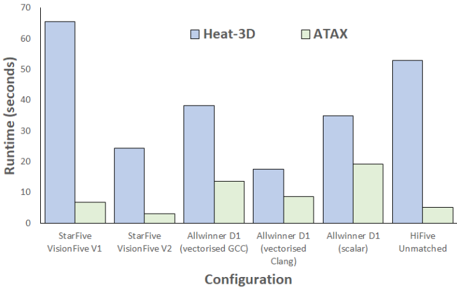
The chart compares runtime times (in seconds) for two configurations, **Heat-3D** (blue bars) and **ATAX** (green bars), across six hardware/software setups. The x-axis lists configurations, while the y-axis represents runtime duration. Heat-3D consistently shows significantly higher runtime than ATAX across all configurations.
### Components/Axes
- **X-axis (Configuration)**:
- StarFive VisionFive V1
- StarFive VisionFive V2
- Allwinner D1 (vectorised GCC)
- Allwinner D1 (vectorised Clang)
- Allwinner D1 (scalar)
- HiFive Unmatched
- **Y-axis (Runtime)**: 0–70 seconds (linear scale).
- **Legend**:
- **Heat-3D**: Blue bars (top-right placement).
- **ATAX**: Green bars (top-right placement).
### Detailed Analysis
1. **StarFive VisionFive V1**:
- Heat-3D: ~65 seconds (tallest blue bar).
- ATAX: ~6 seconds (shortest green bar).
2. **StarFive VisionFive V2**:
- Heat-3D: ~24 seconds.
- ATAX: ~3 seconds.
3. **Allwinner D1 (vectorised GCC)**:
- Heat-3D: ~38 seconds.
- ATAX: ~14 seconds (tallest green bar).
4. **Allwinner D1 (vectorised Clang)**:
- Heat-3D: ~18 seconds.
- ATAX: ~9 seconds.
5. **Allwinner D1 (scalar)**:
- Heat-3D: ~34 seconds.
- ATAX: ~19 seconds (second-tallest green bar).
6. **HiFive Unmatched**:
- Heat-3D: ~52 seconds.
- ATAX: ~5 seconds.
### Key Observations
- **Heat-3D Dominance**: Heat-3D runtime is 10–20x higher than ATAX in all cases.
- **ATAX Outliers**:
- Allwinner D1 (vectorised GCC) has the highest ATAX runtime (~14s), suggesting potential inefficiency or workload-specific behavior.
- Allwinner D1 (scalar) shows the second-highest ATAX runtime (~19s), indicating scalar optimizations may not fully mitigate overhead.
- **StarFive VisionFive V2**: ATAX runtime is the lowest (~3s), possibly due to hardware/software synergy.
- **HiFive Unmatched**: Heat-3D runtime is the second-highest (~52s), but ATAX remains efficient (~5s).
### Interpretation
The data suggests **ATAX is significantly more efficient** than Heat-3D across all tested configurations, with runtime differences ranging from 4x (HiFive Unmatched) to 10x (StarFive VisionFive V1). The Allwinner D1 (vectorised GCC) configuration exhibits an anomaly: while Heat-3D runtime is moderate (~38s), ATAX runtime is unusually high (~14s), potentially indicating workload sensitivity or suboptimal vectorisation. The StarFive VisionFive V2’s minimal ATAX runtime (~3s) highlights its suitability for ATAX workloads, possibly due to hardware acceleration or optimized drivers. These results could inform decisions about hardware selection for compute-intensive tasks, with ATAX being the preferred choice for efficiency.