## Bar Chart: Runtime Comparison of Heat-3D and ATAX
### Overview
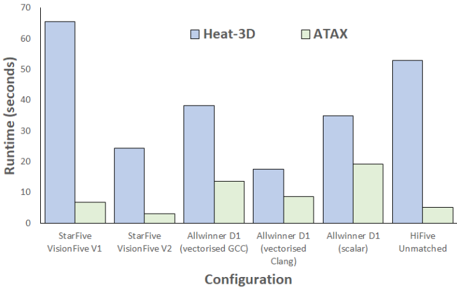
This bar chart compares the runtime (in seconds) of two algorithms, Heat-3D and ATAX, across six different configurations. The chart uses paired bars for each configuration, with Heat-3D represented in blue and ATAX in light green. The x-axis represents the configuration, and the y-axis represents the runtime in seconds.
### Components/Axes
* **X-axis:** Configuration. Labels are: "StarFive VisionFive V1", "StarFive VisionFive V2", "Allwinner D1 (vectorised GCC)", "Allwinner D1 (vectorised Clang)", "Allwinner D1 (scalar)", "HiFive Unmatched".
* **Y-axis:** Runtime (seconds). Scale ranges from 0 to 70, with increments of 10.
* **Legend:** Located at the top-right of the chart.
* Blue bar: Heat-3D
* Light Green bar: ATAX
### Detailed Analysis
Let's analyze each configuration and the corresponding runtimes for both algorithms.
1. **StarFive VisionFive V1:**
* Heat-3D: Approximately 68 seconds. (Blue bar reaches almost the 70-second mark)
* ATAX: Approximately 7 seconds. (Light green bar reaches the 10-second mark)
2. **StarFive VisionFive V2:**
* Heat-3D: Approximately 24 seconds. (Blue bar reaches the 25-second mark)
* ATAX: Approximately 5 seconds. (Light green bar is slightly above the 5-second mark)
3. **Allwinner D1 (vectorised GCC):**
* Heat-3D: Approximately 39 seconds. (Blue bar reaches the 40-second mark)
* ATAX: Approximately 12 seconds. (Light green bar reaches the 10-second mark, and extends a bit further)
4. **Allwinner D1 (vectorised Clang):**
* Heat-3D: Approximately 17 seconds. (Blue bar reaches the 20-second mark)
* ATAX: Approximately 8 seconds. (Light green bar reaches the 10-second mark)
5. **Allwinner D1 (scalar):**
* Heat-3D: Approximately 31 seconds. (Blue bar reaches the 30-second mark, and extends a bit further)
* ATAX: Approximately 15 seconds. (Light green bar reaches the 15-second mark)
6. **HiFive Unmatched:**
* Heat-3D: Approximately 55 seconds. (Blue bar reaches the 55-second mark)
* ATAX: Approximately 6 seconds. (Light green bar reaches the 10-second mark)
### Key Observations
* Heat-3D consistently exhibits longer runtimes than ATAX across all configurations.
* The runtime of Heat-3D varies significantly depending on the configuration, with the largest runtime observed on the "StarFive VisionFive V1" configuration (approximately 68 seconds) and the smallest on the "Allwinner D1 (vectorised Clang)" configuration (approximately 17 seconds).
* The runtime of ATAX also varies, but to a lesser extent than Heat-3D.
* The difference in runtime between Heat-3D and ATAX is most pronounced on the "StarFive VisionFive V1" configuration.
### Interpretation
The data suggests that ATAX is generally a more efficient algorithm than Heat-3D, as it consistently achieves lower runtimes. However, the performance of both algorithms is heavily influenced by the underlying hardware configuration. The "StarFive VisionFive V1" configuration appears to be particularly challenging for Heat-3D, resulting in a significantly longer runtime compared to other configurations. The vectorization of the GCC compiler seems to have a positive impact on the performance of Heat-3D, as the runtime is reduced when using the "Allwinner D1 (vectorised GCC)" configuration compared to the "Allwinner D1 (scalar)" configuration. The choice of compiler (GCC vs. Clang) also affects performance, with Clang showing slightly better results for Heat-3D on the Allwinner D1. This data could be used to inform decisions about algorithm selection and hardware configuration optimization for specific applications. The large difference in runtime on the StarFive VisionFive V1 suggests a potential bottleneck or incompatibility with that specific hardware.