\n
## Diagram: Reasoning and Answer Extraction Process
### Overview
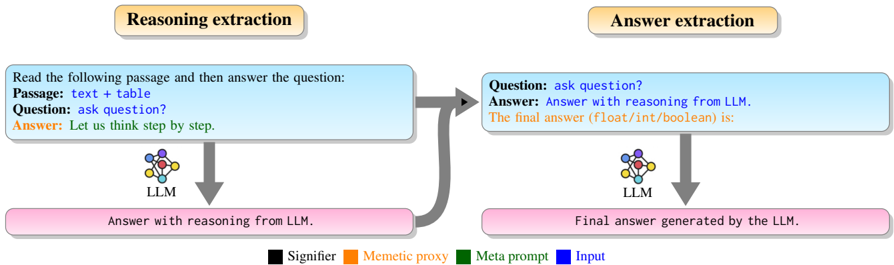
The image depicts a diagram illustrating a two-stage process: "Reasoning extraction" and "Answer extraction," both utilizing a Large Language Model (LLM). The diagram shows the flow of information from input through the LLM to generate an answer. The diagram uses color-coding to represent different types of input and output.
### Components/Axes
The diagram consists of two main rectangular blocks labeled "Reasoning extraction" (left) and "Answer extraction" (right). Each block contains text describing the process and an LLM representation (a cluster of colored spheres with arrows). Below each block is a pink rectangular area describing the output. A legend at the bottom explains the color-coding:
* **Black:** Signifier
* **Yellow:** Memetic proxy
* **Light Blue:** Meta prompt
* **Blue:** Input
An arrow connects the "Reasoning extraction" block to the "Answer extraction" block, indicating the flow of information.
### Detailed Analysis or Content Details
**Reasoning Extraction Block:**
* **Title:** Reasoning extraction (top-left)
* **Text:** "Read the following passage and then answer the question: Passage: text + table Question: ask question? Answer: Let us think step by step."
* **LLM Representation:** A cluster of spheres with arrows.
* **Output Area:** "Answer with reasoning from LLM." (pink rectangle)
**Answer Extraction Block:**
* **Title:** Answer extraction (top-right)
* **Text:** "Question: ask question? Answer: Answer with reasoning from LLM. The final answer (float/int/boolean) is:"
* **LLM Representation:** A cluster of spheres with arrows.
* **Output Area:** "Final answer generated by the LLM." (pink rectangle)
**Flow:** A curved arrow originates from the bottom of the "Reasoning extraction" block and points towards the "Answer extraction" block.
### Key Observations
The diagram highlights a two-step process where the LLM first performs reasoning based on a passage and question, and then generates a final answer. The color-coding clearly distinguishes between different types of input (text, table, question) and the LLM's role in processing this information. The output of the reasoning stage feeds into the answer extraction stage.
### Interpretation
This diagram illustrates a common approach in utilizing LLMs for complex tasks. The separation into "Reasoning extraction" and "Answer extraction" suggests a deliberate attempt to improve the quality and reliability of the LLM's responses. By first prompting the LLM to "think step by step," the system encourages more thorough and logical reasoning before generating a final answer. The inclusion of "float/int/boolean" in the answer extraction block indicates the LLM can produce different data types as output. The color-coding provides a visual representation of the data flow and the different components involved in the process. The diagram suggests a pipeline architecture where the output of one stage becomes the input for the next, allowing for a more controlled and interpretable process. The use of "Memetic proxy" is interesting and suggests a concept of transferring knowledge or patterns within the LLM. The diagram doesn't provide specific data or numerical values, but rather a conceptual framework for how an LLM can be used to solve problems.