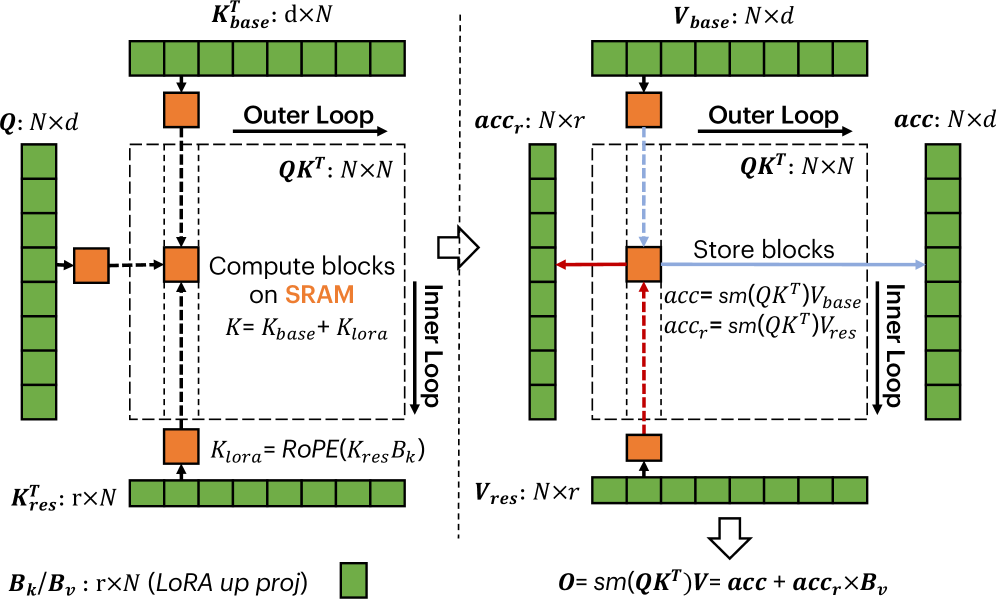
## Diagram: Attention Mechanism with LoRA Integration
### Overview
The diagram illustrates a two-stage attention computation process combining base attention and low-rank adaptation (LoRA) components. It shows data flow through outer and inner loops, with explicit memory storage and computation steps.
### Components/Axes
**Left Panel (Outer Loop):**
- **Inputs:**
- `Q`: Query matrix (N×d)
- `K_base`: Base key matrix (d×N)
- `V_base`: Base value matrix (N×d)
- `K_res`: Residual key matrix (r×N)
- **Operations:**
- `K_lora = RoPE(K_res B_k)` (LoRA-updated keys)
- `K = K_base + K_lora` (Combined keys)
- `QK^T`: N×N attention score matrix
- **Output:**
- `acc_r`: Residual attention component (N×r)
**Right Panel (Inner Loop):**
- **Inputs:**
- `acc_r`: Residual attention (N×r)
- `V_res`: Residual value matrix (N×r)
- **Operations:**
- `acc = sm(QK^T)V_base` (Base attention output)
- `acc_r = sm(QK^T)V_res` (Residual attention output)
- **Final Output:**
- `O = acc + acc_r × B_v` (Combined attention result)
**Legend/Color Coding:**
- Green blocks: Matrix dimensions
- Orange blocks: Computation operations
- Blue arrows: Data flow
- Red dashed lines: Attention score propagation
### Detailed Analysis
1. **Memory Optimization:**
- Base matrices (`K_base`, `V_base`) stored in SRAM
- Residual matrices (`K_res`, `V_res`) processed in inner loop
- LoRA adaptation applied via `RoPE(K_res B_k)`
2. **Attention Computation:**
- Outer loop computes base attention scores (`QK^T`)
- Inner loop calculates residual attention via `sm(QK^T)V_res`
- Final output combines base (`acc`) and residual (`acc_r`) components
3. **Dimensionality:**
- Base matrices: N×d (standard attention)
- Residual matrices: N×r (low-rank adaptation)
- Final output: N×d (matches input dimension)
### Key Observations
- **Efficiency:** Residual matrices (r×N) are smaller than base matrices (d×N), reducing memory requirements
- **Modularity:** Base and residual components processed separately but combined in final output
- **LoRA Integration:** `K_lora` and `V_res` represent low-rank adaptations to base matrices
- **Memory Access Pattern:** Explicit storage of blocks suggests hardware-aware optimization
### Interpretation
This diagram demonstrates a hybrid attention mechanism that:
1. Maintains standard transformer attention (`QK^T` computation)
2. Adds low-rank adaptations via LoRA (`K_lora`, `V_res`)
3. Optimizes memory usage through block storage and separate processing loops
4. Preserves output dimensionality while enabling parameter-efficient fine-tuning
The architecture suggests a design for efficient large language model inference/training, where:
- Base attention handles general context
- LoRA adaptations capture task-specific modifications
- Separate computation paths enable parallel processing
- Memory optimization reduces hardware requirements
The use of `RoPE` (Rotary Positional Encoding) on residual keys indicates positional awareness in the low-rank adaptations. The final output combines both base and adapted attention through element-wise addition and scaling by `B_v`, maintaining compatibility with standard transformer architectures while enabling efficient parameter updates.