## Photograph: The Iron Pillar of Delhi
### Overview
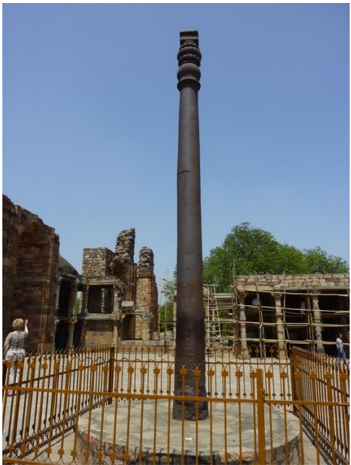
The image is a daytime photograph of the famous Iron Pillar of Delhi, located within the Qutb complex in Mehrauli, Delhi, India. The pillar stands as the central subject, surrounded by a protective fence, with ancient stone ruins and a clear blue sky in the background. The scene is captured from a ground-level perspective, emphasizing the pillar's height and its archaeological setting.
### Components/Visual Elements
1. **Central Subject: The Iron Pillar**
* **Material & Color:** A tall, dark, metallic column with a smooth, slightly reflective surface. Its color is a deep, dark brown-black, consistent with weathered iron.
* **Shape & Structure:** It is a single, monolithic shaft that tapers slightly as it rises. The top features a decorative capital with multiple fluted or ringed sections, culminating in a flattened, bulbous finial.
* **Position:** Centered horizontally in the frame, extending from the lower third to the top edge of the image.
2. **Protective Barrier**
* **Structure:** A low, ornate metal fence encircles the base of the pillar.
* **Design:** Composed of vertical bars with decorative, pointed finials at the top, connected by horizontal rails. The fence forms a square or rectangular perimeter.
* **Color & Condition:** The fence is painted a faded yellow or gold color, showing signs of weathering and rust in places.
3. **Background: Archaeological Ruins**
* **Left Side:** The remains of a large, arched stone structure, likely part of an ancient mosque (the Quwwat-ul-Islam Mosque). The stonework is a weathered, sandy brown color.
* **Center/Right Background:** Further ruined stone walls and pillars. Some sections are covered in green scaffolding, indicating ongoing preservation or restoration work.
* **Ground:** The area around the pillar and ruins appears to be a mix of stone paving and bare earth.
4. **Sky & Lighting**
* **Sky:** A clear, cloudless, bright blue sky occupies the upper portion of the image.
* **Lighting:** The scene is illuminated by strong, direct sunlight, casting sharp shadows. The sun appears to be high and slightly to the right, as the right side of the pillar is more brightly lit.
5. **Human Figures (for scale)**
* **Left Foreground:** A person with light-colored hair, wearing a grey top, is partially visible, looking towards the ruins.
* **Right Background:** Another person in a blue shirt is visible near the scaffolding.
### Detailed Analysis
* **Pillar Details:** The pillar's surface appears remarkably smooth and free of significant corrosion for its age, a well-known characteristic. The decorative capital consists of a series of rounded, fluted rings below a larger, inverted lotus-shaped element and a final cylindrical top.
* **Spatial Relationships:** The pillar is the focal point, positioned in an open courtyard. The fence creates a clear boundary between the artifact and visitors. The ruins frame the pillar, providing historical context. The scaffolding on the right indicates active conservation efforts at the site.
* **Textual Information:** **There is no visible textual information, labels, charts, diagrams, or data tables embedded in this photograph.** The image is purely a visual record of a physical monument and its surroundings.
### Key Observations
1. **Monument Preservation:** The primary subject, the iron pillar, is actively protected by a fence, highlighting its cultural and historical value.
2. **Active Conservation:** The presence of scaffolding on the background structures shows that the archaeological site is under active maintenance.
3. **Scale and Context:** The human figures provide a sense of scale, emphasizing the pillar's considerable height (approximately 7.2 meters or 23 feet, based on known facts about the monument).
4. **Material Contrast:** The dark, metallic pillar stands in stark visual contrast to the light-colored, sandy stone of the surrounding ruins and the bright blue sky.
### Interpretation
This photograph documents a specific moment at a world-renowned archaeological site. The image's primary informational value is not in extracted data points but in its visual testimony to:
* **Historical Engineering:** The pillar itself is a testament to ancient Indian metallurgical skill, famous for its resistance to rust over centuries.
* **Archaeological Context:** It shows the pillar *in situ*, within the complex of ruins of the Qutb Minar complex, a UNESCO World Heritage Site. This spatial relationship is crucial for understanding its original purpose and setting.
* **Modern Stewardship:** The fence and scaffolding represent contemporary efforts to preserve and protect this ancient artifact for future generations. The image captures the intersection of ancient history and modern conservation practice.
**Conclusion:** While the image contains no extractable text or numerical data, it provides rich visual information about the physical state, setting, and preservation context of the Iron Pillar of Delhi. A technical document would use this image to illustrate the monument's appearance, its immediate environment, and the measures taken for its protection.