\n
## Diagram: Zinogre Attack Prediction System
### Overview
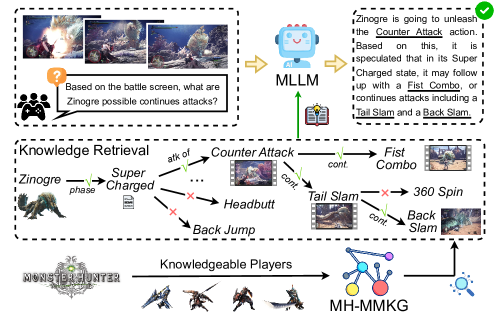
This diagram illustrates a system for predicting Zinogre's attacks in a game, likely Monster Hunter. It depicts a flow of information from the game battle screen to a model (MLLM) that retrieves knowledge and predicts possible attack continuations, ultimately informing knowledgeable players. The diagram is divided into sections representing input, processing, and output.
### Components/Axes
The diagram contains the following key components:
* **Input:** Game Battle Screen (images of Zinogre in action), Controller icon with a question mark.
* **Processing:** MLLM (Model), Knowledge Retrieval, Attack Flow Diagram.
* **Output:** Predicted Attack Sequence (Fist Combo, Tail Slam, Back Slam, 360 Spin), Knowledgeable Players (represented by player icons), MH-MMKG.
* **Labels:** "Zinogre", "Super Charged", "Headbutt", "Back Jump", "Counter Attack", "Fist Combo", "Tail Slam", "Back Slam", "360 Spin", "atk of", "cont.", "phase", "Based on the battle screen, what are Zinogre possible continues attacks?", "Zinogre is going to unleash the Counter Attack action. Based on this, it speculated that in its Super Charged state, it may follow up with a Fist Combo, or continues attacks including a Tail Slam and a Back Slam."
* **Icons:** Monster Hunter logo, robot icon representing MLLM, book icon representing knowledge.
### Detailed Analysis or Content Details
The diagram shows a flow of information starting from the game battle screen.
1. **Input:** The battle screen images of Zinogre are presented as input, along with a question: "Based on the battle screen, what are Zinogre possible continues attacks?". A controller icon suggests player input.
2. **MLLM Processing:** This input is fed into an MLLM (Model), represented by a robot icon. The MLLM processes the information and retrieves knowledge. A checkmark indicates a successful prediction.
3. **Knowledge Retrieval & Attack Flow:** The core of the system is a directed graph illustrating Zinogre's attack patterns.
* Zinogre starts in a "phase" of "Super Charged".
* From "Super Charged", Zinogre can transition to "Counter Attack" (green arrow labeled "atk of"), "Headbutt" (red arrow), or "Back Jump" (red arrow).
* "Counter Attack" leads to "Fist Combo" (green arrow labeled "cont.").
* "Tail Slam" leads to "360 Spin" (green arrow labeled "cont.").
* "Headbutt" leads to "Tail Slam" (green arrow labeled "cont.").
* "Back Jump" leads to "Back Slam" (green arrow labeled "cont.").
4. **Output:** The predicted attack sequences ("Fist Combo", "Tail Slam", "Back Slam", "360 Spin") are displayed alongside images of Zinogre performing those attacks. These predictions are then conveyed to "Knowledgeable Players" (represented by multiple player icons). The output also connects to "MH-MMKG".
### Key Observations
* The diagram emphasizes the prediction of attack continuations based on Zinogre's "Super Charged" state.
* The use of color-coded arrows (green for continuation, red for alternative paths) clearly indicates the flow of attack sequences.
* The system appears to leverage both visual input (battle screen images) and knowledge retrieval to make predictions.
* The "MH-MMKG" component is not fully explained but seems to be a knowledge base or system related to Monster Hunter.
### Interpretation
This diagram represents a system designed to assist players in anticipating Zinogre's attacks in Monster Hunter. The MLLM acts as a bridge between the game's visual information and a knowledge base of attack patterns. By analyzing the battle screen, the MLLM can predict likely attack continuations, providing players with a strategic advantage. The diagram highlights the importance of understanding Zinogre's "Super Charged" state as a key indicator of future actions. The system's effectiveness relies on the accuracy of the knowledge retrieval and the MLLM's ability to correctly interpret the visual cues from the battle screen. The inclusion of "MH-MMKG" suggests a broader knowledge management system supporting the attack prediction process. The diagram is a conceptual illustration of a complex system, likely used for research or development purposes. It doesn't provide numerical data, but rather a qualitative representation of the system's functionality.