\n
## Bar Chart: Number of HE Review Papers Published Per Year (2020-2025)
### Overview
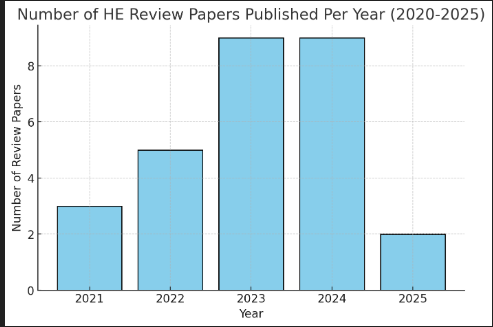
This bar chart displays the number of "HE Review Papers" published each year from 2021 to 2025. The chart uses vertical bars to represent the number of papers, with the year on the horizontal axis.
### Components/Axes
* **Title:** Number of HE Review Papers Published Per Year (2020-2025) - positioned at the top-center.
* **X-axis:** Year - labeled at the bottom-center. Markers indicate the years 2021, 2022, 2023, 2024, and 2025.
* **Y-axis:** Number of Review Papers - labeled on the left side. The scale ranges from 0 to 9, with increments of 1.
* **Bars:** Light blue bars representing the number of papers published each year.
### Detailed Analysis
The chart shows the following data points:
* **2021:** The bar height is approximately 3.2.
* **2022:** The bar height is approximately 5.1.
* **2023:** The bar height is approximately 9.1.
* **2024:** The bar height is approximately 9.1.
* **2025:** The bar height is approximately 2.1.
The trend shows an increase in the number of papers published from 2021 to 2023, a plateau in 2023 and 2024, and a decrease in 2025.
### Key Observations
* The highest number of papers were published in 2023 and 2024, with approximately 9 papers each.
* The lowest number of papers were published in 2021, with approximately 3 papers.
* There is a significant increase in publications between 2021 and 2022.
* There is a sharp decrease in publications from 2024 to 2025.
### Interpretation
The data suggests a period of growth in the publication of "HE Review Papers" from 2021 to 2023, followed by a stabilization in 2023 and 2024, and a subsequent decline in 2025. This could indicate a surge of interest in the topic during those years, potentially due to a specific event or funding initiative, followed by a waning of that interest or a shift in research focus. The sharp drop in 2025 is particularly noteworthy and might warrant further investigation to understand the underlying causes. The chart provides a clear visual representation of the publication trend over the five-year period, allowing for easy identification of peak years and periods of decline. The "HE" in "HE Review Papers" is not defined, but it is likely an abbreviation for a specific field or topic.