TECHNICAL ASSET FINGERPRINT
b3debb84e7dc61e8c689000c
Click to view fullscreen
Press ESC or click to close
FOUND IN PAPERS
EXPERT: gemini-2.0-flash VERSION 1
RUNTIME: nugit/gemini/gemini-2.0-flash
INTEL_VERIFIED
## Communication Diagram: Prompt Engineering Strategies
### Overview
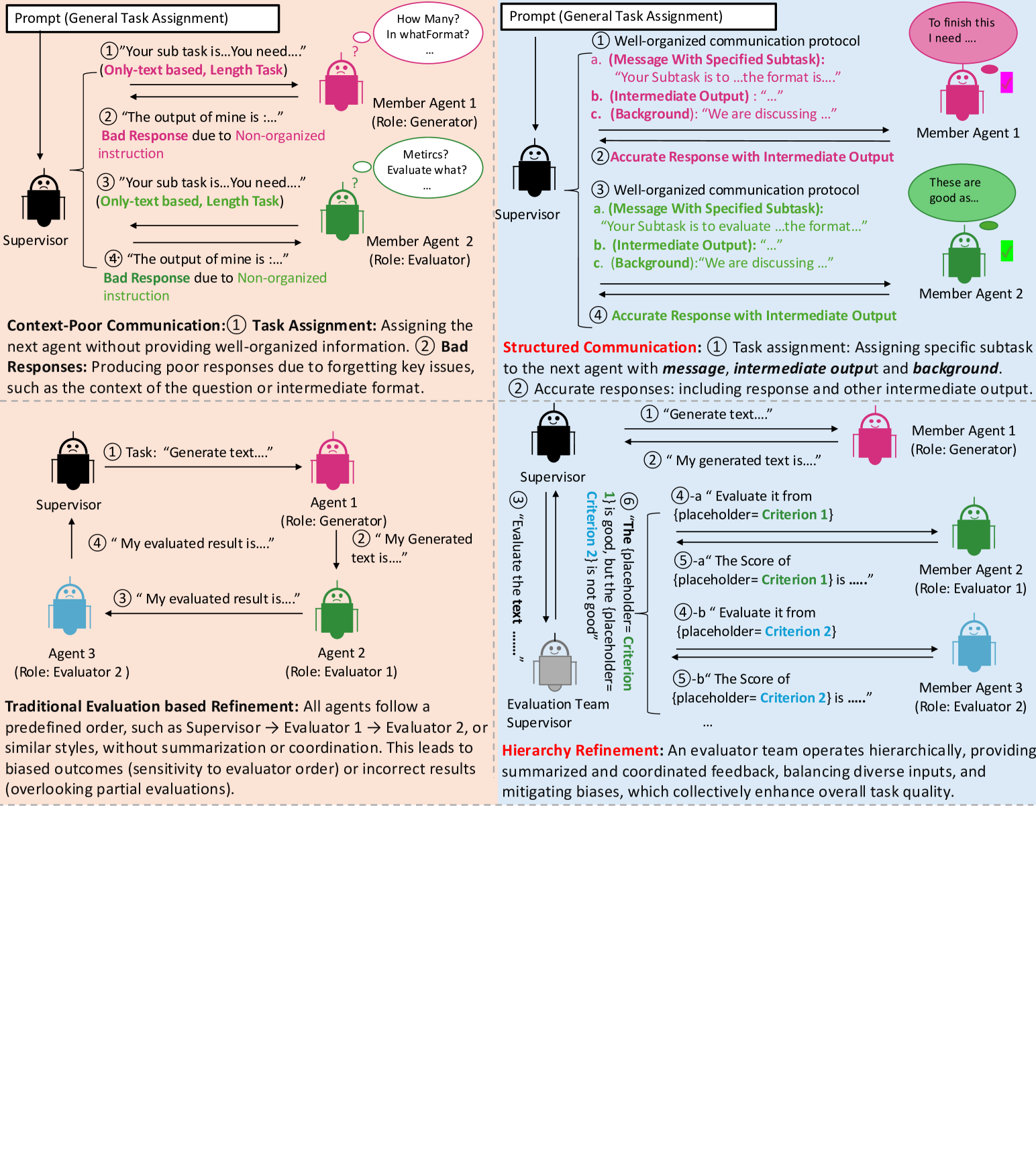
The image presents two contrasting approaches to prompt engineering for multi-agent systems: Context-Poor Communication with Traditional Evaluation and Structured Communication with Hierarchy Refinement. It illustrates the flow of information and tasks between a supervisor and multiple agents (generators and evaluators) in each approach, highlighting the differences in task assignment, response quality, and overall coordination.
### Components/Axes
**Left Side: Context-Poor Communication**
* **Roles:** Supervisor, Agent 1 (Generator), Agent 2 (Evaluator 1), Agent 3 (Evaluator 2)
* **Flow:** Sequential, Supervisor -> Agent 1 -> Agent 2 -> Agent 3 -> Supervisor
* **Task Assignment:** General, lacking specific details or context.
* **Responses:** Prone to errors due to non-organized instruction and forgotten context.
**Right Side: Structured Communication**
* **Roles:** Supervisor, Member Agent 1 (Generator), Member Agent 2 (Evaluator 1), Member Agent 3 (Evaluator 2), Evaluation Team Supervisor
* **Flow:** Iterative, Supervisor <-> Agent 1, Supervisor <-> Agent 2, Supervisor <-> Agent 3, with feedback loops.
* **Task Assignment:** Specific subtasks with message, intermediate output, and background information.
* **Responses:** Accurate, including response and other intermediate output.
* **Evaluation:** Hierarchical, with summarized and coordinated feedback.
### Detailed Analysis or ### Content Details
**Context-Poor Communication (Left Side)**
1. **Task Assignment:**
* ① Task: "Generate text...." (Supervisor to Agent 1)
* ① "Your sub task is... You need...." (Only-text based, Length Task) (Supervisor to Member Agent 1)
* ③ "Your sub task is... You need...." (Only-text based, Length Task) (Supervisor to Member Agent 2)
2. **Responses:**
* ② "My Generated text is...." (Agent 1 to Agent 2)
* ② "The output of mine is :..." Bad Response due to Non-organized instruction (Member Agent 1)
* ④ "My evaluated result is...." (Agent 3 to Supervisor)
* ④ "The output of mine is :..." Bad Response due to Non-organized instruction (Supervisor to Member Agent 2)
* ③ " My evaluated result is...." (Agent 2 to Agent 3)
**Structured Communication (Right Side)**
1. **Task Assignment:**
* ① "Generate text...." (Supervisor to Member Agent 1)
* ① Well-organized communication protocol (Supervisor to Member Agent 1):
* a. (Message With Specified Subtask): "Your Subtask is to ...the format is...."
* b. (Intermediate Output) : "..."
* c. (Background): "We are discussing ..."
* ③ Well-organized communication protocol (Supervisor to Member Agent 2):
* a. (Message With Specified Subtask): "Your Subtask is to evaluate ...the format..."
* b. (Intermediate Output): "..."
* c. (Background): "We are discussing ..."
* ③ "Evaluate the text ......" (Evaluation Team Supervisor to Member Agents 1, 2, 3)
2. **Responses:**
* ② "My generated text is...." (Member Agent 1 to Member Agent 2)
* ② Accurate Response with Intermediate Output (Member Agent 1)
* ④ Accurate Response with Intermediate Output (Member Agent 2)
* ④-a "Evaluate it from {placeholder= Criterion 1}" (Member Agent 2 to Member Agent 3)
* ⑤-a "The Score of {placeholder= Criterion 1} is ....." (Member Agent 2 to Member Agent 3)
* ④-b "Evaluate it from {placeholder= Criterion 2}" (Member Agent 3 to Evaluation Team Supervisor)
* ⑤-b "The Score of {placeholder= Criterion 2} is ....." (Member Agent 3 to Evaluation Team Supervisor)
* ⑥ "The {placeholder= Criterion 1} is good, but the {placeholder= Criterion 2} is not good" (Evaluation Team Supervisor to Supervisor)
### Key Observations
* **Context-Poor Communication:** Results in bad responses due to non-organized instruction and lack of context. The agents seem to be working in isolation, leading to potential inconsistencies and errors.
* **Structured Communication:** Emphasizes well-organized communication protocols, specific subtasks, and intermediate outputs. This approach promotes accurate responses and coordinated feedback, leading to higher quality results.
* **Hierarchy Refinement:** The structured approach incorporates a hierarchical evaluation process, where an evaluation team supervisor provides summarized and coordinated feedback, balancing diverse inputs and mitigating biases.
### Interpretation
The diagram illustrates the significant impact of prompt engineering on the effectiveness of multi-agent systems. Context-poor communication, characterized by vague task assignments and a lack of coordination, leads to poor responses and potentially biased outcomes. In contrast, structured communication, with its emphasis on clear instructions, intermediate outputs, and hierarchical evaluation, fosters collaboration, reduces errors, and enhances overall task quality. The diagram suggests that careful prompt engineering is crucial for harnessing the full potential of multi-agent systems, particularly in complex tasks requiring diverse inputs and coordinated feedback. The "Hierarchy Refinement" approach is superior because it addresses the limitations of traditional evaluation methods by promoting a more holistic and unbiased assessment of the generated content.
DECODING INTELLIGENCE...
EXPERT: nemotron-free VERSION 1
RUNTIME: free/nvidia/nemotron-nano-12b-v2-vl:free
INTEL_VERIFIED
## Diagram: Communication Protocol Comparison and Evaluation Methods
### Overview
The image is a comparative diagram illustrating two communication protocols ("Context-Poor Communication" and "Structured Communication") and two evaluation methodologies ("Traditional Evaluation based Refinement" and "Hierarchy Refinement"). It uses color-coded robotic agents (pink, green, blue) to represent roles (Generator, Evaluator, Supervisor) and arrows to depict workflows. The diagram emphasizes structured communication's advantages in task clarity and evaluation robustness.
---
### Components/Axes
#### Left Side: Context-Poor Communication
1. **Task Assignment**
- Supervisor assigns ambiguous tasks (e.g., "Your sub task is... You need...").
- Member Agent 1 (Generator) produces a "Bad Response" due to non-organized instructions.
- Member Agent 2 (Evaluator) critiques the response using vague metrics.
2. **Traditional Evaluation based Refinement**
- Linear workflow: Supervisor → Agent 1 (Generator) → Agent 2 (Evaluator 1) → Agent 3 (Evaluator 2).
- Criticism: Biased outcomes due to evaluator order sensitivity and lack of coordination.
#### Right Side: Structured Communication
1. **Well-Organized Protocol**
- Task assignment includes **specified subtasks**, **intermediate outputs**, and **background context**.
- Example: "Your subtask is to... format is..." with structured feedback loops.
2. **Accurate Response with Intermediate Output**
- Member Agent 1 (Generator) produces text with intermediate outputs (e.g., "We are discussing...").
- Member Agent 2 (Evaluator) provides structured feedback (e.g., "These are good as...").
#### Bottom: Evaluation Methodologies
1. **Traditional Evaluation**
- Linear evaluation chain: Supervisor → Evaluator 1 → Evaluator 2.
- Criticism: Sensitivity to evaluator order and lack of coordination.
2. **Hierarchy Refinement**
- Hierarchical evaluator team with summarized/coordinated feedback.
- Mitigates biases by balancing diverse inputs and overseeing partial evaluations.
---
### Detailed Analysis
#### Context-Poor Communication
- **Task Assignment**: Ambiguous instructions lead to poor responses (e.g., "How Many? In what Format?").
- **Bad Responses**: Generated due to missing context (e.g., question context, intermediate format).
- **Evaluation**: Evaluators use vague metrics ("Metrics? Evaluate what?") without structured criteria.
#### Structured Communication
- **Specified Subtasks**: Clear task breakdown (e.g., "Evaluate it from placeholder=Criterion 1").
- **Intermediate Outputs**: Arrows show iterative feedback (e.g., "The Score of placeholder=Criterion 1 is...").
- **Coordinated Feedback**: Evaluators reference specific criteria (e.g., "placeholder=Criterion 2").
#### Evaluation Methodologies
- **Traditional Evaluation**:
- Agent 3 (Evaluator 2) critiques Agent 1’s output without oversight.
- Risk of biased outcomes due to sequential, uncoordinated evaluations.
- **Hierarchy Refinement**:
- Evaluators operate hierarchically, with summaries and coordination.
- Example: "Evaluate it from placeholder=Criterion 2" ensures alignment with predefined metrics.
---
### Key Observations
1. **Color Coding**:
- Pink boxes denote "Bad Response" (context-poor) and "Evaluate it from..." (structured).
- Green boxes indicate "Accurate Response" and "Good as..." feedback.
- Blue boxes represent Evaluator roles.
2. **Workflow Complexity**:
- Structured communication introduces more feedback loops (e.g., "Evaluate it from..." → "The Score of...").
- Hierarchy refinement adds layers of evaluator oversight compared to traditional methods.
3. **Textual Emphasis**:
- Structured protocol explicitly includes **message**, **intermediate output**, and **background** in task assignments.
- Traditional evaluation lacks coordination (e.g., "My evaluated result is..." without criteria).
---
### Interpretation
1. **Structured Communication Advantages**:
- By specifying subtasks and intermediate outputs, structured communication reduces ambiguity and improves response accuracy.
- Example: "We are discussing..." (intermediate output) ensures evaluators understand context.
2. **Evaluation Methodology Impact**:
- Traditional evaluation’s linear workflow risks bias (e.g., Evaluator 2’s critique may override Evaluator 1’s feedback).
- Hierarchy refinement mitigates this by coordinating evaluators and balancing diverse inputs.
3. **Critical Insight**:
- The diagram suggests that structured communication and hierarchical evaluation are interdependent for optimal task quality.
- Without structured communication, even hierarchical evaluation struggles due to poor initial task clarity.
4. **Anomalies**:
- Context-poor communication lacks explicit criteria (e.g., "Metrics? Evaluate what?"), leading to subjective evaluations.
- Structured communication’s use of "placeholder=Criterion X" ensures objective, repeatable assessments.
---
### Conclusion
The diagram demonstrates that structured communication protocols (with clear subtasks and intermediate outputs) paired with hierarchical evaluation methodologies (coordinated feedback) collectively enhance task quality. Context-poor communication and traditional evaluation methods are prone to ambiguity and bias, respectively. The use of color-coded roles and arrows effectively visualizes these relationships, emphasizing the need for both task clarity and evaluator coordination.
DECODING INTELLIGENCE...