## Communication Diagram: Prompt Engineering Strategies
### Overview
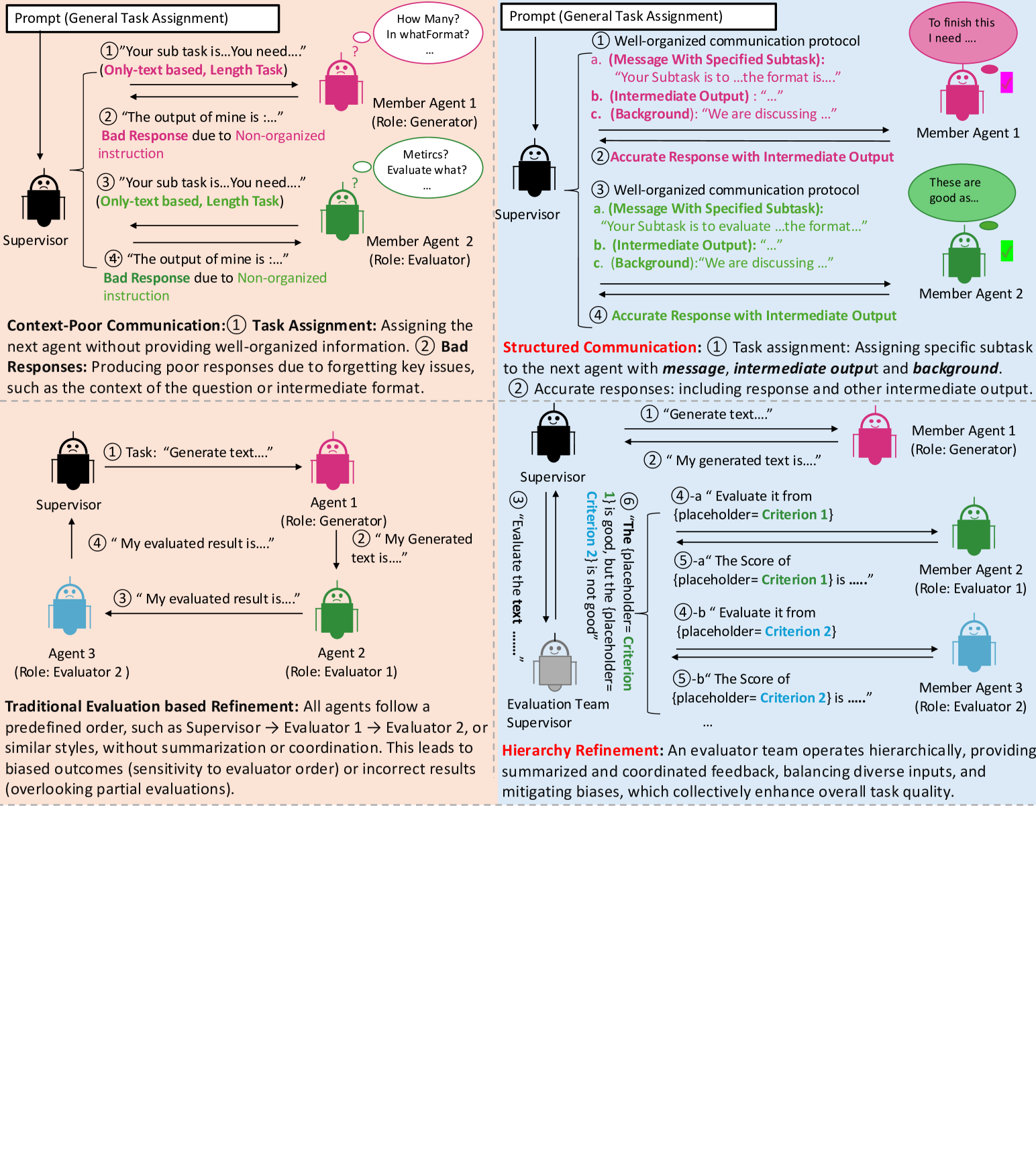
The image presents two contrasting approaches to prompt engineering for multi-agent systems: Context-Poor Communication with Traditional Evaluation and Structured Communication with Hierarchy Refinement. It illustrates the flow of information and tasks between a supervisor and multiple agents (generators and evaluators) in each approach, highlighting the differences in task assignment, response quality, and overall coordination.
### Components/Axes
**Left Side: Context-Poor Communication**
* **Roles:** Supervisor, Agent 1 (Generator), Agent 2 (Evaluator 1), Agent 3 (Evaluator 2)
* **Flow:** Sequential, Supervisor -> Agent 1 -> Agent 2 -> Agent 3 -> Supervisor
* **Task Assignment:** General, lacking specific details or context.
* **Responses:** Prone to errors due to non-organized instruction and forgotten context.
**Right Side: Structured Communication**
* **Roles:** Supervisor, Member Agent 1 (Generator), Member Agent 2 (Evaluator 1), Member Agent 3 (Evaluator 2), Evaluation Team Supervisor
* **Flow:** Iterative, Supervisor <-> Agent 1, Supervisor <-> Agent 2, Supervisor <-> Agent 3, with feedback loops.
* **Task Assignment:** Specific subtasks with message, intermediate output, and background information.
* **Responses:** Accurate, including response and other intermediate output.
* **Evaluation:** Hierarchical, with summarized and coordinated feedback.
### Detailed Analysis or ### Content Details
**Context-Poor Communication (Left Side)**
1. **Task Assignment:**
* ① Task: "Generate text...." (Supervisor to Agent 1)
* ① "Your sub task is... You need...." (Only-text based, Length Task) (Supervisor to Member Agent 1)
* ③ "Your sub task is... You need...." (Only-text based, Length Task) (Supervisor to Member Agent 2)
2. **Responses:**
* ② "My Generated text is...." (Agent 1 to Agent 2)
* ② "The output of mine is :..." Bad Response due to Non-organized instruction (Member Agent 1)
* ④ "My evaluated result is...." (Agent 3 to Supervisor)
* ④ "The output of mine is :..." Bad Response due to Non-organized instruction (Supervisor to Member Agent 2)
* ③ " My evaluated result is...." (Agent 2 to Agent 3)
**Structured Communication (Right Side)**
1. **Task Assignment:**
* ① "Generate text...." (Supervisor to Member Agent 1)
* ① Well-organized communication protocol (Supervisor to Member Agent 1):
* a. (Message With Specified Subtask): "Your Subtask is to ...the format is...."
* b. (Intermediate Output) : "..."
* c. (Background): "We are discussing ..."
* ③ Well-organized communication protocol (Supervisor to Member Agent 2):
* a. (Message With Specified Subtask): "Your Subtask is to evaluate ...the format..."
* b. (Intermediate Output): "..."
* c. (Background): "We are discussing ..."
* ③ "Evaluate the text ......" (Evaluation Team Supervisor to Member Agents 1, 2, 3)
2. **Responses:**
* ② "My generated text is...." (Member Agent 1 to Member Agent 2)
* ② Accurate Response with Intermediate Output (Member Agent 1)
* ④ Accurate Response with Intermediate Output (Member Agent 2)
* ④-a "Evaluate it from {placeholder= Criterion 1}" (Member Agent 2 to Member Agent 3)
* ⑤-a "The Score of {placeholder= Criterion 1} is ....." (Member Agent 2 to Member Agent 3)
* ④-b "Evaluate it from {placeholder= Criterion 2}" (Member Agent 3 to Evaluation Team Supervisor)
* ⑤-b "The Score of {placeholder= Criterion 2} is ....." (Member Agent 3 to Evaluation Team Supervisor)
* ⑥ "The {placeholder= Criterion 1} is good, but the {placeholder= Criterion 2} is not good" (Evaluation Team Supervisor to Supervisor)
### Key Observations
* **Context-Poor Communication:** Results in bad responses due to non-organized instruction and lack of context. The agents seem to be working in isolation, leading to potential inconsistencies and errors.
* **Structured Communication:** Emphasizes well-organized communication protocols, specific subtasks, and intermediate outputs. This approach promotes accurate responses and coordinated feedback, leading to higher quality results.
* **Hierarchy Refinement:** The structured approach incorporates a hierarchical evaluation process, where an evaluation team supervisor provides summarized and coordinated feedback, balancing diverse inputs and mitigating biases.
### Interpretation
The diagram illustrates the significant impact of prompt engineering on the effectiveness of multi-agent systems. Context-poor communication, characterized by vague task assignments and a lack of coordination, leads to poor responses and potentially biased outcomes. In contrast, structured communication, with its emphasis on clear instructions, intermediate outputs, and hierarchical evaluation, fosters collaboration, reduces errors, and enhances overall task quality. The diagram suggests that careful prompt engineering is crucial for harnessing the full potential of multi-agent systems, particularly in complex tasks requiring diverse inputs and coordinated feedback. The "Hierarchy Refinement" approach is superior because it addresses the limitations of traditional evaluation methods by promoting a more holistic and unbiased assessment of the generated content.