## Diagram: Communication Protocol Comparison and Evaluation Methods
### Overview
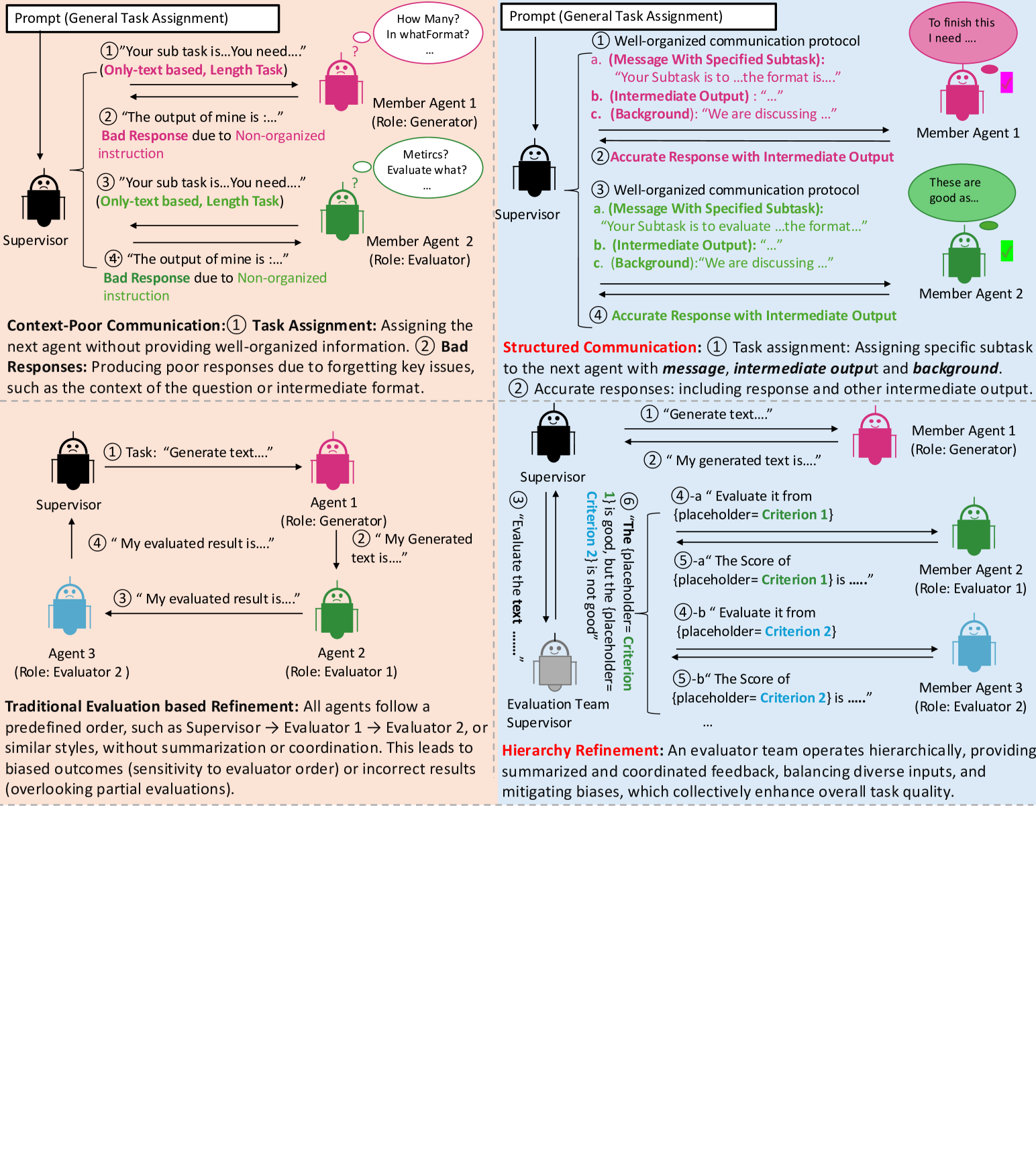
The image is a comparative diagram illustrating two communication protocols ("Context-Poor Communication" and "Structured Communication") and two evaluation methodologies ("Traditional Evaluation based Refinement" and "Hierarchy Refinement"). It uses color-coded robotic agents (pink, green, blue) to represent roles (Generator, Evaluator, Supervisor) and arrows to depict workflows. The diagram emphasizes structured communication's advantages in task clarity and evaluation robustness.
---
### Components/Axes
#### Left Side: Context-Poor Communication
1. **Task Assignment**
- Supervisor assigns ambiguous tasks (e.g., "Your sub task is... You need...").
- Member Agent 1 (Generator) produces a "Bad Response" due to non-organized instructions.
- Member Agent 2 (Evaluator) critiques the response using vague metrics.
2. **Traditional Evaluation based Refinement**
- Linear workflow: Supervisor → Agent 1 (Generator) → Agent 2 (Evaluator 1) → Agent 3 (Evaluator 2).
- Criticism: Biased outcomes due to evaluator order sensitivity and lack of coordination.
#### Right Side: Structured Communication
1. **Well-Organized Protocol**
- Task assignment includes **specified subtasks**, **intermediate outputs**, and **background context**.
- Example: "Your subtask is to... format is..." with structured feedback loops.
2. **Accurate Response with Intermediate Output**
- Member Agent 1 (Generator) produces text with intermediate outputs (e.g., "We are discussing...").
- Member Agent 2 (Evaluator) provides structured feedback (e.g., "These are good as...").
#### Bottom: Evaluation Methodologies
1. **Traditional Evaluation**
- Linear evaluation chain: Supervisor → Evaluator 1 → Evaluator 2.
- Criticism: Sensitivity to evaluator order and lack of coordination.
2. **Hierarchy Refinement**
- Hierarchical evaluator team with summarized/coordinated feedback.
- Mitigates biases by balancing diverse inputs and overseeing partial evaluations.
---
### Detailed Analysis
#### Context-Poor Communication
- **Task Assignment**: Ambiguous instructions lead to poor responses (e.g., "How Many? In what Format?").
- **Bad Responses**: Generated due to missing context (e.g., question context, intermediate format).
- **Evaluation**: Evaluators use vague metrics ("Metrics? Evaluate what?") without structured criteria.
#### Structured Communication
- **Specified Subtasks**: Clear task breakdown (e.g., "Evaluate it from placeholder=Criterion 1").
- **Intermediate Outputs**: Arrows show iterative feedback (e.g., "The Score of placeholder=Criterion 1 is...").
- **Coordinated Feedback**: Evaluators reference specific criteria (e.g., "placeholder=Criterion 2").
#### Evaluation Methodologies
- **Traditional Evaluation**:
- Agent 3 (Evaluator 2) critiques Agent 1’s output without oversight.
- Risk of biased outcomes due to sequential, uncoordinated evaluations.
- **Hierarchy Refinement**:
- Evaluators operate hierarchically, with summaries and coordination.
- Example: "Evaluate it from placeholder=Criterion 2" ensures alignment with predefined metrics.
---
### Key Observations
1. **Color Coding**:
- Pink boxes denote "Bad Response" (context-poor) and "Evaluate it from..." (structured).
- Green boxes indicate "Accurate Response" and "Good as..." feedback.
- Blue boxes represent Evaluator roles.
2. **Workflow Complexity**:
- Structured communication introduces more feedback loops (e.g., "Evaluate it from..." → "The Score of...").
- Hierarchy refinement adds layers of evaluator oversight compared to traditional methods.
3. **Textual Emphasis**:
- Structured protocol explicitly includes **message**, **intermediate output**, and **background** in task assignments.
- Traditional evaluation lacks coordination (e.g., "My evaluated result is..." without criteria).
---
### Interpretation
1. **Structured Communication Advantages**:
- By specifying subtasks and intermediate outputs, structured communication reduces ambiguity and improves response accuracy.
- Example: "We are discussing..." (intermediate output) ensures evaluators understand context.
2. **Evaluation Methodology Impact**:
- Traditional evaluation’s linear workflow risks bias (e.g., Evaluator 2’s critique may override Evaluator 1’s feedback).
- Hierarchy refinement mitigates this by coordinating evaluators and balancing diverse inputs.
3. **Critical Insight**:
- The diagram suggests that structured communication and hierarchical evaluation are interdependent for optimal task quality.
- Without structured communication, even hierarchical evaluation struggles due to poor initial task clarity.
4. **Anomalies**:
- Context-poor communication lacks explicit criteria (e.g., "Metrics? Evaluate what?"), leading to subjective evaluations.
- Structured communication’s use of "placeholder=Criterion X" ensures objective, repeatable assessments.
---
### Conclusion
The diagram demonstrates that structured communication protocols (with clear subtasks and intermediate outputs) paired with hierarchical evaluation methodologies (coordinated feedback) collectively enhance task quality. Context-poor communication and traditional evaluation methods are prone to ambiguity and bias, respectively. The use of color-coded roles and arrows effectively visualizes these relationships, emphasizing the need for both task clarity and evaluator coordination.