\n
## Diagram: Reasoning Process with LLM and Theorem Prover
### Overview
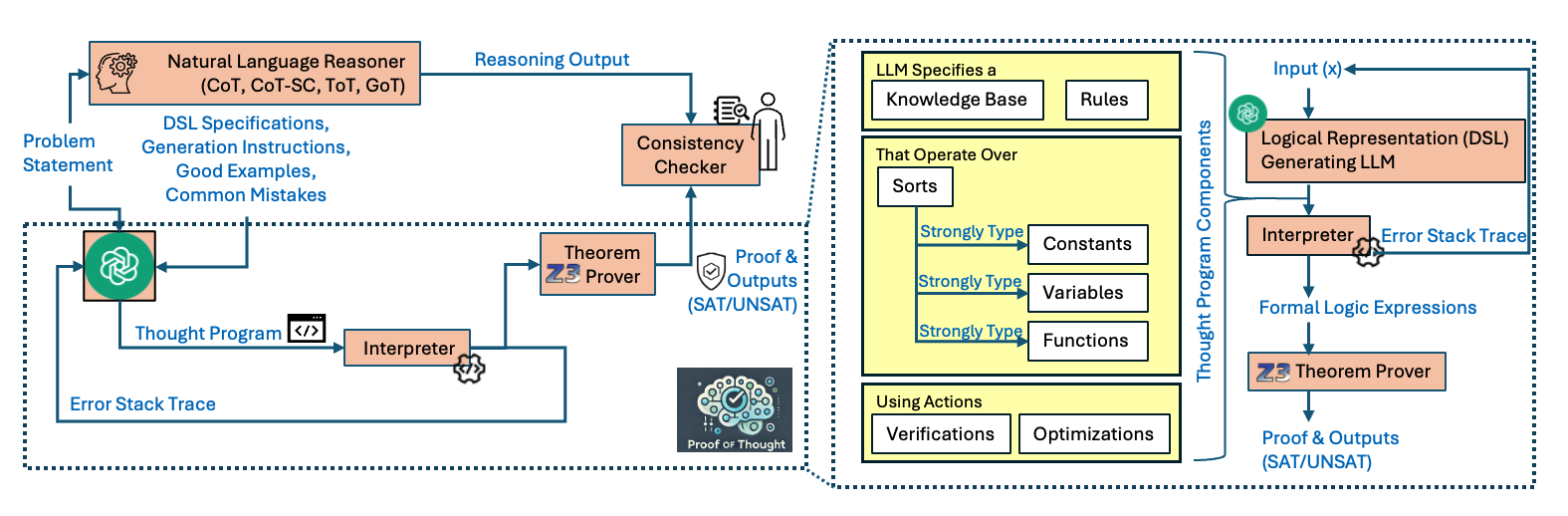
The image depicts a diagram illustrating a reasoning process involving a Natural Language Reasoner (LLM) and a Theorem Prover. The diagram is split into two main sections, visually separated by a dashed vertical line. The left side shows the LLM's reasoning loop, while the right side details the Thought Program Components and their interaction with the Theorem Prover. The overall process appears to be a system for generating, verifying, and optimizing logical statements using a combination of natural language processing and formal reasoning.
### Components/Axes
The diagram consists of several key components:
* **Natural Language Reasoner:** Includes labels for (CoT, CoT-SC, ToT, GoT) and input of "Problem Statement" and output of "Reasoning Output".
* **Thought Program:** A central component within the LLM loop, with an associated "Error Stack Trace".
* **Interpreter:** Connects the Thought Program to the Theorem Prover, also generating an "Error Stack Trace".
* **Consistency Checker:** Receives Reasoning Output and feeds into the Theorem Prover.
* **Theorem Prover:** Outputs "Proof & Outputs (SAT/UNSAT)".
* **LLM Specifies a Knowledge Base:** A box containing "Rules" and "Sorts".
* **Sorts:** Contains "Constants", "Variables", and "Functions", all labeled as "Strongly Type".
* **Using Actions:** Contains "Verifications" and "Optimizations".
* **Input (x):** Input to the Generating LLM.
* **Generating LLM:** Converts Input (x) to "Logical Representation (DSL)".
* **Formal Logic Expressions:** Output of the Interpreter.
The diagram uses arrows to indicate the flow of information between these components. There are no explicit axes or scales.
### Detailed Analysis or Content Details
The diagram illustrates a cyclical process.
1. **Problem Statement to Reasoning Output:** A "Problem Statement" is fed into the "Natural Language Reasoner" (which utilizes methods like CoT, CoT-SC, ToT, and GoT), resulting in "Reasoning Output".
2. **Reasoning Output to Theorem Prover:** The "Reasoning Output" is passed to a "Consistency Checker" and then to the "Theorem Prover".
3. **Theorem Prover Output:** The "Theorem Prover" generates "Proof & Outputs (SAT/UNSAT)".
4. **Thought Program Loop:** The "Thought Program" receives input and generates an "Error Stack Trace". The "Interpreter" processes the "Thought Program" and outputs "Formal Logic Expressions", also generating an "Error Stack Trace".
5. **LLM Knowledge Base:** The LLM specifies a "Knowledge Base" that operates over "Sorts" (Constants, Variables, Functions – all "Strongly Type").
6. **Thought Program Components:** The right side of the diagram details the "Thought Program Components" starting with an "Input (x)" to a "Generating LLM" which creates a "Logical Representation (DSL)". This is then interpreted and sent to the "Theorem Prover".
7. **Actions:** The "Theorem Prover" is used for "Verifications" and "Optimizations".
### Key Observations
* The diagram emphasizes the interplay between natural language reasoning and formal logical verification.
* The presence of "Error Stack Trace" outputs from both the "Interpreter" and the "Thought Program" suggests a debugging or iterative refinement process.
* The "SAT/UNSAT" output from the "Theorem Prover" indicates a boolean satisfiability check, a common technique in formal verification.
* The "Strongly Type" label on the "Sorts" suggests a focus on type safety within the knowledge base.
* The diagram is highly conceptual and doesn't contain specific numerical data.
### Interpretation
This diagram represents a system designed to enhance the reliability and correctness of reasoning performed by Large Language Models (LLMs). The LLM generates reasoning steps (the "Thought Program"), which are then translated into formal logic and verified by a "Theorem Prover". This verification step provides a means to detect inconsistencies or errors in the LLM's reasoning. The iterative loop, indicated by the "Error Stack Trace", suggests a process of refinement where the LLM adjusts its reasoning based on the feedback from the Theorem Prover.
The use of a "Consistency Checker" before the Theorem Prover suggests a preliminary check for logical coherence. The "Knowledge Base" specified by the LLM provides the foundational rules and types for the formal reasoning process. The inclusion of "Verifications" and "Optimizations" indicates that the system is not only concerned with correctness but also with efficiency and performance.
The diagram highlights a trend towards integrating formal methods with LLMs to overcome the limitations of purely statistical or heuristic approaches to reasoning. The system aims to combine the flexibility and expressiveness of natural language with the rigor and reliability of formal logic. The diagram does not provide any quantitative data on the performance or effectiveness of this system, but it clearly outlines the key components and their interactions.