TECHNICAL ASSET FINGERPRINT
b42a25d729d2f04a09329a50
Click to view fullscreen
Press ESC or click to close
FOUND IN PAPERS
EXPERT: gemini-2.0-flash VERSION 1
RUNTIME: nugit/gemini/gemini-2.0-flash
INTEL_VERIFIED
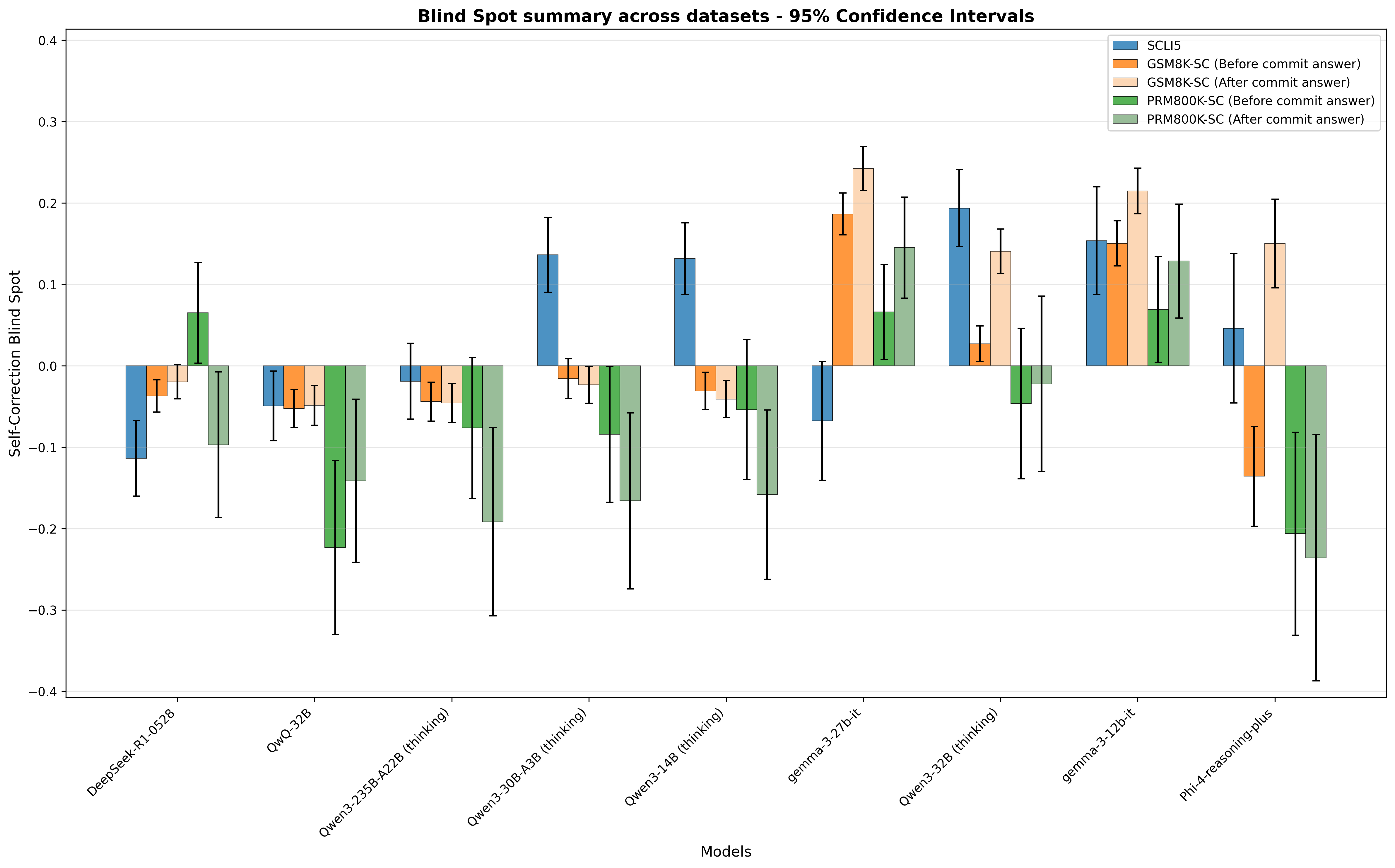
## Bar Chart: Blind Spot summary across datasets - 95% Confidence Intervals
### Overview
The image is a bar chart comparing the self-correction blind spot across different models. The chart displays the mean self-correction blind spot for each model, with error bars representing 95% confidence intervals. The models are evaluated using different self-correction methods: SCL15, GSM8K-SC (Before commit answer), GSM8K-SC (After commit answer), PRM800K-SC (Before commit answer), and PRM800K-SC (After commit answer).
### Components/Axes
* **Title:** Blind Spot summary across datasets - 95% Confidence Intervals
* **X-axis:** Models (DeepSeek-R1-0528, QwQ-32B, Qwen3-235B-A22B (thinking), Qwen3-30B-A3B (thinking), Qwen3-14B (thinking), gemma-3-27b-it, Qwen3-32B (thinking), gemma-3-12b-it, Phi-4-reasoning-plus)
* **Y-axis:** Self-Correction Blind Spot (ranging from -0.4 to 0.4, with increments of 0.1)
* **Legend:** Located in the top-right corner.
* Blue: SCL15
* Orange: GSM8K-SC (Before commit answer)
* Light Orange: GSM8K-SC (After commit answer)
* Green: PRM800K-SC (Before commit answer)
* Light Green: PRM800K-SC (After commit answer)
### Detailed Analysis
The chart presents data for nine different models, each evaluated using five different self-correction methods. The height of each bar represents the mean self-correction blind spot, and the error bars indicate the 95% confidence interval.
* **DeepSeek-R1-0528:**
* SCL15 (Blue): Approximately -0.12, confidence interval extends from approximately -0.18 to -0.06.
* GSM8K-SC (Before commit answer) (Orange): Approximately -0.01, confidence interval extends from approximately -0.07 to 0.05.
* GSM8K-SC (After commit answer) (Light Orange): Approximately -0.04, confidence interval extends from approximately -0.1 to 0.02.
* PRM800K-SC (Before commit answer) (Green): Approximately 0.07, confidence interval extends from approximately 0.01 to 0.13.
* PRM800K-SC (After commit answer) (Light Green): Approximately -0.05, confidence interval extends from approximately -0.11 to 0.01.
* **QwQ-32B:**
* SCL15 (Blue): Approximately -0.04, confidence interval extends from approximately -0.1 to 0.02.
* GSM8K-SC (Before commit answer) (Orange): Approximately -0.04, confidence interval extends from approximately -0.1 to 0.02.
* GSM8K-SC (After commit answer) (Light Orange): Approximately -0.04, confidence interval extends from approximately -0.1 to 0.02.
* PRM800K-SC (Before commit answer) (Green): Approximately -0.22, confidence interval extends from approximately -0.28 to -0.16.
* PRM800K-SC (After commit answer) (Light Green): Approximately -0.15, confidence interval extends from approximately -0.21 to -0.09.
* **Qwen3-235B-A22B (thinking):**
* SCL15 (Blue): Approximately 0.03, confidence interval extends from approximately -0.03 to 0.09.
* GSM8K-SC (Before commit answer) (Orange): Approximately -0.04, confidence interval extends from approximately -0.1 to 0.02.
* GSM8K-SC (After commit answer) (Light Orange): Approximately -0.04, confidence interval extends from approximately -0.1 to 0.02.
* PRM800K-SC (Before commit answer) (Green): Approximately -0.04, confidence interval extends from approximately -0.1 to 0.02.
* PRM800K-SC (After commit answer) (Light Green): Approximately -0.19, confidence interval extends from approximately -0.3 to -0.08.
* **Qwen3-30B-A3B (thinking):**
* SCL15 (Blue): Approximately 0.14, confidence interval extends from approximately 0.08 to 0.2.
* GSM8K-SC (Before commit answer) (Orange): Approximately -0.04, confidence interval extends from approximately -0.1 to 0.02.
* GSM8K-SC (After commit answer) (Light Orange): Approximately -0.04, confidence interval extends from approximately -0.1 to 0.02.
* PRM800K-SC (Before commit answer) (Green): Approximately -0.04, confidence interval extends from approximately -0.1 to 0.02.
* PRM800K-SC (After commit answer) (Light Green): Approximately -0.17, confidence interval extends from approximately -0.28 to -0.06.
* **Qwen3-14B (thinking):**
* SCL15 (Blue): Approximately 0.13, confidence interval extends from approximately 0.07 to 0.19.
* GSM8K-SC (Before commit answer) (Orange): Approximately -0.04, confidence interval extends from approximately -0.1 to 0.02.
* GSM8K-SC (After commit answer) (Light Orange): Approximately -0.04, confidence interval extends from approximately -0.1 to 0.02.
* PRM800K-SC (Before commit answer) (Green): Approximately -0.04, confidence interval extends from approximately -0.1 to 0.02.
* PRM800K-SC (After commit answer) (Light Green): Approximately -0.05, confidence interval extends from approximately -0.16 to 0.06.
* **gemma-3-27b-it:**
* SCL15 (Blue): Approximately -0.08, confidence interval extends from approximately -0.14 to -0.02.
* GSM8K-SC (Before commit answer) (Orange): Approximately 0.19, confidence interval extends from approximately 0.13 to 0.25.
* GSM8K-SC (After commit answer) (Light Orange): Approximately 0.23, confidence interval extends from approximately 0.17 to 0.29.
* PRM800K-SC (Before commit answer) (Green): Approximately 0.07, confidence interval extends from approximately 0.01 to 0.13.
* PRM800K-SC (After commit answer) (Light Green): Approximately 0.03, confidence interval extends from approximately -0.03 to 0.09.
* **Qwen3-32B (thinking):**
* SCL15 (Blue): Approximately 0.15, confidence interval extends from approximately 0.09 to 0.21.
* GSM8K-SC (Before commit answer) (Orange): Approximately 0.01, confidence interval extends from approximately -0.05 to 0.07.
* GSM8K-SC (After commit answer) (Light Orange): Approximately 0.2, confidence interval extends from approximately 0.14 to 0.26.
* PRM800K-SC (Before commit answer) (Green): Approximately 0.15, confidence interval extends from approximately 0.09 to 0.21.
* PRM800K-SC (After commit answer) (Light Green): Approximately -0.04, confidence interval extends from approximately -0.15 to 0.07.
* **gemma-3-12b-it:**
* SCL15 (Blue): Approximately 0.15, confidence interval extends from approximately 0.09 to 0.21.
* GSM8K-SC (Before commit answer) (Orange): Approximately 0.16, confidence interval extends from approximately 0.1 to 0.22.
* GSM8K-SC (After commit answer) (Light Orange): Approximately 0.22, confidence interval extends from approximately 0.16 to 0.28.
* PRM800K-SC (Before commit answer) (Green): Approximately 0.07, confidence interval extends from approximately 0.01 to 0.13.
* PRM800K-SC (After commit answer) (Light Green): Approximately 0.03, confidence interval extends from approximately -0.03 to 0.09.
* **Phi-4-reasoning-plus:**
* SCL15 (Blue): Approximately 0.05, confidence interval extends from approximately -0.01 to 0.11.
* GSM8K-SC (Before commit answer) (Orange): Approximately -0.14, confidence interval extends from approximately -0.2 to -0.08.
* GSM8K-SC (After commit answer) (Light Orange): Approximately 0.15, confidence interval extends from approximately 0.09 to 0.21.
* PRM800K-SC (Before commit answer) (Green): Approximately -0.14, confidence interval extends from approximately -0.2 to -0.08.
* PRM800K-SC (After commit answer) (Light Green): Approximately -0.23, confidence interval extends from approximately -0.34 to -0.12.
### Key Observations
* The GSM8K-SC (After commit answer) method generally shows a higher self-correction blind spot compared to the GSM8K-SC (Before commit answer) method.
* The PRM800K-SC (After commit answer) method often results in a negative self-correction blind spot, indicating a potential over-correction or bias.
* The confidence intervals vary across models and methods, suggesting different levels of uncertainty in the estimated blind spots.
* For some models, the SCL15 method shows a relatively high self-correction blind spot compared to other methods.
### Interpretation
The bar chart provides a comparative analysis of the self-correction blind spot across different models and self-correction methods. The data suggests that the choice of self-correction method can significantly impact the model's performance and bias. The positive and negative values of the self-correction blind spot indicate the degree to which the model is either under-correcting or over-correcting its errors. The confidence intervals provide a measure of the reliability of these estimates.
The chart highlights the importance of carefully selecting and tuning self-correction methods to optimize model performance and minimize bias. The observed differences across models suggest that the effectiveness of a particular self-correction method may depend on the specific architecture and training data of the model.
DECODING INTELLIGENCE...
EXPERT: nemotron-free VERSION 1
RUNTIME: free/nvidia/nemotron-nano-12b-v2-vl:free
INTEL_VERIFIED
## Bar Chart: Blind Spot summary across datasets - 95% Confidence Intervals
### Overview
The chart compares self-correction blind spot performance across multiple AI models (e.g., DeepSeek-R1-0328, QwQ-32B, Gemma-3-27b-it) using five datasets. Values represent deviations from perfect self-correction, with error bars showing 95% confidence intervals. Positive values indicate overestimation of blind spots, while negative values suggest underestimation.
### Components/Axes
- **X-axis**: Models (DeepSeek-R1-0328, QwQ-32B, Qwen-3-23B-A22B, Qwen-3-30B-A3B, Qwen-3-148, Gemma-3-27b-it, Qwen-3-328, Gemma-3-12b-it, Phi-4-reasoning-plus)
- **Y-axis**: Self-Correction Blind Spot (range: -0.4 to 0.4)
- **Legend**:
- Blue: SCL15
- Orange: GSM8K-SC (Before commit answer)
- Pink: GSM8K-SC (After commit answer)
- Green: PRM800K-SC (Before commit answer)
- Light Green: PRM800K-SC (After commit answer)
### Detailed Analysis
1. **DeepSeek-R1-0328**:
- SCL15: -0.05 (±0.08)
- GSM8K-SC (Before): -0.02 (±0.05)
- GSM8K-SC (After): -0.01 (±0.04)
- PRM800K-SC (Before): 0.06 (±0.07)
- PRM800K-SC (After): -0.03 (±0.06)
2. **QwQ-32B**:
- SCL15: -0.01 (±0.04)
- GSM8K-SC (Before): -0.03 (±0.06)
- GSM8K-SC (After): -0.02 (±0.05)
- PRM800K-SC (Before): -0.20 (±0.12)
- PRM800K-SC (After): -0.10 (±0.10)
3. **Qwen-3-23B-A22B (thinking)**:
- SCL15: -0.01 (±0.03)
- GSM8K-SC (Before): -0.02 (±0.04)
- GSM8K-SC (After): -0.01 (±0.03)
- PRM800K-SC (Before): -0.15 (±0.09)
- PRM800K-SC (After): -0.05 (±0.07)
4. **Qwen-3-30B-A3B (thinking)**:
- SCL15: 0.13 (±0.09)
- GSM8K-SC (Before): -0.03 (±0.05)
- GSM8K-SC (After): -0.02 (±0.04)
- PRM800K-SC (Before): -0.05 (±0.06)
- PRM800K-SC (After): -0.02 (±0.05)
5. **Qwen-3-148 (thinking)**:
- SCL15: 0.12 (±0.08)
- GSM8K-SC (Before): -0.02 (±0.04)
- GSM8K-SC (After): -0.01 (±0.03)
- PRM800K-SC (Before): -0.03 (±0.05)
- PRM800K-SC (After): -0.01 (±0.04)
6. **Gemma-3-27b-it**:
- SCL15: -0.05 (±0.07)
- GSM8K-SC (Before): 0.18 (±0.09)
- GSM8K-SC (After): 0.24 (±0.10)
- PRM800K-SC (Before): 0.06 (±0.07)
- PRM800K-SC (After): 0.13 (±0.08)
7. **Qwen-3-328 (thinking)**:
- SCL15: 0.19 (±0.08)
- GSM8K-SC (Before): 0.03 (±0.05)
- GSM8K-SC (After): 0.14 (±0.07)
- PRM800K-SC (Before): -0.02 (±0.04)
- PRM800K-SC (After): -0.01 (±0.03)
8. **Gemma-3-12b-it**:
- SCL15: 0.15 (±0.07)
- GSM8K-SC (Before): 0.16 (±0.08)
- GSM8K-SC (After): 0.22 (±0.09)
- PRM800K-SC (Before): 0.07 (±0.06)
- PRM800K-SC (After): 0.12 (±0.07)
9. **Phi-4-reasoning-plus**:
- SCL15: 0.04 (±0.06)
- GSM8K-SC (Before): -0.08 (±0.07)
- GSM8K-SC (After): 0.15 (±0.08)
- PRM800K-SC (Before): -0.15 (±0.09)
- PRM800K-SC (After): -0.20 (±0.10)
### Key Observations
- **Positive Trends**:
- GSM8K-SC (After commit answer) consistently shows improved performance (higher values) across most models compared to "Before commit answer" versions.
- SCL15 demonstrates the largest positive deviations (0.19 for Qwen-3-328), suggesting significant overestimation of blind spots.
- **Negative Trends**:
- PRM800K-SC (Before commit answer) frequently shows negative values (e.g., -0.20 for Phi-4-reasoning-plus), indicating underestimation of blind spots.
- Qwen-3-148 (thinking) has the smallest confidence intervals (±0.04–0.08), suggesting higher measurement precision.
- **Anomalies**:
- Gemma-3-27b-it exhibits the largest improvement in GSM8K-SC (After commit answer: +0.06).
- Phi-4-reasoning-plus shows the most drastic negative shift in PRM800K-SC (After commit answer: -0.20).
### Interpretation
The data suggests that model updates ("After commit answer") generally reduce blind spots for GSM8K-SC and PRM800K-SC datasets, with SCL15 showing the most persistent overestimation. The negative values for PRM800K-SC (Before commit answer) across multiple models imply systematic underestimation of blind spots in this configuration. Confidence interval lengths vary significantly, with larger intervals (e.g., ±0.12 for QwQ-32B PRM800K-SC Before) indicating lower reliability in those estimates. The correlation between model size (e.g., Qwen-3-30B-A3B vs. Qwen-3-148) and performance trends warrants further investigation.
DECODING INTELLIGENCE...